
Bond Capital | Market & Sector Intelligence | August 4, 2026
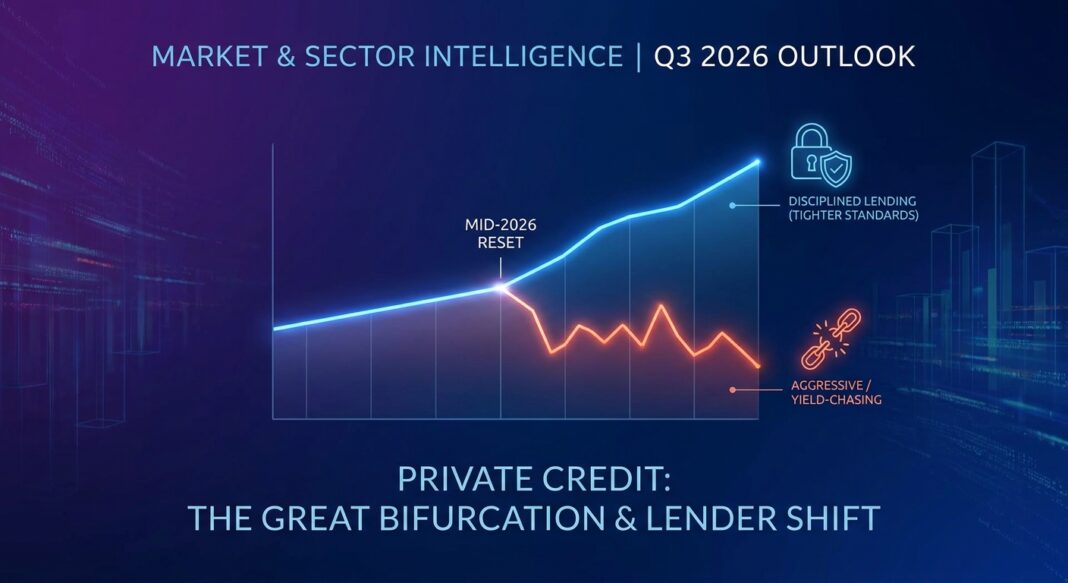
Private Credit’s Lender-Friendly Reset: Spreads Widen, Standards Tighten, and the Great Bifurcation Accelerates
Mid-2026 marks a structural inflection for private and public credit markets. Spreads have repriced materially, bank lending standards continue to tighten, a landmark regulatory deregulation reshapes bank competition with private lenders, and a deepening bifurcation between disciplined and yield-chasing lenders is rewriting the rules of middle-market finance.
Market Headline: A Lender-Friendly Reset Takes Hold
After years of aggressive spread compression and borrower-friendly structuring, 2026 is delivering a meaningful correction in private credit market dynamics — one that favors disciplined lenders with dry powder over those stretched thin by aggressive 2021–2024 vintage commitments. The catalyst is a convergence of macro, regulatory, and structural forces that have simultaneously widened spreads, tightened underwriting documentation, and elevated borrower credit scrutiny.
At the macro level, the Federal Reserve held its target range for the federal funds rate steady at 3.50%–3.75% through Q1 2026, citing elevated inflation pressures and geopolitical uncertainty, while five-year U.S. Treasury yields climbed to approximately 4.23% in June, up from 3.92% in March — reinforcing a higher-for-longer rate environment that continues to strain leveraged balance sheets. Three converging shocks defined the first half: a U.S.-Iran military conflict that stalled deal activity in March; an AI-driven reassessment of software credit quality that triggered a sharp selloff in software-related debt; and a wave of BDC redemption requests that exposed structural vulnerabilities in retail-oriented private credit vehicles.
The result, per Lord Abbett’s midyear outlook, is that “the market has reset in a more lender-friendly direction” — a view broadly validated by current spread data, Fed survey results, and BDC portfolio disclosures. The second half of 2026 is likely to be defined by dispersion: between strong and weak credits, between disciplined and aggressive lenders, and between sectors attracting capital and those facing structural headwinds.
Quantitative Market Snapshot
The following data box synthesizes the most current publicly available market metrics as of Q2 2026. All figures are sourced from institutional research, regulatory filings, and market data providers as cited.
| Metric | Current Value (Q2 2026) | Prior Period | Change | Source |
|---|---|---|---|---|
| Middle Market Private Credit Spreads (SOFR+) | ~S+500 bps | ~S+450 bps (mid-2025) | +50 bps | Hamilton Lane, 2026 |
| MM Expected Yield Increase (Q2 2026) | +50 bps QoQ | Q1 2026 (post +25 bps in March) | Widening | VRC Q2 2026 |
| Global High Yield Spreads | ~250 bps (mid-200s) | ~304 bps (Jan 2026) | Tightening in Q2 | Chicago Atlantic / Morgan Stanley |
| Software Secondary Spreads vs. Broader B-Rated Loans | ~229 bps wider than B-rated index | Year-end 2025 | +245 bps vs. YE | PitchBook LCD / VRC, June 2026 |
| Fed SLOOS: Banks Tightening C&I Standards (Large & Mid-Market Firms) | 8.1% net tightening | Q4 2025 baseline | Tighter | Fed SLOOS / FRED, May 2026 |
| BDC Non-Accruals as % of Portfolio (Cost) — Representative BDC | 2.9% (cost); 1.9% (fair value) | 0.6% / 0.3% (Sept 2025) | Sharply Higher | Golub Capital BDC 10-Q, June 2026 |
| PIK Loans as % of Private Credit Market | >11% | ~5% (early 2022) | +600 bps | Columbia Threadneedle / S&P, 2026 |
| 3-Month Term SOFR | 3.68% | 3.67% (Q1 2026) | +1 bps QoQ | VRC Q2 2026 |
KPI Context: Leverage, Coverage, and Underwriting Standards
On borrower financial KPIs, the picture is nuanced. Heron Finance’s Q2 2026 benchmark analysis of 69 established private credit funds found that borrower interest coverage ratios (EBITDA/interest) improved year-over-year due to lower interest rates and some EBITDA growth, while loan-to-value (LTV) ratios have remained stable — indicating lenders have not materially loosened underwriting standards over the past three years, preserving a meaningful first-loss cushion. This is broadly consistent with Morgan Stanley’s observation that EBITDA-to-interest coverage ratios have moved modestly higher, with EBITDA growth expected to accelerate for sponsor-backed mid-market companies.
The critical risk indicator, however, is the 6.0x total debt-to-EBITDA threshold that previously governed bank underwriting under the now-rescinded 2013 Interagency Leveraged Lending Guidance. With that ceiling removed by the OCC and FDIC in December 2025, lenders now face a more open — and more competitive — leverage environment in which fixed charge coverage ratios (FCCR) and free cash flow generation will become the primary underwriting anchors, particularly as PIK loan structures continue to mask true cash-pay coverage dynamics.
Sector Analysis: Capital Flows, Lender Appetite, and Structural Shifts
Software & Technology: From Core Allocation to Credit Flashpoint
The most consequential sector story of 2026 is the AI-driven repricing of software credit. What was, from 2020 onward, viewed as a near-ideal private credit borrower profile — sticky subscription revenue, high switching costs, recurring enterprise contracts — has been forcefully reassessed. PitchBook LCD data as of June 2026 shows software secondary spreads running approximately 245 basis points wider than year-end levels and roughly 229 basis points above the broader B-rated loan index, reflecting continued uncertainty related to AI-driven disruption. PitchBook’s Q1 2026 BDC report further flagged that software fair value marks are falling more steeply than the rest of BDC portfolios, and PIK loans in the sector are being marked down faster than non-PIK equivalents. Industry-average software exposure in BDC portfolios stood at approximately 22–24%, creating concentrated risk for managers who did not reduce exposure early.
The Capstone Partners Q1 2026 Leveraged Finance report noted that “the most consequential new variable in leveraged credit markets in Q1 2026 was not macroeconomics, it was technology,” with AI strategy now emerging as a critical analytical component in underwriting both new transactions and evaluating existing portfolio credits. Lender appetite for new software commitments has tightened materially, particularly for companies without clear AI-resilience strategies.
Healthcare: Durable Demand with Non-Accrual Watch
Healthcare has historically been private credit’s most reliable sector. Octus data shows healthcare led all sectors in direct lending deal volume in 2025, accounting for 19% of all direct lending transactions — and it was the only sector to not see significant year-over-year spread tightening, maintaining a pricing premium that reflects both sustained demand and operational complexity. Demographic tailwinds and non-cyclical service models continue to attract capital, as Creative Planning notes in its 2026 private credit outlook. However, Morgan Stanley’s direct lending team has maintained a “significant underweight” to healthcare, citing its lead in loans placed on non-accrual status over the past year — a cautionary signal for operators reliant on thin FCCR margins.
Infrastructure & Asset-Backed Finance: The Growth Engine
Infrastructure credit and asset-backed finance (ABF) represent the clearest structural opportunity in the current cycle. McKinsey’s 2026 Global Private Markets Report highlights ABF fundraising totaling $70 billion in 2025 — with infrastructure credit, in particular, driven by AI data center build-outs, fiber networks, and power generation. Morgan Stanley estimates private credit could supply more than half of the $1.5 trillion needed for global data center buildouts through 2028. McKinsey also pegs the addressable U.S. private credit market — inclusive of ABF, infrastructure, residential mortgages, and CRE transitioning from bank balance sheets — at a potential $30 trillion. Capital is rotating toward this segment, and lender appetite is strong, with spreads supported by the genuine complexity premium of large-scale structured transactions.
Energy-Intensive Industrials & Manufacturing: Underwriting Tightens
Geopolitical risk has directly affected lender appetite in energy-intensive sectors. Capstone Partners reported that lenders responded to the 2026 geopolitical shock by tightening underwriting standards for energy-intensive industries and businesses whose leverage was predicated on stable energy costs, with the market expected to continue factoring oil price movements into deals with heavy sector exposure over the next several quarters.
Real Estate: Office Exit, CRE Selectivity
S&P Global Market Intelligence reports that private credit lenders are retreating from office property exposure as questions around occupancy, workplace transformation, and technological change influence lending decisions — with appetite for office assets having diminished relative to other property and infrastructure-linked segments. Meanwhile, the Fed’s April 2026 SLOOS noted banks reported basically unchanged lending standards but weaker demand for commercial real estate loans, suggesting constrained bank appetite that may create selective private credit opportunities in transitional and industrial CRE.
Regulatory Shift: The OCC/FDIC Leveraged Lending Deregulation and Its Implications
The most structurally significant regulatory event of the current cycle occurred on December 5, 2025, when the OCC and FDIC jointly rescinded the 2013 Interagency Guidance on Leveraged Lending and its 2014 implementing FAQs. Banking Dive noted that the agencies called the guidance “overly restrictive” and acknowledged it had contributed to a “significant drop in leveraged lending market share by regulated banks” — effectively pushing leveraged lending outside the regulatory perimeter and into private credit.
The practical effect was a de facto 6.0x total debt-to-EBITDA leverage ceiling that had governed bank underwriting for over a decade. With that constraint removed, Chambers & Partners’ 2026 Private Credit Guide notes that private credit lenders now have “greater flexibility to underwrite a broader range of loans” and may compete at deeper leverage levels that were previously restricted. Banks re-entering the market — particularly in the upper middle market — are already intensifying competition, as VRC Q2 2026 observed, with banks gradually returning in June 2026 and alleviating some upward spread pressure. The Federal Reserve has not yet rescinded its equivalent guidance, leaving a residual open question for Fed-supervised entities.
For operators and borrowers, this shift has immediate implications: historical leverage covenants once enforced by bank supervisors no longer constrain the institutional lender universe on the same basis, and debt-to-EBITDA levels at or above 6.0x may become more accessible for high-quality credits — though lenders are expected to apply correspondingly higher FCCRs and free cash flow stress tests in the absence of prescriptive regulatory guardrails.
Implications for Institutional Investors and Operators
For Institutional Investors and Lenders
The current environment rewards selectivity, patience, and manager discipline. Lord Abbett’s midyear analysis argues the most durable advantage will come from better documentation, more conservative leverage, and thorough pre-deployment stress analysis — not simply riding wider spreads. The “Great Bifurcation” now underway is creating visible portfolio differentiation: non-accruals, PIK usage, sector concentration, and 2021–2022 vintage exposure are the key indicators to monitor. Rithm Capital confirms that BDC non-accrual rates across the universe run from near zero to double digits by platform — and count-based default measures inclusive of restructurings, PIK conversions, and liability management exercises reach approximately 6%, while notional-weighted measures (the closest analog to BSL default reporting) narrow to roughly 3%.
PwC’s 2026 Private Credit Survey identifies a strategic pivot in capital allocation: capital is increasingly shifting toward specialist strategies, including asset-backed finance, non-sponsor lending, and selective use of leverage — with managers accepting greater complexity in exchange for differentiated returns. More than half (51%) of institutional investors surveyed plan to increase their overall alternative credit allocation over the next 12 months, with infrastructure debt, ABF, and direct lending as lead destinations. The illiquidity premium vs. high yield has compressed: at current spreads of approximately 150–200 bps over high yield, investors are compensated for structural risks — but with limited margin for the structural alpha that previously justified private credit’s fee load, per Owners.PE analysis.
For Business Operators and Borrowers
Middle-market borrowers with strong fundamentals — defensible EBITDA, consistent free cash flow, and manageable leverage — remain well-positioned to access competitive financing. Cleary M&A Watch notes that the market for debt financing remains highly competitive for large-cap borrowers, who retain meaningful negotiating leverage on terms. However, AI-exposed, energy-intensive, or cyclical companies should anticipate more detailed information requests, stricter covenant packages, and higher pricing. Operators relying on thin FCCR ratios — particularly those with significant PIK load that defers cash interest — face heightened scrutiny and potential covenant renegotiation pressure. The rescission of the 6.0x leverage ceiling creates new structuring flexibility, but lenders will likely replace it with more rigorous free cash flow and FCCR floors on a deal-by-deal basis.
Forward-Looking View: H2 2026 and Beyond
The second half of 2026 is set to be characterized by three defining dynamics:
- Deal flow recovery with enhanced selectivity. Middle market private equity deal value rose approximately 10.7% year-over-year through Q2, with exit activity up 14% over the same period, per PitchBook data via VRC. M&A pipeline improvement — across technology, healthcare, industrials, and media — will expand the opportunity set for private credit, but well-capitalized lenders with dry powder will be increasingly selective, particularly regarding AI and energy exposure.
- Structural spread normalization, not full compression. With banks re-entering the upper middle market and competition intensifying, spread premiums for the largest, highest-quality credits face renewed downward pressure. But the lower and core middle market retains a structural spread premium of approximately 50–200 bps vs. the upper middle market, per ACP Private Markets’ 2026 outlook, offering a compelling risk-adjusted entry point for investors with the origination capability to access it.
- Maturity wall and refinancing pressure into 2027–2028. A significant cohort of 2020–2021 vintage deals face capital structure challenges. Octus notes that as 2021 loans come due, refinancing activity will test both lender appetite and underlying credit quality — with hybrid debt-equity instruments increasingly used to realign stretched balance sheets. Lenders and operators alike should model refinancing timelines and stress FCCR sensitivity to rising rates and EBITDA compression scenarios now, not at maturity.
Key Market Insights
- Spreads have repriced materially. Middle market private credit spreads have widened to approximately S+500 bps, up from the mid-400s in 2025, with expected yields rising an additional 50 bps in Q2 2026. Disciplined lenders deploying fresh capital today are capturing meaningfully better risk-adjusted returns than 2024 vintages.
- Bank lending standards are tightening on two fronts. The Fed’s April 2026 SLOOS shows a net 8.1% of banks tightening C&I standards for large and middle-market firms, and a net 10.0% of large domestic banks tightening — reinforcing sustained demand for private debt solutions even as banks regain leverage flexibility under the rescinded OCC/FDIC guidance.
- Software credit is a systemic stress point, not a systemic crisis. Software secondary spreads are running 229 bps above the B-rated loan index and BDC non-accruals are rising sharply — but the stress is concentrated among 2021–2024 vintage deals with aggressive documentation and high leverage. Portfolio managers with limited software exposure and tighter documentation are demonstrating materially better credit performance.
- Infrastructure and ABF are the structural capital rotation story of the cycle. With a potential $30 trillion addressable U.S. private credit market in long-duration assets, and Morgan Stanley estimating private credit financing more than half of $1.5 trillion in global data center buildouts through 2028, infrastructure debt and ABF are absorbing the capital exiting over-allocated software and office CRE exposures.
- Manager and vintage selection are the dominant return drivers. With BDC non-accruals ranging from near-zero to double digits by platform, and PIK loans exceeding 11% of the private credit market, the era of beta-driven private credit returns is over. FCCR discipline, covenant quality, and sponsor track record will separate durable performers from stressed portfolios as the 2028 maturity wall approaches.


