
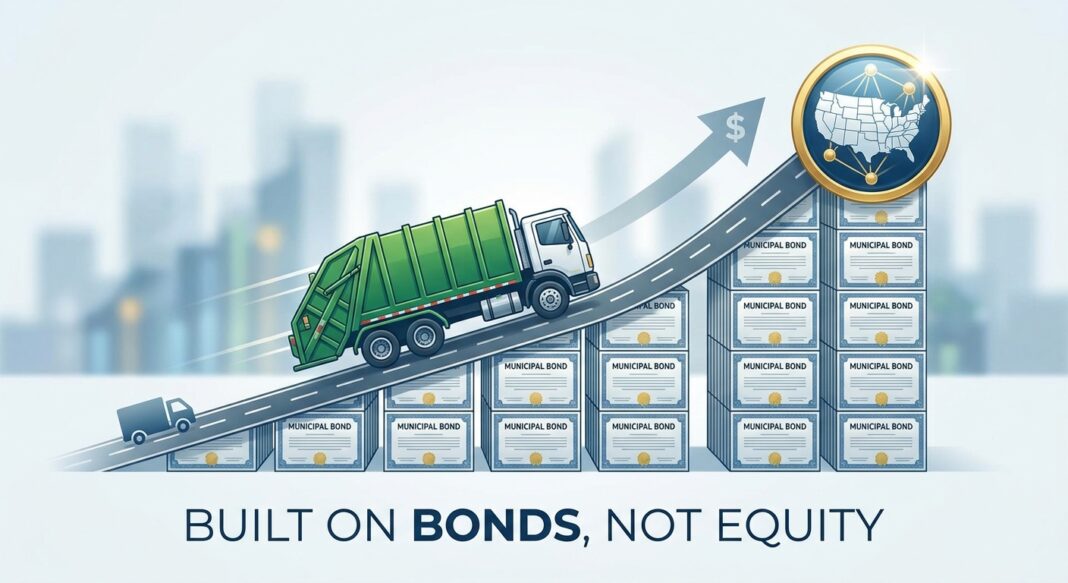
The Story: A Trash Empire Built on Debt, Not Dilution
In 2001, John Jennings started Waste Pro USA with a single garbage truck and a straightforward premise: serve customers well, build for the long term, and never lose the wheel. prnewswire.com
Twenty-five years later, his son Sean Jennings runs the same company — now a regional powerhouse with more than 4,300 vehicles and over 5,500 employees across ten states. prnewswire.com The Jennings family still owns it. No private equity. No outside shareholders. No dilution.
That outcome wasn’t an accident. It was a capital strategy, executed consistently over nearly a decade, centered on one instrument most PE-sponsored competitors never bothered to master: tax-exempt municipal revenue bonds.
In early July 2026, Waste Pro closed its latest move — a $150 million Florida Development Finance Corporation Solid Waste Disposal Revenue Bond issuance, Series 2026 — bringing its total tax-exempt debt portfolio to approximately $736.7 million, built from zero in under nine years. prnewswire.com The bonds were significantly oversubscribed, with institutional demand far exceeding supply. The market, in other words, wanted in on the Jennings family’s story — just not as owners.
This is what founder-controlled growth through non-dilutive capital looks like at scale.
The Decision: Bonds Over Buyout
The waste-management industry is capital-intensive by design. Trucks cost $300,000 to $500,000 each. Municipal contracts require upfront fleet commitments. Route density takes years to optimize. Most regional operators, when they hit a certain scale, face a binary: sell to a strategic (Republic Services, Waste Management, GFL), or bring in a PE sponsor to fund the next chapter. Either path means losing the seat at the head of the table.
Waste Pro chose a third road. Beginning in August 2017 with its first tax-exempt financing, the company systematically rebuilt its capital stack around long-term, fixed-rate municipal bonds — instruments traditionally used by public utilities and municipalities, but available to qualified private waste operators through state development finance authorities like Florida’s FDFC.
The math is compelling. The Series 2026 bonds priced at 4.35% interest during their initial five-year term, with a final maturity of April 1, 2037. prnewswire.com Compared to the leveraged loan market — where sponsor-backed waste companies routinely carry SOFR + 300–400bps floating exposure — fixed-rate tax-exempt paper at sub-5% represents a structurally lower cost of capital, with no covenants designed to push toward an exit event, and no GP incentive fee waiting on the backend.
CFO Cort Sabina made the philosophy explicit in the company’s announcement: “Optimizing our balance sheet toward long-term, fixed-rate debt remains a priority, and these tax-exempt financings have become a cornerstone of our capital structure.” finance.yahoo.com
This wasn’t a one-time opportunistic trade. It was a repeatable framework: identify tax-advantaged debt structures, match them to long-duration operational assets, and use the proceeds to fund fleet expansion, infrastructure, and market entry — all without touching the equity cap table.
The Outcome: Scale Without Surrender
The numbers tell the story cleanly. From 2017 to 2026 — a nine-year window — Waste Pro scaled from a regional operator to a ten-state network, growing its tax-exempt debt portfolio from $0 to approximately $736.7 million. prnewswire.com The Jennings family retained 100% of the equity throughout — meaning every dollar of enterprise value created by that growth belongs to them, not to a fund manager earning carry.
Consider the counterfactual. A PE-sponsored competitor accessing the same growth capital would have diluted the founding family to somewhere between 15% and 45% equity, depending on deal structure, with a 5–7 year hold period, a mandated exit, and an incentive structure misaligned with multi-generational ownership. The Jennings family’s stated ambition — building for the “next 100 years” — is not a narrative a PE fund can accommodate.
The institutional debt market validated the strategy emphatically: the Series 2026 bonds were significantly oversubscribed, with broad support from both new and existing investors. finance.yahoo.com Fitch’s prior rating assignment of a ‘B+’ IDR with a Stable outlook confirmed what the market was pricing: a privately-held operator with a largely fixed-rate debt mix and durable cash flows backed by long-term municipal contracts. wasteprousa.com
The Lands’ End story offers a useful parallel from the opposite direction. Facing a $234 million term loan and seeking strategic flexibility, Lands’ End contributed its intellectual property into a new joint venture with brand management firm WHP Global in April 2026, receiving $300 million in cash for a 50% controlling stake in the JV. globenewswire.com The company used the majority of the proceeds to fully repay its $234 million term loan, eliminating interest expense and freeing the balance sheet for future strategic moves. stocktitan.net Critically, Lands’ End retained full operational control of its core DTC and B2B businesses — the debt was the problem, and structured capital was the solution, not a sale. investors.landsend.com The announcement moved the stock 33.5% on the day it was made. stocktitan.net
Two companies. Two structures. One shared principle: keep control, use capital intelligently, and refuse to let a balance sheet problem become an ownership problem.
The Lessons: A Framework for Operators Facing the Same Fork in the Road
The Waste Pro and Lands’ End stories are not outliers. They represent a broader and increasingly accessible playbook for operators who understand that the type of capital matters as much as the amount. Here are the principles that cut across both stories:
1. Match the Instrument to the Asset Life
Waste Pro’s trucks run for 10–15 years. Their municipal contracts run for 5–10. Funding that infrastructure with long-dated, fixed-rate bonds creates natural asset-liability alignment. Short-duration floating-rate leveraged loans create refinancing risk and interest rate exposure that can destabilize an otherwise healthy operation.
2. Debt-Funded Growth Preserves All Equity Upside
In a high-growth business, the equity dilution from a PE transaction isn’t just the percentage sold at closing — it compounds over time through management fees, monitoring fees, and carry. A founder who sells 60% to fund a 3x growth phase keeps 40% of the eventual exit. A founder who funds the same growth with structured debt keeps 100%.
3. Tax-Advantaged Structures Are Underutilized by Private Operators
Municipal revenue bonds, PACE financing, NMTC structures, and USDA business loans represent legitimate, institutionally-supported capital for qualified private companies. The waste, energy, and infrastructure sectors in particular have deep access to these markets — access that most operators simply haven’t explored because their advisors default to conventional bank debt or equity introductions.
4. When Equity Must Be Used, Ring-Fence It
Lands’ End’s JV structure is instructive. Rather than issuing common equity broadly, the company isolated one asset — its IP — contributed it into a separate vehicle, and monetized a partial interest in that vehicle. The core operating business remained wholly owned. This is the logic of structured finance applied to corporate strategy: carve, monetize, retain.
5. Market Signals Are Clear: Institutions Prefer Lending to Owning in These Sectors
The oversubscription of Waste Pro’s Series 2026 bonds is not a coincidence. In an environment where institutional fixed-income investors are hungry for yield with durability, a privately-held operator with long-term municipal contracts, fixed-rate debt, and a disciplined management team is exactly the credit profile the market wants to lend to. Operators who understand this dynamic can access capital at terms that rival — or beat — equity dilution on a risk-adjusted basis.
Key Insights
- Non-dilutive debt is a long-term compounding advantage: Waste Pro grew from $0 to ~$736.7M in tax-exempt debt over nine years while retaining 100% family ownership — a compounding equity story that no PE partnership agreement could have produced.
- Tax-exempt municipal bonds offer structurally lower cost of capital: At 4.35% fixed for five years, Waste Pro’s Series 2026 bonds price well below what sponsor-backed competitors typically carry on floating leveraged loans, creating a durable operating cost advantage.
- Structured asset monetization can eliminate debt without surrendering operational control: Lands’ End’s IP joint venture with WHP Global generated $300M — enough to fully retire a $234M term loan — while the core DTC and B2B businesses remained 100% under Lands’ End’s operational control.
- The “next 100 years” is a business strategy, not just a slogan: Founder-family operators with multi-generational ownership horizons are structurally misaligned with PE’s 5–7 year exit mandates. Long-duration fixed-rate debt is the capital instrument that matches their time horizon.
- Oversubscribed deals signal market validation: When institutional investors bid above allocation for a private company’s bonds, they are effectively confirming the credit thesis and the operator’s strategy — a market signal as meaningful as any equity valuation event.


