
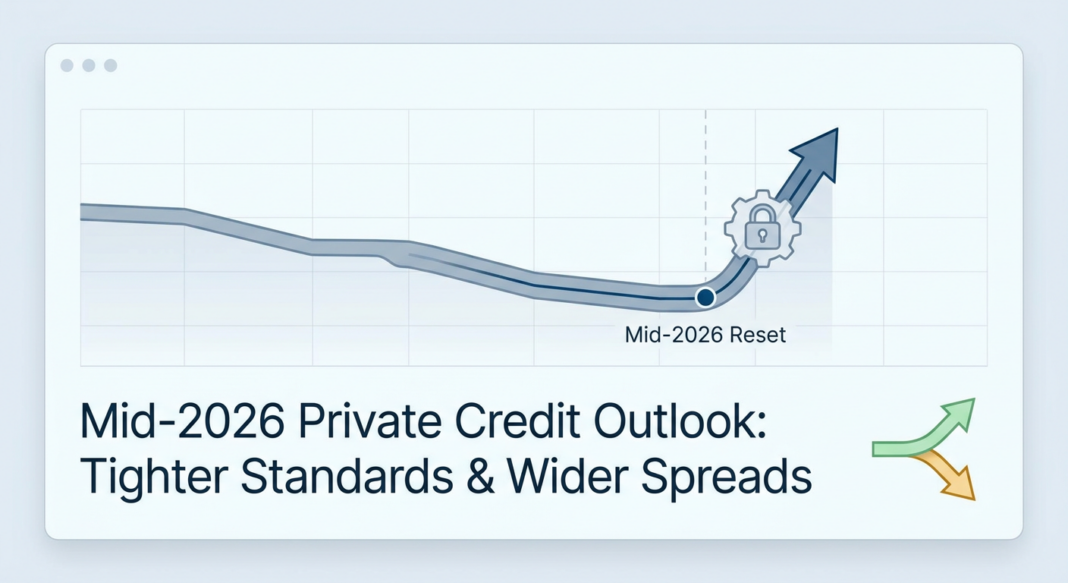
Market Headline: A Lender-Friendly Reset Takes Hold — But Dispersion Is the Real Story
The credit cycle has turned a meaningful corner heading into the second half of 2026. After years of spread compression, covenant erosion, and borrower-friendly structuring, the market has undergone what several institutional participants are now calling a “lender-friendly reset” — one driven not by a systemic shock, but by a convergence of geopolitical volatility, AI-related disruption fears, bank credit tightening, and a significant regulatory deregulation event in leveraged lending.
In practical terms, spreads have widened by roughly 50 to 100 basis points since late 2025, while defensive deal terms have also improved, according to PitchBook. But as the leading institutional managers are quick to note, the spread move alone doesn’t capture the full picture. More importantly, new loans are increasingly coming with better credit structures: less leverage, more covenants, fewer PIK requests, and tighter documentation.
Heightened volatility in early 2026, driven by AI-related disruption concerns and geopolitical developments, pushed credit markets back into price discovery mode, while primary market activity slowed late in Q1 and secondary spreads widened — particularly for technology and software-exposed credits.
Simultaneously, a pivotal regulatory development is reshaping competitive dynamics between banks and private lenders. On December 5, 2025, the OCC and FDIC rescinded the 2013 Interagency Guidance on Leveraged Lending, a move expected to allow banks to better apply enterprise-wide risk management programs and potentially create additional competition in the private credit loan market. The Federal Reserve has not yet followed suit, and banks may continue to be constrained by capital requirements, liquidity considerations, syndication risk, and investor appetite for higher-leveraged structures. Still, the statement marks what could be a significant shift in the regulatory landscape for banks engaged in leveraged lending.
The strategic read: the second half of 2026 is likely to be defined by dispersion. Capital is increasingly selective. Managers with dry powder and disciplined underwriting are well-positioned; those with legacy software exposures or stretched 2021–2022 vintages face a materially different environment.
Quantitative Market Snapshot
Data Box: Key Credit Market Metrics — Mid-2026
| Metric | Current Level (Q2 2026) | Prior Period (Q4 2025) | Change | Source |
|---|---|---|---|---|
| Middle Market Unitranche Spreads | SOFR + 475–550 bps | SOFR + 450–525 bps | +25 bps (maintained after Mar. increase) | VRC Q2 2026 |
| Private Credit Spreads (Broad) | ~S+500 bps | Mid-400 bps | +50–100 bps | Hamilton Lane 2026 |
| Software Sector Spreads (Secondary) | ~245 bps wider vs. year-end | Baseline | ~229 bps above broad B-rated loan index | VRC / PitchBook LCD, June 2026 |
| 3-Month Term SOFR | 3.68% | ~3.67% | +1 bps QoQ; forward curve flat | VRC Q2 2026 |
| 5-Year U.S. Treasury Yield | ~4.23% | ~3.92% (March 2026) | +31 bps | VRC Q2 2026 |
| Private Credit All-In Yield (First Lien) | +~50 bps vs. Q1 2026 | ~8.0–8.5% (year-start estimate) | Upward pressure from SOFR shift | VRC Q2 2026 / Morgan Stanley |
| KBRA Private Credit Default Rate (2025) | 3.4% (by count); 2.0% (by value) | Below 2% (headline) | Rising; KBRA 2.0% by volume forecast for 2026 | KBRA / CTA Acquisitions |
| Mid-Market LBO Leverage (Standard) | 4.0x–5.0x EBITDA | ~4.5–5.5x (2021–22 peak) | Compression; sponsors reverting to lower multiples | Private Capital Global |
Sources: Valuation Research Corp. (VRC) Q2 2026, Hamilton Lane, Morgan Stanley Investment Management, KBRA, PitchBook LCD, Private Capital Global. Data as of June–July 2026.
Bank Lending Standards: The SLOOS Signal
The Federal Reserve’s April 2026 Senior Loan Officer Opinion Survey (SLOOS) delivered a clear macro signal: the April 2026 SLOOS, covering the first quarter of 2026, showed that survey respondents reported, on balance, tighter lending standards and basically unchanged demand for commercial and industrial (C&I) loans to firms of all sizes. Critically, banks reported, on net, tighter standards for all categories of non-depository financial institution (NDFI) loans over the past year — including significant net shares reporting tighter standards for business credit intermediaries and consumer credit intermediaries. The most widely reported tightening actions included higher premiums charged on riskier loans, stricter loan covenants, shorter maximum maturities of loans or credit lines, and lower maximum sizes of credit lines.
KPI Benchmarks: What Lenders Are Requiring
The shift toward more conservative underwriting is measurable in credit metric expectations. Cash flow lending standards emphasize multiple coverage ratios, particularly the debt service coverage ratio (DSCR) measuring EBITDA relative to mandatory principal and interest payments, with most senior lenders requiring a minimum DSCR of 1.25x to 1.50x. Fixed Charge Coverage Ratios (FCCR) — incorporating capital expenditures, taxes, and mandatory debt service — are increasingly the gating metric for new underwriting, not simply leverage multiples. VRC’s proprietary 2021 cohort data indicates that leverage has increased by approximately 0.9x, while adjusted cash interest coverage has declined by roughly 0.4x as of Q1 2026, underscoring why lenders are intensifying scrutiny of coverage metrics on legacy vintages.
Sector Analysis: Capital Is Concentrating — and Rotating
Healthcare: The Durable Anchor
According to Octus Data, healthcare led the way for private credit in 2025, accounting for 19% of all direct lending deals. The sector was also the only industry not to see significant year-over-year price tightening, with spreads landing at an average of approximately SOFR+500 bps in Q4 2025. Specialist healthcare credit funds have demonstrated superior performance: specialist private credit healthcare funds have posted median net internal rates of return of 15%, compared to 11% for generalist U.S. direct lending funds, according to bfinance. U.S. buyout deal value in the pharma, medical, and biotech sector totaled $78.9 billion in 2025, the second-highest recorded in the past 15 years, barely trailing 2021’s $79.6 billion. However, Morgan Stanley notes a significant underweight to healthcare in some portfolios, as it has led all sectors in loans placed on non-accrual status over the last year, highlighting that strong deal flow does not immunize the sector from credit impairment risks.
Technology & Software: High Conviction, But Bifurcated
Software and AI have dominated the private credit narrative in 2026. Private leveraged finance markets have a higher allocation to software than liquid markets, with software representing about 20% of private market exposure versus roughly 13% in the liquid market, per PitchBook and the Morningstar LSTA US Leveraged Loan Index. Yet the sector is now the center of the market’s most acute stress. Secondary spreads in the software sector are approximately 245 basis points wider than year-end levels and roughly 229 basis points above the broader B-rated loan index, per PitchBook LCD data as of June 19, 2026, reflecting continued uncertainty related to AI-driven disruption. Moody’s found software represents roughly 25% of BDC portfolios on a median basis and flagged AI as a developing credit risk, though their own language notes that software loan maturities do not increase more meaningfully until 2028–2029, suggesting AI risk will be a sentiment and monitoring issue in the near term rather than an immediate ratings driver.
On the opportunity side, Morgan Stanley estimates private credit could supply more than half the $1.5 trillion needed for global data center buildouts through 2028. There is a rise in private credit financing in the technology space, and private credit has been leading the development of financing structures for large-scale AI-related infrastructure.
Infrastructure, Industrials & Aerospace/Defense: Emerging Rotation
Market participants expect activity to broaden across sectors such as technology, healthcare, industrials, and media. Aerospace, defense, and government services have emerged as a bright spot for M&A, with a high volume of activity in the final months of 2025. Lenders are increasingly cautious, however, on energy-intensive industries: macroeconomic concerns around continued increases in energy costs for industrial and manufacturing businesses have caused a pause, and lenders have responded by tightening underwriting standards for energy-intensive industries whose leverage was predicated on stable energy costs.
Structural Market Shifts: Banks Re-Enter, But Selectively
As banks begin to re-enter the lending market in Q2 2026, they have contributed to increased competition in the upper middle market, alleviating some upward pressure on credit spreads. This re-entry is amplified by the regulatory deregulation: on December 5, 2025, the OCC and FDIC issued a joint statement rescinding the 2013 Interagency Guidance on Leveraged Lending and its 2014 FAQs. This has the potential to allow lenders to make their own determinations of risk appetite, giving private credit lenders — and returning banks — greater flexibility to underwrite a broader range of loans. Meanwhile, capital is increasingly shifting toward specialist strategies, including asset-backed finance, non-sponsor lending, and the selective use of leverage.
Implications for Borrowers and Institutional Investors
What This Means for Borrowers and Operators
The current environment is fundamentally more demanding for middle-market borrowers. Despite near-term uncertainty, lender demand remains strong, and the market backdrop continues to favor high-quality borrowers — but with higher risk premiums for AI-, tariff-, and cycle-exposed assets. Operators must present tighter FCCR and DSCR documentation: lenders are no longer willing to accept projected earnings without rigorous normalization. As 2021 vintage cohorts approach maturity with leverage approximately 0.9x higher and cash interest coverage 0.4x lower, refinancing risk has increased, raising the likelihood of liability management exercises, restructurings, defaults, or forced asset sales.
The OCC/FDIC deregulation creates a potential near-term tailwind for borrowers seeking to move transactions from private credit to bank markets at tighter pricing — but many market participants believe competitive dynamics, rather than guidance documents, have been the primary driver of private credit’s growth, and banks may remain constrained by capital requirements, liquidity considerations, and syndication risk.
What This Means for Institutional Investors and Lenders
Institutional investors with consistent asset allocations stand to benefit from more favorable supply and demand dynamics, as periods of broader disruption create fertile opportunities for long-term private capital to take share on attractive terms and at wider spreads. The Cliffwater Direct Lending Index provides context on the long-run return profile: for 2025, the CDLI returned 9.3% on interest income of 10.4%; over 20 years, the index posted default losses of just 1.01% versus high-yield bond default losses of 1.49%.
That said, the FSB has raised systemic concerns: the FSB warns that valuation opacity and reliance on private credit ratings can amplify strains in stress, noting that private credit borrowers typically lack public ratings and typically have lower credit quality and higher leverage than borrowers in comparable public markets. There are some signs of borrower stress, as usage of payment-in-kind arrangements has increased, and some increases in default rates, albeit from low levels.
Forward-Looking View: The Next 3–6 Months
Market expectations continue to reflect a higher-for-longer rate environment, with the forward curve broadly flat as of June 2026. Short-term forward rates have moved meaningfully higher relative to December 2025 expectations, with longer SOFR rates expected to stabilize at approximately 4% versus nearly 3% in late 2025, reflecting increased inflation uncertainty and changes in the Federal Reserve’s stance.
Over time, new deal demand together with a large refinancing wave is expected to gradually overtake private credit supply, creating an imbalance that allows lenders to preserve discipline, strengthen terms, and capture the illiquidity premium to public markets. Middle market private equity activity has shown signs of improvement, with deal value increasing approximately 10.7% year-over-year and exit activity rising 14% over the same period, per PitchBook. However, as of June, private equity deal volumes were approximately 5.6% lower compared with June 2025 levels and 52.33% below January 2026 volumes, according to MergerMarket, indicating that the recovery in M&A activity remains uneven and volume-dependent.
Overall, private markets in Q2 2026 are best characterized as stabilizing but increasingly selective, with activity levels, pricing, and investor behavior reflecting increased sensitivity to credit quality, sector exposure, and macroeconomic conditions. The divergence between disciplined, sector-specialized lenders and those with concentrated legacy exposures is widening — and that dispersion will be the defining credit dynamic for the remainder of the year.
Key Market Insights
- Spread Widening Creates a Selective Vintage Opportunity: Today’s environment is potentially more attractive for disciplined lenders than the tighter conditions that prevailed six months ago, particularly for new issuance structured with stronger covenants and tighter documentation.
- FCCR and DSCR Are the New Gatekeepers: Coverage ratios — not headline leverage multiples — are now the primary screening mechanism for senior lenders. Operators with cash interest coverage deteriorating versus 2021 underwriting assumptions face meaningful refinancing headwinds as maturities approach.
- Software Remains a Fault Line: Stress is concentrated in 2021–2022 vintages and software-related exposures, where higher borrowing costs, weaker fundamentals, and AI-related disruption are contributing to increased use of restructurings and liability management strategies. Incremental exposure requires deep due diligence on AI vulnerability.
- Regulatory Deregulation Is a Long-Term Structural Shift: The OCC and FDIC’s rescission of the 2013 Leveraged Lending Guidance removes prescriptive numerical leverage thresholds. Examiners will still evaluate underwriting and risk ratings, but without reference to numerical leverage thresholds or prescriptive repayment metrics. This shifts underwriting discipline from regulatory compliance to institutional risk culture — a meaningful change with long-term implications for credit standards.
- Healthcare and Infrastructure Are the Risk-Adjusted Winners: In healthcare, demographic shifts and non-cyclical service models continue to attract lenders seeking stable cash flows, while infrastructure financing for AI data centers and defense-related buildouts represents the primary new capital deployment opportunity in the second half of 2026.


