
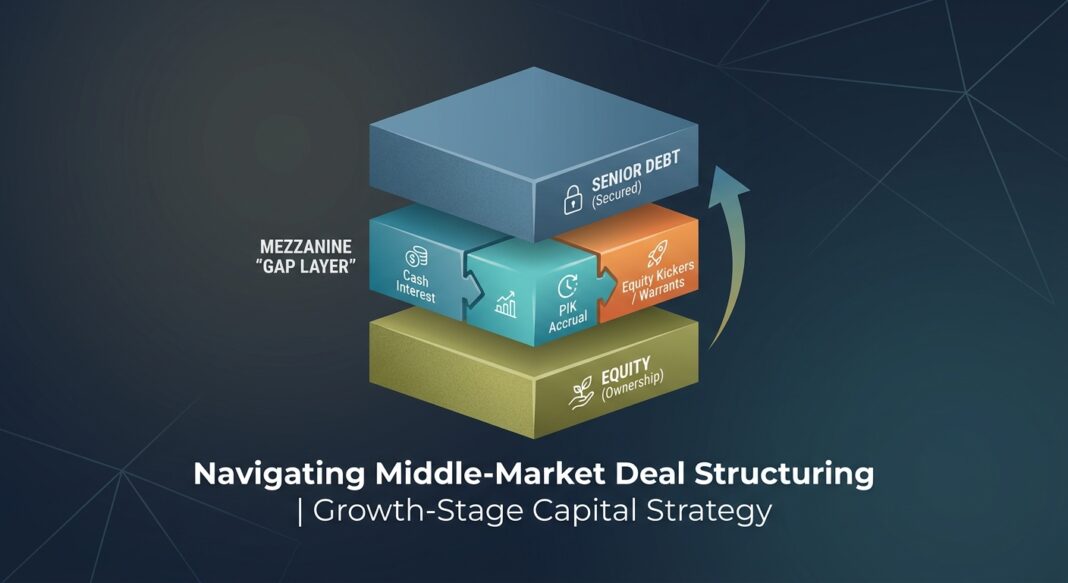
The Financing Gap Every Growth-Stage Operator Eventually Hits
Picture this scenario: a mid-market business services company generating $8M in EBITDA has identified an acquisition target that would add $4M in EBITDA and immediately expand its geographic footprint. The deal is priced at $42M — roughly 6x the combined pro-forma EBITDA. The company’s senior lender will stretch to 3.5x leverage, providing approximately $21M. Equity sponsors are willing to commit $10M but will not go higher without diluting the founder below 50% ownership. That leaves a $11M gap that conventional financing cannot fill.
This is the exact scenario mezzanine financing was designed for. It is the layer of the capital stack that sits subordinated to senior secured debt but senior to all equity — accepting higher risk in exchange for a structurally differentiated return profile. Understanding how to navigate this layer, price it correctly, and negotiate its terms is one of the most consequential skills in middle-market deal structuring.
In 2026, this matters more than ever. The private credit market has reshaped the financing landscape, unitranche structures dominate the middle market, and borrowers in the growth stage face a nuanced cost-of-capital spectrum that demands precise mapping between their use-of-proceeds and the most appropriate funding source.
The Capital Stack at the Growth Stage: Mapping Use-of-Proceeds to Funding Sources
Before structuring any acquisition, a growth-stage operator must understand where each dollar of financing sits in the repayment priority hierarchy — and what each layer costs.
The stack, from most senior to most junior, functions as follows:
- Senior Secured Debt (Banks / Direct Lenders): First-lien position, lowest cost of capital. In the current environment, quality middle-market credits access senior or unitranche debt at all-in rates of approximately 9%–11%, with credit spreads running SOFR + 475–700 basis points depending on deal size and credit quality.
- Unitranche (Direct Lenders): A single-tranche instrument that collapses senior and subordinated debt into one facility. The borrower sees one loan document, one lender, and one interest rate — simplicity that commands a pricing premium. In Q2 2026, unitranche coupon spreads ranged from approximately 4.75% to 5.50% over SOFR, with OIDs between 98.75 and 99.25 for standard transactions.
- Mezzanine Debt (BDCs / Specialty Funds): Subordinated, typically unsecured. Carries higher interest rates and equity participation features. The all-in cost in 2026 ranges from 10%–14% on a cash coupon basis, with total returns to lenders targeting 16%–22% IRR when equity kickers are included.
- Preferred Equity: Below mezzanine, above common equity. Carries liquidation preference and fixed dividend rights. Returns typically target 20%–30%+.
- Common Equity: The residual claimant. Highest risk, unlimited upside.
For an acquisition use-of-proceeds, the operator’s job is to identify the minimum cost of capital that can be sourced at each layer — then fill the gap between senior capacity and total deal cost without over-diluting equity.
Mezzanine Structure Breakdown: The Three Components That Define Pricing
Mezzanine financing is not a single instrument. It is a combination of three interlocking components, each of which must be understood and negotiated independently.
1. Cash Interest
The current-pay component. In 2026, mezzanine cash interest for lower-middle-market acquisition financing typically runs 8%–12% annually, paid monthly or quarterly. This is the base cost a company must service from operating cash flow. A business with 2.0x interest coverage on its senior debt load will feel significant pressure as the mezzanine cash coupon is layered on top — which is why lenders look hard at debt service coverage ratios before committing.
2. PIK Interest (Payment-in-Kind)
Rather than requiring cash payment, PIK interest accrues to the principal balance, compounding over the life of the facility. A typical mezzanine structure in 2026 carries a PIK component of 2%–4% on top of the cash coupon — creating an all-in stated rate of 10%–14% before the equity kicker is accounted for. The critical mechanical point: PIK compounds the outstanding principal balance each period. A $10M loan at 2% PIK grows to $10.2M after year one, then compounds from that new base in year two. Over a five-year term, this meaningfully increases the bullet repayment obligation at maturity.
Borrowers favor PIK precisely because it preserves near-term cash flow during integration periods, capital expenditure cycles, or market downturns. But the tradeoff is explicit: deferred cash interest increases total principal obligations and elevates the all-in cost of borrowing when measured by IRR. Effective PIK structures include performance-based triggers — such as minimum liquidity thresholds or maximum leverage ratio tests — that condition when PIK elections are permissible, preventing the instrument from compounding the borrower into distress.
3. Equity Kicker (Warrants or Conversion Rights)
The equity participation component is what transforms mezzanine from pure debt into a hybrid instrument. Warrants typically grant the lender the right to purchase 1%–5% of the company’s equity at a pre-set strike price, allowing them to participate in upside if the company exits at a premium. In some structures, particularly in sponsor-backed deals, conversion rights replace warrants — enabling the lender to convert their debt position into equity at a predetermined valuation. The equity kicker is the mechanism that drives the gap between the stated interest rate and the lender’s target IRR. Founders who evaluate mezzanine only on its stated coupon — without modeling the dilutive impact of warrants across multiple exit scenarios — systematically underestimate the true cost of this capital.
Worked Example: $42M Acquisition for a Business Services Platform
Returning to the opening scenario, here is how a structured capital stack could finance the $42M deal:
| Layer | Amount | Pricing | Key Features |
|---|---|---|---|
| Senior Unitranche | $21M (3.5x EBITDA) | SOFR + 550 bps (~9.5%–10%) | First-lien, single document, DDTL available |
| Mezzanine | $11M (1.85x EBITDA) | 10% cash + 3% PIK + warrants (3% equity) | Bullet maturity, 6-year term, subordinated |
| Equity | $10M | Target 25%+ IRR | Minority stake, board seat, tag-along rights |
The total debt load is 5.35x EBITDA — within the range that upper-middle-market direct lenders are underwriting in mid-2026 for high-quality transactions. The mezzanine component enables the transaction to close without forcing the founder below majority ownership. The all-in blended cost of the debt stack is approximately 10.2%, a level that requires careful modeling against the combined entity’s projected EBITDA margin and free cash flow conversion.
Mezzanine vs. the Alternatives: When Each Structure Wins
Mezzanine vs. Unitranche
The private credit market’s dominant shift has been the rise of unitranche facilities, which combine senior and subordinated debt into a single instrument. The borrower gains simplicity: one loan document, one lender relationship, and no intercreditor agreement to negotiate. In 2026, the unitranche market is particularly active in the $25M–$200M enterprise value range, where direct lenders such as Ares Capital, Blue Owl, and Antares Capital compete aggressively.
Unitranche wins when the borrower prioritizes speed (45–90 day close vs. 90–150 days for a traditional senior/mezz syndication), simplicity, and relationship continuity. It loses when the blended pricing is materially higher than what a bifurcated senior/mezz structure could achieve — particularly for larger deals where mezzanine can be sourced from specialty funds at tight spreads relative to unitranche last-out pricing.
Mezzanine vs. Growth Equity
The structural comparison here is fundamental. Growth equity raises equity capital through a minority stake, imposing no fixed debt service burden but permanently diluting the cap table. Mezzanine preserves equity ownership at the cost of higher cash obligations and warrant coverage. The right answer depends entirely on the company’s growth trajectory and exit timeline: if the company is expected to grow rapidly toward a high-multiple exit, preserving equity ownership through mezzanine can dramatically increase founder proceeds. If the business is capital-constrained or faces earnings volatility, the fixed service requirements of mezzanine can become a constraint on operations.
Mezzanine vs. Second-Lien Debt
A structural distinction that is frequently confused in practice: second-lien debt is secured — it holds a second-priority lien on the company’s assets. Mezzanine debt is typically unsecured. In a default or liquidation, second-lien holders have a collateral claim; mezzanine holders do not. This distinction materially affects recovery rates and should drive pricing: second-lien debt should carry a lower coupon than true mezzanine, all else equal.
Current Market Terms: 2026 Benchmarks for Practitioners
The following data points represent current market conditions as of mid-2026, drawn from institutional market sources:
- Unitranche all-in yields in the U.S. middle market range between approximately 9.00% and 9.75%, representing a decline of roughly 250 basis points from late 2023 peak levels — but remaining well above the pre-2022 historical range of 7%–8%.
- Mezzanine all-in cost for lower-middle-market acquisition financing runs 10%–14% on a cash coupon basis in 2026, with total lender IRR targets of 16%–22% when PIK and warrant coverage are included.
- Leverage levels for high-quality transactions are running 5.0x–6.0x total debt-to-EBITDA, though underwriting standards have become more conservative since March 2026 amid expectations for higher base rates and constrained M&A volumes.
- Covenant divergence is widening. In the broadly syndicated loan market, nearly 90% of newly issued institutional loans are now covenant-lite, eliminating financial maintenance tests. By contrast, private credit lenders — particularly in the lower middle market — have largely maintained financial maintenance covenants, with quarterly leverage or fixed-charge coverage tests remaining standard on deals below $50M in EBITDA. In the upper middle market, approximately 30% of recent private credit deals are now covenant-lite, up from just 5% a decade ago.
- PIK toggles have become more common features in unitranche and mezzanine facilities, potentially activating when coverage falls below defined thresholds or at the borrower’s election for a rate step-up of 50–100 basis points — providing flexibility without requiring structural re-documentation.
The Gap Capital Playbook: Quantifying, Preparing, Running the Process
For operators approaching a mezzanine raise, execution discipline separates successful closings from broken processes. Here is the tactical sequence:
Step 1: Quantify the Gap Precisely
The capital stack must finance the total project cost — not just the headline purchase price. On a $42M acquisition, the total project cost will typically run $44M–$48M after accounting for working capital reserves, quality-of-earnings fees, legal costs, financing fees, and post-close transition expenses. Build a use-of-proceeds table that maps every dollar before approaching lenders. Mezzanine providers diligence the gap first; they need to see that the equity layer is real and that the senior debt capacity has been fully optimized before they will size their commitment.
Step 2: Prepare the Information Package
Mezzanine lenders underwrite on cash flow, not assets. The information package must include: three years of audited financials plus trailing twelve months; a detailed quality-of-earnings analysis or third-party QoE report; an EBITDA bridge showing the acquisition’s pro-forma contribution and integration synergies; a five-year projection model with base, downside, and stress cases; customer concentration analysis; and a management team biography. Lenders will apply a debt service coverage stress test — typically requiring 1.5x–2.0x DSCR on pro-forma projections — before issuing a term sheet.
Step 3: Run a Competitive Process
For a deal in the $10M–$30M mezzanine range, a borrower should approach 6–10 providers simultaneously: BDCs (Ares Capital, Blue Owl, Main Street, FS KKR), specialty mezzanine funds (Audax Mezzanine, NewSpring, Madison Capital, Twin Brook), and select family office mezzanine platforms. The competitive process typically takes 60–90 days from initial outreach to close. A well-run competitive process should generate at least three executable term sheets, giving the borrower genuine negotiating leverage on pricing, PIK toggle mechanics, and warrant coverage.
Step 4: Negotiate the Structure — Key Deal Points
For Borrowers:
- Warrant coverage and strike price: Negotiate warrant coverage below 3% of equity where possible, and set the strike price at current fair market value rather than a discount. A nominal-strike warrant is a much more expensive equity kicker than a market-price warrant.
- PIK trigger mechanics: Push for performance-based PIK triggers rather than purely elective toggles. A PIK toggle conditioned on falling below a minimum liquidity threshold protects the company from using PIK opportunistically — which can erode lender confidence — while preserving the option for genuine stress scenarios.
- Prepayment flexibility: Mezzanine facilities typically carry call protection of 102–103 in year one, stepping to par by year three. For acquisitions with a defined exit timeline, negotiate a make-whole calculation that uses a reasonable discount rate, and clarify whether capitalized PIK interest is included in the prepayment base.
- Covenant headroom: In private credit, maintenance covenants are still standard on sub-$50M EBITDA deals. Fight for 30%–35% headroom above your closing leverage ratio on day one — tighter cushions create waiver risk and give lenders procedural leverage in renegotiations.
For Investors:
- Confirm the intercreditor agreement between senior and mezzanine lenders before committing equity. Specifically: what are the standstill provisions? What remedies does the mezzanine holder have if the senior lender accelerates? Weak intercreditor protections can subordinate mezzanine holders into near-equity-level risk.
- Model warrant value under multiple exit scenarios — not just the base case. A 3% warrant at a $0.01 strike against a company that doubles in value before exit is a materially different instrument than the stated coupon implies.
Key Takeaways
- Mezzanine fills the structural gap between what senior lenders will provide (typically 3x–4x EBITDA) and what the total transaction requires — enabling growth-stage acquisitions that would otherwise require either excessive equity dilution or deal abandonment.
- The true all-in cost is always higher than the stated coupon. Cash interest, PIK compounding, warrant dilution, and origination fees must all be modeled together across realistic exit scenarios before signing a term sheet.
- PIK interest preserves near-term cash flow but compounds the bullet repayment obligation. Use performance-based PIK triggers to maintain lender confidence and avoid a debt spiral if the acquisition integration takes longer than projected.
- Covenant design is a negotiation, not a standard form. Maintenance covenants in private credit remain the norm below $50M EBITDA — push for maximum headroom at closing, and understand what triggers a technical default before you sign.
- Run a competitive process. Six to ten mezzanine providers approached simultaneously, with a well-prepared information package, is the single most effective way to tighten pricing, reduce warrant coverage, and improve structural flexibility before committing to terms.


