
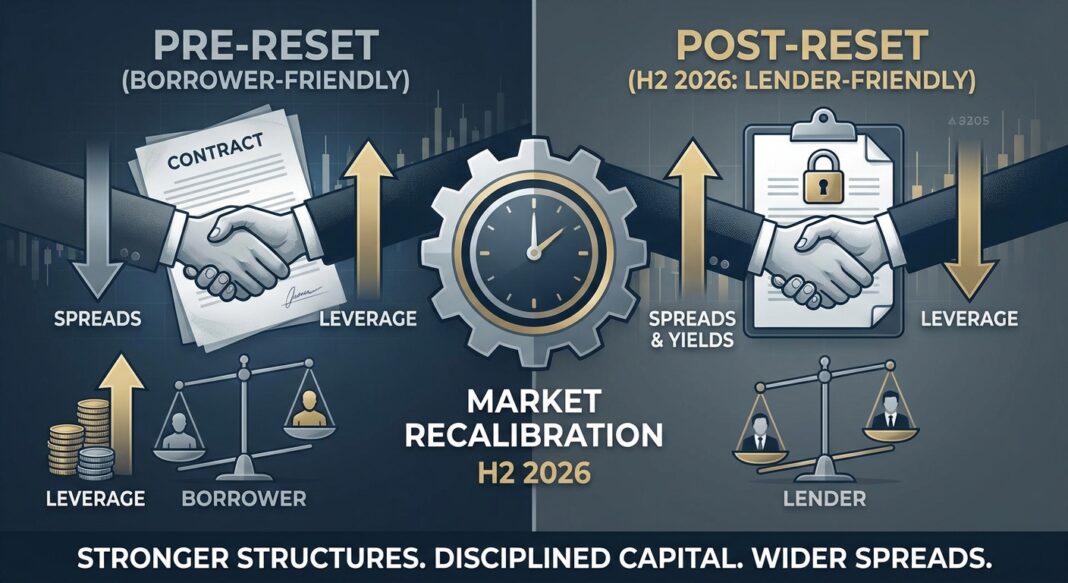
Market Headline: The Lender-Friendly Reset Is Real — and It’s Accelerating Into H2 2026
The private credit market entered mid-2026 in a state of meaningful recalibration. After a multi-year period in which abundant capital chased a limited deal supply — compressing spreads, loosening documentation, and inflating leverage — the tables have turned. According to Lord Abbett’s 2026 Midyear Outlook, the market has reset in a more lender-friendly direction: spreads are wider, covenants and documentation are improving, and managers with dry powder can be more selective about the credits they choose to finance.
Three converging forces drove the reset. First, geopolitical disruption — specifically the U.S.-Iran military conflict that began in February 2026 — elevated oil prices, stoked inflation fears, and pushed the Fed toward a rate pause rather than a resumption of cuts. Second, an AI-driven reassessment of software-sector credit quality triggered a sharp widening in secondary spreads for technology-exposed loans. Third, a wave of redemption requests at non-traded BDCs and semi-liquid vehicles exposed structural liquidity mismatches at select platforms, making capital providers more selective across the board.
The net result, as Valuation Research Corporation (VRC) confirmed in its Q2 2026 Private Markets Update, is a market in transition: direct lending volumes and buyout activity remained restrained in Q2, but conditions stabilized relative to the March shock, and the forward setup for disciplined lenders — more deal flow, less competition per transaction, better pricing and structure — is more constructive than at any time in the past three years.
Quantitative Market Snapshot
The table below captures the most current, sourced data points across private and public credit markets as of early July 2026.
| Metric | Current Value | Prior Period | Change | Source |
|---|---|---|---|---|
| Unitranche Spreads (Middle Market) | SOFR + 475–550 bps | SOFR + 450–525 bps (YE 2025) | +~25 bps wider | VRC Q2 2026 |
| Private Credit Spread (Direct Lending, Senior) | SOFR + ~500 bps | SOFR + mid-400 bps (mid-2025) | +50–100 bps wider since late 2025 | Hamilton Lane, Apr 2026 |
| Software Sector Secondary Spread Premium | ~245 bps above B-rated loan index | In line with index (YE 2025) | +245 bps vs. index; +229 bps above broader B-rated | VRC / PitchBook LCD, Jun 19, 2026 |
| 3-Month Term SOFR | 3.68–3.69% | ~3.0% (late 2025 forward expectations) | ~+70 bps vs. late-2025 projections | VRC Q2 2026 |
| 5-Year U.S. Treasury Yield | ~4.23% (June 2026) | 3.92% (March 2026) | +31 bps quarter-over-quarter | VRC Q2 2026 |
| Fed SLOOS — Net % Banks Tightening C&I Standards (Large/Mid-Market Firms) | +8.1% (Q2 2026) | Net tightening in Q4 2025 also | Continued net tightening | FRED / Fed SLOOS, May 4, 2026 |
| Fed SLOOS — Net % Large Banks Tightening C&I (Large/Mid-Market) | +10.0% (Q2 2026) | — | Net tightening among large institutions | FRED / Fed SLOOS, May 4, 2026 |
| Private Credit Non-Accrual Rate (BDC Median) | 1.4% (Q1 2026) | Below 1.4% (prior quarters) | Rising; smaller borrowers driving increase | Heron Finance / SEC Filings, Q2 2026 |
| Institutional Leveraged Loan Volume (Q1 2026 YOY) | -22.5% YOY | Strong 2025 comparator | Material YOY decline | Capstone / PitchBook Q1 2026 Credit Wrap |
| Direct Lending Fund Net Outflows (Q1 2026) | -$1.8 billion (10 largest funds) | Net inflows in 2025 | First meaningful net outflows in recent cycle | VRC Q2 2026 |
Key takeaway on KPIs: In the current environment, lenders are demanding tighter covenant discipline. Leverage-based maintenance tests now drive margin step-ups/step-downs, excess cash flow sweep percentages, and incurrence baskets, making the EBITDA definition and FCCR calibration critically important underwriting variables. With PIK interest income in BDC portfolios still below the 5% stress threshold — sitting at under 5% of total investment income per Heron Finance’s Q2 2026 Benchmark Report — the system is not broadly stressed, but early-warning signals warrant close monitoring across weaker vintage positions.
Sector Analysis: Who’s Hot, Who’s Cold, and Why
Software & Technology: Under Structural Re-Pricing Pressure
Software is the central credit narrative of 2026. Private leveraged finance markets carry approximately 20% exposure to software — versus ~13% in liquid leveraged finance markets (PitchBook / Morningstar LSTA data, December 31, 2025), making the sector’s AI disruption concerns a systemic issue for the private credit asset class specifically. Secondary spreads for software-exposed credits are now roughly 245 basis points above the broader B-rated loan index as of June 19, 2026 (VRC/PitchBook LCD). Lenders are evaluating AI-impacted software borrowers on a case-by-case basis, with new transactions in the sector pricing at premiums of 75–100 bps above year-end 2025 levels. The 2019–2022 vintage cohort — financed when rates were near zero and AI disruption was not yet an underwriting consideration — is the focal point of stress.
Healthcare: Volume Leader, Spread Premium Maintained
Healthcare led all sectors in 2025 direct lending volume, accounting for 19% of all deals (Octus Data). Notably, it was also the only major sector that did not experience significant price tightening last year, with spreads landing at an average of approximately SOFR + 500 bps in Q4 2025. Some lenders, including Morgan Stanley Investment Management, are expressing caution given that healthcare has led all sectors in loans placed on non-accrual status over the last year, prompting selective underwriters to maintain significant underweights. The divergence between healthcare’s strong deal volume and rising non-accrual rates signals a bifurcation between platform quality tiers.
Infrastructure, Energy & Industrials: Macro-Sensitive Re-Underwriting
The geopolitical shock from the Iran conflict has created new underwriting variables for energy-intensive industries. Lenders have responded by tightening underwriting standards for energy-intensive industries and businesses whose leverage was predicated on stable energy costs (Capstone Partners, Q1 2026). Conversely, energy infrastructure and defense-linked sectors are attracting fresh lender appetite, particularly in Europe, where Apollo Global Management and Ares Management have cited a substantial origination opportunity driven by European defense and infrastructure spending mandates.
Business Services & Non-Cyclical Sectors: The Preferred Lane
Disciplined lenders are concentrating new deployment in senior secured loans to high-quality, sponsor-backed middle market companies in non-cyclical sectors. Business services, asset-light models, and companies with limited international supply chain exposure remain the preferred target. Middle market private equity deal value increased approximately 10.7% year-over-year and exit activity rose 14% (PitchBook, Q2 2026), suggesting selective normalization in the core middle market even as the upper market faces headwinds.
Regulatory Structural Shift: Leveraged Lending Guidance Rescinded
A critical regulatory development with long-term structural implications: on December 5, 2025, the OCC and FDIC jointly rescinded the March 2013 Interagency Guidance on Leveraged Lending, removing the longstanding supervisory framework for leveraged loan underwriting. This gives private credit lenders greater flexibility to develop institution-specific definitions of leveraged loans and to underwrite at deeper leverage levels previously restricted under the prior framework — a structural tailwind for private credit competition with the broadly syndicated market, particularly at the upper end of the leverage spectrum.
Implications: What This Means for Borrowers and Lenders
For Borrowers
The borrower-friendly environment of 2023–2025 has ended. Spreads ground tighter, leverage moved higher, and loan documents often became more flexible during that window — conditions that no longer prevail. Borrowers seeking capital today must contend with unitranche pricing between SOFR + 475 and 550 bps, original issue discounts holding between 98.75 and 99.25 for standard transactions, and — critically — tighter financial covenant suites. Fixed Charge Coverage Ratio (FCCR) tests, net leverage maintenance covenants, and more aggressive cash flow sweep triggers are returning to deal documents. Borrowers in software, manufacturing, and energy-intensive verticals face an additional AI or commodity-risk spread premium of 75–100 bps above standard market pricing. Operators carrying 2021–2022-vintage debt should proactively engage lenders now — an estimated $300–$350 billion of leveraged and private credit is entering a refinancing window in 2026.
For Institutional Investors and Lenders
The second half of 2026 is likely to be defined by dispersion. Non-accruals, PIK usage, sector concentration, and 2021–2022 vintage exposure will become increasingly visible portfolio differentiators. Lenders and investors with dry powder and disciplined underwriting are positioned to capitalize on a market that now offers more transactions to finance, less aggressive competition per deal, and improved ability to negotiate price and documentation. The rescission of leveraged lending guidance opens new structural flexibility. Life insurers — whose median allocation to private credit reached 9% of total assets (up 110% since 2021) (PitchBook, Q2 2026) — face growing concentration risk and warrant enhanced counterparty monitoring. All-in yields on first-lien directly originated loans are expected to remain in the 8.0%–8.5% range (Morgan Stanley IM), elevated by historic standards and in the upper half of the 12-year yield range.
Forward-Looking View: Next 3–6 Months
Market expectations reflect a higher-for-longer rate environment, with the forward SOFR curve broadly flat at approximately 3.7% over the near term — roughly 50 bps above year-end 2025 expectations. This suppresses refinancing-driven deal flow (which collapsed 40.6% YOY in Q1) but amplifies the yield advantage of floating-rate private credit relative to fixed-income alternatives. Over time, new deal demand together with a large refinancing wave is expected to gradually overtake private credit supply, reinforcing lender pricing power into 2027. Near-term deal flow recovery hinges on M&A normalization, which itself depends on geopolitical stabilization and Federal Reserve policy clarity. Diplomatic developments between the U.S. and Iran, including a memorandum of understanding in principle lifting certain economic sanctions, represent the most significant near-term catalyst for a deal flow reopening.
Key Market Insights
- Spreads Are Wider and Staying There: Middle market direct lending spreads are back at SOFR + ~500 bps — up 50–100 bps from the mid-400s of mid-2025 — with unitranche structures pricing at SOFR + 475–550 bps. The higher-for-longer rate environment and geopolitical risk premium are structural, not transient, spread drivers. (Hamilton Lane; VRC Q2 2026)
- Bank Lending Standards Are Net-Tightening: The Fed’s April 2026 SLOOS confirmed that a net 8.1% of all domestic banks (and 10.0% of large banks specifically) tightened C&I lending standards for large and middle-market firms in Q2 2026, reinforcing the structural migration of middle-market lending demand to private credit channels. (FRED/Fed SLOOS)
- Software Is a Sector-Specific Crisis, Not a Systemic One: Software secondary spreads are 245 bps above the broad B-rated loan index, driven by AI-disruption risk and elevated LTV ratios on 2019–2022 vintage deals. This is concentrated stress — not a market-wide credit event — but managers with outsized software exposure face meaningful portfolio differentiation risk in H2 2026. (VRC/PitchBook LCD)
- Documentation and Covenant Quality Are the New Alpha Source: As the market resets, the durability of returns will be determined less by headline spreads and more by covenant structure, EBITDA add-back discipline, FCCR calibration, and cash flow sweep mechanics. EBITDA add-backs in current-market documents can represent 30%+ of reported EBITDA, obscuring true leverage and FCCR headroom — a key due diligence variable for lenders and investors alike. (Sidley Austin; Private Equity Bro)
- A $300–$350B Refinancing Wave Is the Defining Event of 2026–2027: Loans originated in 2020–2022 are entering their refinancing window now. Operators and sponsors with these vintage positions must proactively manage capital structures — those with deteriorating FCCR headroom below 1.1x on a rate-shocked basis face the highest near-term execution risk. Lenders with first-lien, senior-secured positioning and ~40% LTV will be best placed to navigate recoveries in distressed scenarios. (Verdence Capital; Heron Finance Q2 2026)


