
The Story: A Founder Who Refused to Be Diluted
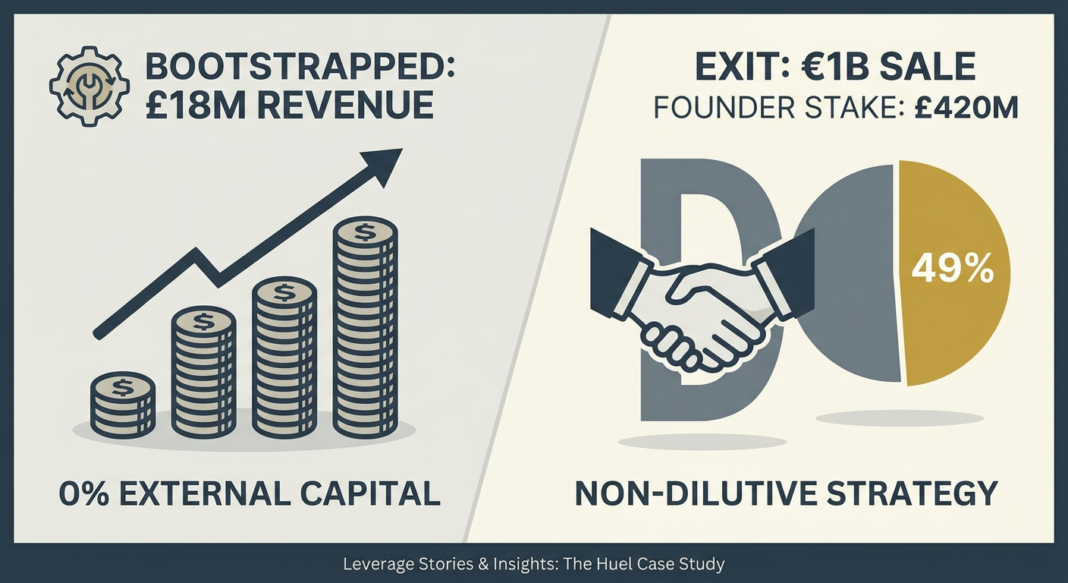
In 2026, Danone paid €1 billion for Huel — a UK-based complete nutrition brand that began life mixing powdered food in a Northamptonshire kitchen. When the proceeds were distributed, Huel founder Julian Hearn walked away with £420 million personally. That represented 49.3% of the exit — an almost unthinkable ownership stake for a founder who had raised $184 million across three institutional funding rounds.
To appreciate how unusual that outcome is, consider the baseline: the average DTC (direct-to-consumer) founder who raises comparable capital across multiple rounds typically exits owning somewhere between 15% and 25% of their company. Hearn owned more than double the upper end of that range. The difference between a 49% exit and a 20% exit — on a €1 billion sale — is the difference between £420 million and £170 million. That £250 million gap is not strategy. It is not luck. It is capital discipline — and the story of how Hearn built it is one of the clearest illustrations of equity preservation through deliberate non-dilutive bootstrapping available in the public record.
Hearn’s story didn’t begin in a boardroom. It began in 2013 with a gap in the market he saw personally: nutritionally complete, affordable, convenient food that didn’t require cooking. By the time he took his first institutional pound, Huel had already crossed £18 million in annual revenue, entirely on internal cash flow. That single decision — to delay external capital until he had real unit economics to negotiate from — is the foundation of everything that followed.
The Decision: Raise Minimally, Raise Late, Raise at Your Terms
When most consumer brand founders hit £1–2 million in revenue, the pressure to raise begins. Investors arrive, decks go out, term sheets get signed — often at low valuations and high dilution. The logic is understandable: marketing capital compounds fast in DTC, and the fear of being outspent by a better-funded competitor is real. Hearn rejected that logic entirely.
By waiting until £18 million in revenue before approaching institutional investors, Hearn achieved something most founders never can: he negotiated from a position of demonstrated performance rather than projected potential. Investors were no longer funding a hypothesis; they were buying into a proven operation. That shifts pricing power dramatically toward the founder. Hearn raised what he needed — not what the market was willing to give him — and structured rounds that preserved his controlling stake through each dilution event.
According to Companies House filings analysed in public reporting by creatorsblueprint.co, Hearn’s total raise of $184 million across three rounds still left him at 49.3% ownership at exit — a figure that reflects not just when he raised, but how much he raised each time. He took capital at inflection points: when international expansion or supply chain investment required more than organic cash flow could support. He did not raise speculatively. The rounds were sized for purpose, not for runway-padding or valuation signalling.
The parallel universe for Hearn would have looked like this: raise a £5M Series A at £15M valuation in 2016 when revenue was £2M, follow with a £30M B at a stretched multiple, and arrive at exit owning 18%. On a €1B sale, that’s £150 million — a life-changing number, but not £420 million. The cost of early dilution is not linear. It is exponential at large exit values.
The Outcome: Premium Multiple, Maximum Founder Capture
Danone’s acquisition wasn’t just notable for its size — it was notable for its multiple. Public reporting indicates Danone paid approximately 17–20× EBITDA for Huel despite the brand’s revenue growth having slowed to around 17% in the period preceding the deal. That premium is directly attributable to the unit economics Hearn built over a decade of capital discipline.
Huel’s gross margins had expanded steadily — a product of vertical integration that most VC-backed DTC brands never achieve because they’re burning cash on customer acquisition rather than investing in supply chain. The omnichannel strategy (moving beyond pure DTC into retail) broadened the acquirer base and signalled maturity. Slowing revenue growth did not kill the valuation because the EBITDA margin trajectory told a different story: the business was becoming more profitable as it grew, not less.
For Danone, paying a premium for a cash-generative, brand-differentiated nutrition platform with a proven founder-led operating model is rational strategic logic. For Hearn, the combination of premium multiple and preserved ownership created an outcome that very few founder exits in the consumer space can match in absolute pound terms. The investors who backed him — including Piper Serica among others — also generated strong returns, underscoring that founder equity preservation and investor returns are not mutually exclusive when the underlying business is built properly.
The Lessons: A Framework for Founders Facing Capital Decisions
Hearn’s story is not a case study in avoiding venture capital — it is a case study in controlling the terms of your relationship with capital. The distinction matters. Huel did take institutional money. It did grow aggressively. The lesson is not ideological purity about bootstrapping; it is about sequencing and leverage — in the negotiating sense of the word.
The broader principle here echoes across the capital structure spectrum. In the same market environment where Hearn was building Huel, the largest private credit deal in history was being assembled to fund Anthropic’s compute infrastructure — a $35 billion debt package structured through Apollo and Blackstone, using special purpose vehicles and a Broadcom residual value guarantee to deliver chips to an AI lab that couldn’t fund the capex through equity rounds alone, as reported by easternherald.com. The mechanism is different, but the underlying logic is identical: preserve equity by finding non-dilutive or minimally dilutive structures when the underlying asset can support them.
Similarly, Hut 8’s $3.25 billion, 16.5-year investment-grade construction bond — structured to pay down entirely from contracted data centre cash flows without a future refinancing event — represents the same philosophy applied to infrastructure capital, as detailed by blockspace.media. The asset generates the cash. The debt services itself. The equity base is protected. Whether you are a nutrition brand founder or a data centre developer, the structural instinct is the same: let the business service the capital, not the other way around.
The framework for founders facing similar decisions:
- Delay external capital until you have negotiating leverage. Revenue and profitability are your strongest term sheet tools. Use them.
- Size each raise for a defined purpose, not for maximum runway. Raising more than you need is not conservative — it is pre-emptive dilution.
- Understand what your equity is worth at various exit multiples before you price a round. A 5-point dilution difference at a £2M valuation becomes a £25M difference on a £500M exit.
- Build unit economics before building market share. A profitable business at scale commands a premium multiple that compounds the value of every percentage point you retained.
- Structure matters as much as quantum. How much you raise matters less than what you give up to get it.
Key Insights
- Bootstrap to leverage, not to avoid capital: Hearn’s £18M revenue pre-raise wasn’t ideological — it was strategic. Proven performance transforms negotiating dynamics and protects cap table ownership at the moment it matters most.
- The dilution clock starts the moment you sign: Early rounds at low valuations are the most expensive capital a founder ever takes. The compounding cost of dilution only becomes visible at exit — by which point it is too late to reverse.
- Premium multiples reward margin discipline: Danone paid 17–20× EBITDA partly because Huel’s margins were expanding, not contracting. Capital efficiency creates exit optionality that growth-at-all-costs strategies rarely preserve.
- Non-dilutive structures are scaling across asset classes: From Huel’s bootstrapped DTC model to Hut 8’s 16.5-year investment-grade bond to Apollo and Blackstone’s $35B AI chip SPV, the instinct to preserve equity by structuring debt against contracted cash flows is the defining capital theme of 2025–2026.
- Founder returns and investor returns are not a zero-sum trade: Hearn’s investors made strong returns alongside his £420M personal exit. Equity preservation is not about denying investors returns — it is about ensuring the founder captures the value they created.


