
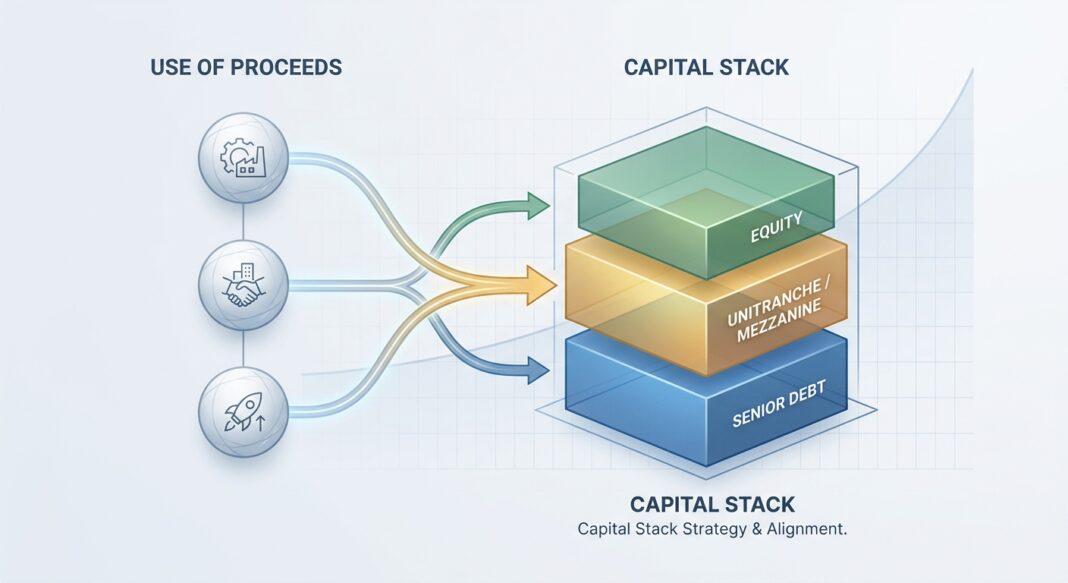
The Growth-Stage Capital Problem: You Have Traction, But Your Funding Menu Has Changed
A company crossing the $3M–$10M ARR threshold faces one of the most consequential financing decisions in its lifecycle. The seed-to-Series A equity path that funded product development is now expensive relative to your de-risked business model — each incremental equity dollar costs meaningful ownership at a moment when your valuation has not yet caught up to your trajectory. At the same time, commercial banks are not ready to lend against recurring revenue or forward cash flows without hard assets and two or three years of consistent EBITDA. The gap between what banks will do and what equity costs is precisely where capital strategy creates or destroys enterprise value.
This gap is not hypothetical. It is structural. Venture and growth investors deployed $425 billion into more than 24,000 private companies in 2025, up 30% year-over-year — yet capital is concentrating into fewer companies, with larger checks flowing primarily to later-stage and AI-driven startups. For companies outside that elite tier, the question is not whether funding exists; it is which layer of the capital stack is the right tool for each specific use of proceeds — and at what cost.
This article maps the full capital spectrum for growth-stage and mature companies pursuing working capital, acquisition finance, and recapitalization objectives. It provides a component-level breakdown of the key structures available today, current market pricing, and a step-by-step Gap Capital Playbook for practitioners running a live process.
The Cost-of-Capital Spectrum: From Senior Bank Lines to Common Equity
Before selecting a structure, practitioners must map the full cost-of-capital spectrum against the specific use of proceeds. Each layer of the stack carries a different combination of cost, access requirements, covenant burden, and dilution profile. The table below is not a menu — it is a decision tree. The cheapest capital is not always the right capital if the business does not yet qualify, and the fastest capital is not the right choice if the covenant package constrains operating strategy.
Layer 1: Senior Bank Debt — Lowest Cost, Highest Barrier
Bank revolving credit facilities and term loans remain the cheapest source of capital — typically SOFR plus 150 to 350 basis points for investment-grade or near-investment-grade credits. But access requires hard collateral (receivables, inventory, equipment), documented EBITDA, and a track record of cash generation. For growth-stage SaaS companies, subscription-based businesses, and pre-profitability platforms, banks will either decline or impose conditions that limit capital to a fraction of actual need. This layer funds working capital and asset-intensive operations, not transformational growth.
Layer 2: Senior Secured Direct Lending (Unitranche) — Speed, Simplicity, Moderate Cost
Unitranche has become the defining instrument of mid-market acquisition and growth financing. Unitranche debt is a single-tranche acquisition loan that combines what would otherwise be senior debt and mezzanine or subordinated debt into one instrument, with one lender and one credit agreement — total leverage typically 4–6x EBITDA and a blended interest rate of 8–11% in 2026. The structural simplicity is the product: one negotiation, one closing, one lender to manage post-close, no agreement-among-lenders to navigate.
On pricing, unitranche pricing in 2026 is SOFR + 500–700 bps plus a 2–3% original issue discount and a 2–3% prepayment fee declining over the first 24 months — resulting in an all-in cost of capital of approximately 9.5–11% for a typical 5x leverage deal.
On execution, unitranche wins on speed — 45 to 90 day close versus 90 to 150 days for broadly syndicated loans — and structural simplicity. This speed premium is not cosmetic. When unitranche financing can close 30 to 45 days faster than a syndicated alternative, sponsors often justify 50 to 100 basis points of extra spread by avoiding financing gaps, broken syndications, or delayed closings that jeopardize purchase agreements.
Layer 3: Mezzanine — Expensive, Non-Dilutive, Purpose-Built for Gaps
Mezzanine sits between senior debt and equity in the capital structure, and it is the most purpose-built tool for filling the gap between senior lending capacity and equity contribution requirements. Mezzanine financing represents a critical component of leveraged buyout and growth capital structures, typically filling the gap between what senior lenders will provide and what equity investors wish to contribute.
Mezzanine debt is typically unsecured or lightly secured, carries higher interest rates than senior loans, and is often structured with warrants or equity participation. The cost of this layer reflects its position: mezzanine debt offers lenders substantial yields — typically 12–20% — while providing borrowers with flexible, non-dilutive growth capital. Flexible repayment terms may include payment-in-kind interest, balloon payments, and long maturities, which can support companies that are growing even if they currently lack sufficient cash on hand.
Layer 4: Preferred Equity and Venture Debt — Hybrid Instruments for Pre-Profitability Borrowers
For companies below the EBITDA threshold required by direct lenders, venture debt and preferred equity provide structured access to growth capital without the dilution of a full equity round. Venture debt is minimally dilutive term financing designed for growth companies; unlike bank loans, it does not require hard assets or profitability. The global venture debt market reached roughly $49 billion in 2025, and Deloitte projects the asset class could grow to represent 20% of total venture funding by 2027.
Layer 5: Common Equity — Highest Cost, Last Resort for Gap Capital
Common equity is the most expensive form of capital measured by cost of dilution at any stage where valuation has not yet caught up to value creation. According to Carta’s State of Private Markets data, median dilution in 2025 sits at approximately 19.5% for seed rounds and 18% for Series A rounds. Growth-stage operators should treat equity as a strategic instrument — deployed when the business needs capabilities, networks, or optionality that capital alone cannot buy — not as a default for funding gaps that structured debt can fill at lower long-term cost.
Structure in Practice: A $50M Unitranche for a $100M EV Growth-Stage Software Company
To make these abstractions concrete, consider a growth-stage B2B SaaS company with $12M in ARR, 85% gross margins, and $4M of adjusted EBITDA seeking to acquire a competitor at a $30M enterprise value while funding organic headcount expansion of $5M. The company has a $20M equity base and has maximized its bank revolver capacity at $5M against receivables. The gap between what the bank will fund and what the transaction requires is $50M.
Illustrative Term Sheet Elements — $50M Unitranche Facility
- Structure: Single-tranche senior secured term loan with a $5M delayed-draw term loan (DDTL) for future add-on acquisitions
- Total Leverage: 5x trailing adjusted EBITDA ($20M total debt / $4M EBITDA)
- Pricing: SOFR + 600 bps (consistent with blended rates of 8–11% for 2026 unitranche facilities in the lower middle market)
- OID: 2.5% (reduces net proceeds at close)
- Prepayment Premium: 3% in year 1, 2% in year 2, 1% in year 3, then par thereafter
- Maturity: 6 years, bullet at maturity
- Amortization: 1% annually per year (mandatory amortization is relatively rare on unitranche debt)
- PIK Toggle: Available at borrower election at SOFR + 675 bps (75 bps PIK premium over cash pay)
- Revolver: $5M super-senior revolving credit facility from a bank, with first-out priority on working capital collateral
- Covenant Package: Single total net leverage maintenance covenant tested quarterly at 6.5x (25–30% cushion over closing leverage); incurrence-based baskets for acquisitions and restricted payments
- Security: First-priority lien on all assets; pledge of equity in subsidiaries
The DDTL provision is a critical structural element for roll-up platforms. Many facilities include DDTLs of 0.5x–1.0x EBITDA for acquisitions or capital expenditures, available for 12–18 months. For a buyer running an add-on strategy, this avoids return trips to the market and associated OID cost for each transaction.
Unitranche vs. Senior + Mezzanine Split: When the Traditional Stack Still Wins
The reflexive preference for unitranche is not always correct. The choice between a single-tranche facility and a bifurcated senior-plus-mezzanine structure turns on four variables: total leverage required, cost sensitivity, execution timeline, and the borrower’s tolerance for covenant complexity.
The Cost Comparison
A traditional senior plus subordinated structure prices senior debt at SOFR + 350–450 bps (7–8.5% all-in) and subordinated debt at 11–13% cash plus 2–3% PIK. On a 50/50 senior-sub split, the traditional structure prices 9–10.5% all-in — only marginally cheaper than unitranche, with materially more execution complexity. For most mid-market borrowers, the marginal cost savings of a split structure rarely justify the execution risk, dual lender relationships, and intercreditor friction that comes with it.
When the Split Structure Wins
There are scenarios where bifurcation is the right answer. When total leverage requirements exceed 6x EBITDA, and no single direct lender can hold the full unitranche, a senior-sub split may be required structurally rather than optionally. Additionally, for companies where the mezzanine layer can be sourced from a lender with deep sector expertise, the equity-participation features of mezz — warrants, co-investment rights — can create advisory value beyond capital. When choosing a mezzanine lender, it is vital that the provider shows interest in supporting the long-term strategies of the companies they finance and is relationship-oriented rather than transaction-oriented.
The Market Sweet Spot
Unitranche has become the financing standard for acquisitions valued between $25M and $200M enterprise value, with roughly 70–80% of deals in that range using at least partial unitranche funding. Smaller deals below $25M enterprise value typically benefit more from SBA financing plus seller notes, while larger deals above $300M often access cheaper broadly-syndicated loans. Know which lane your transaction sits in before designing the structure.
Current Market Terms (Q2 2026): Five Data Points Every Practitioner Needs
Market conditions in mid-2026 reflect a late-cycle credit environment: significant capital availability alongside tightening underwriting standards and elevated cost of capital relative to the zero-rate era. The following data points reflect current market norms across the structures described above.
- Unitranche Pricing: Unitranche facilities typically price at SOFR + 425–475 bps for sponsored upper middle market transactions, with core middle market credits commanding 50–100 basis points higher, according to Capstone Partners’ Winter 2025 Leveraged Finance Report. For lower middle market credits in the $25M–$75M EV range, expect SOFR + 550–700 bps.
- All-In Cost Baseline: All-in cash interest costs on senior debt hover around 9–11% for quality middle market credits; practitioners should use 10% as a baseline for modeling senior or unitranche debt interest, with riskier profiles potentially reaching 12% or higher.
- Covenant Standards — The Divergence: In the broadly syndicated loan market, approximately 90% of new loans in 2024 remained covenant-lite, continuing borrower-friendly documentation trends. However, private credit lenders have maintained firmer positions on covenant inclusion, particularly for mid-market transactions. Borrowers accessing direct lending should expect at least one quarterly-tested maintenance covenant on any deal under $50M EBITDA.
- The Rise of Covenant-Loose (Not Covenant-Light) in Private Credit: Many private credit funds are now providing “covenant loose” terms to stay competitive. While covenant loose loans typically retain at least one maintenance financial covenant — such as a quarterly tested leverage ratio — the cushions are set so generously that the covenant would be unlikely to ever be triggered. A borrower receiving a covenant with 40% headroom to closing leverage should understand this is a structural feature of the market, not a reflection of lender confidence in their projections. A leveraged buyout with debt to EBITDA of 5x at closing may have a maximum total leverage ratio threshold of approximately 8.25x — a nearly 40% cushion that effectively allows for significant EBITDA erosion before the covenant is tripped.
- PIK Toggles — Stress Signal or Structural Feature? PIK toggles have become more common, potentially activating when coverage falls below thresholds or at borrower election for rate increases of 50–100 basis points. PIK is increasingly appearing in senior secured loan documentation — not just mezzanine — and while many managers argue for a distinction between “good” and “bad” PIK, the broad-based increase suggests that borrowers are increasingly managing higher interest burdens. In a term sheet, a PIK toggle at borrower election is an asset; a PIK toggle triggered by covenant breach is a liability.
The Gap Capital Playbook: Quantify, Prepare, Run the Process, Negotiate
For an operator or CFO approaching the capital market for the first time, or for a sponsor evaluating financing options for a platform acquisition, the process is as determinative of outcome as the structure itself. The following four-step playbook applies to any growth-stage or acquisition financing situation where the capital need exceeds what a single source can or will provide.
Step 1 — Quantify the Gap with Precision
The gap is not simply the difference between your cash balance and your transaction requirement. It is the difference between your optimal capital structure and what your current credit profile will support from the cheapest available source. A rigorous gap quantification answers three questions: (1) What is the maximum senior debt my EBITDA base will support at market leverage multiples? (2) What is the minimum equity contribution my equity partners require or that valuation supports? (3) The difference is the structural gap — and it is the gap that a unitranche, mezzanine layer, preferred equity, or hybrid instrument must fill.
This discipline matters because reactive fundraising costs 20–40% more than strategic fundraising. A borrower who approaches lenders with a well-modeled gap analysis and a clearly articulated use-of-proceeds narrative commands materially better terms than one presenting a financing request without structural specificity.
Step 2 — Prepare the Deal Package
The minimum viable deal package for a direct lending or mezzanine process consists of five components: (1) a business overview and market positioning deck; (2) three years of historical financials with clear EBITDA add-back schedules and adjusted metrics; (3) a 3-year financial model with base, upside, and downside cases; (4) a use-of-proceeds breakdown that maps each dollar of capital to a specific operating or strategic objective; and (5) a proposed capital structure with leverage multiples, interest coverage projections, and covenant headroom calculations. Lenders who receive a package with these five components — with integrated coverage ratios at current market rates — approve, price, and close deals faster and with fewer re-trades.
Step 3 — Run a Competitive Process
For unitranche and direct lending, a competitive process means engaging three to five lenders simultaneously with a structured timeline. Active participants in the lower and core middle market unitranche space include Ares Capital, Blue Owl Capital, Antares Capital, Twin Brook Capital Partners, Apollo Global Management Direct Lending, Carlyle Direct Lending, Golub Capital, and Monroe Capital. Each has differentiated sector preferences, hold size constraints, and portfolio concentration limits that determine pricing and structure. A borrower who runs a single-source process has no market intelligence on price tension, and no leverage on structural concessions. A competitive process that produces two or three term sheets creates negotiating leverage on OID, spread, prepayment premium, and covenant cushion simultaneously.
Step 4 — Negotiate the Structure, Not Just the Price
Most borrowers negotiate the headline spread and ignore the structural terms that will determine their actual cost of capital and operating flexibility over the life of the facility. The following are the five highest-leverage negotiation points in any unitranche or mezzanine term sheet:
- DDTL Availability and Commitment Fee: Push for an 18-month availability window rather than 12 months, and negotiate the commitment fee on the undrawn DDTL — typically 0.5–1.0% per year — down to the minimum. For an active acquisition platform, this is not a rounding error.
- Covenant Cushion: The financial covenant is typically a single net first-lien or total net leverage covenant with an initial cushion of 25–35% over the base case plan, stepping down as cash flow grows. Push for a static cushion that does not step down until leverage falls below a defined threshold — this preserves headroom during integration periods where EBITDA may temporarily compress.
- MFN Protection on Incremental Debt: Incremental debt permissions are sized by the larger of a fixed amount and a grower basket, with most-favored-nation protection capping new-money margin increases at 50 basis points for 6 to 12 months. Negotiate the MFN sunset to 6 months rather than 12 to preserve flexibility for future capital optimization.
- PIK Toggle at Borrower Election: A PIK toggle at borrower election with a modest rate premium (50–75 bps) is a cash flow management tool. Ensure the toggle is not conditioned on lender consent or limited to distress scenarios — its value is as a proactive lever, not a defensive one.
- Equity Participation (Mezzanine Only): If the structure includes a mezzanine tranche with warrants or an equity co-invest right, negotiate the warrant coverage percentage, exercise price (fair market value vs. a discount), and the duration of the exercise window. The primary advantage of mezzanine financing is accessing significant capital while minimizing equity dilution compared to a traditional equity raise; for a PE sponsor executing a leveraged buyout, this means contributing less equity capital, which can significantly boost potential IRR.
Key Takeaways
- The capital stack is a sequencing decision, not a single event. Map each use of proceeds — working capital, growth headcount, acquisition, recap — to the lowest-cost layer of capital that you can actually access at each stage of business development. Using equity to fund what structured debt can finance is the most common and most expensive capital strategy mistake.
- Unitranche is the dominant mid-market acquisition instrument in 2026. Unitranche combines senior and subordinated debt into a single tranche from one direct lender, offering 4–6x leverage at blended rates of 8–11%, and has become the financing standard for acquisitions valued between $25M and $200M enterprise value. Below and above that range, the structural economics favor alternative instruments.
- Covenant structure is as important as pricing. Maintenance covenants require borrowers to pass financial tests every quarter regardless of any action taken, while incurrence covenants only apply when the borrower takes a specific action like incurring new debt or paying a dividend; most syndicated leveraged loans today are covenant-lite, though private credit deals typically retain maintenance covenants for earlier lender intervention. Understand which regime your facility uses, and negotiate the cushion accordingly.
- PIK toggles are structural tools, not distress signals — when positioned correctly. A PIK toggle at borrower election preserves cash flow flexibility during integration periods, seasonal trough quarters, or strategic investment cycles. Borrowers should insist on election-based PIK rather than condition-based PIK in any acquisition or growth facility.
- Running a competitive process is not optional. The spread between the best and median term sheets in a competitive direct lending process is routinely 50–100 bps on pricing plus material structural concessions on OID, covenant design, and prepayment terms. A single-source process is a donation to your lender’s economics at the direct expense of your own capital efficiency.


