
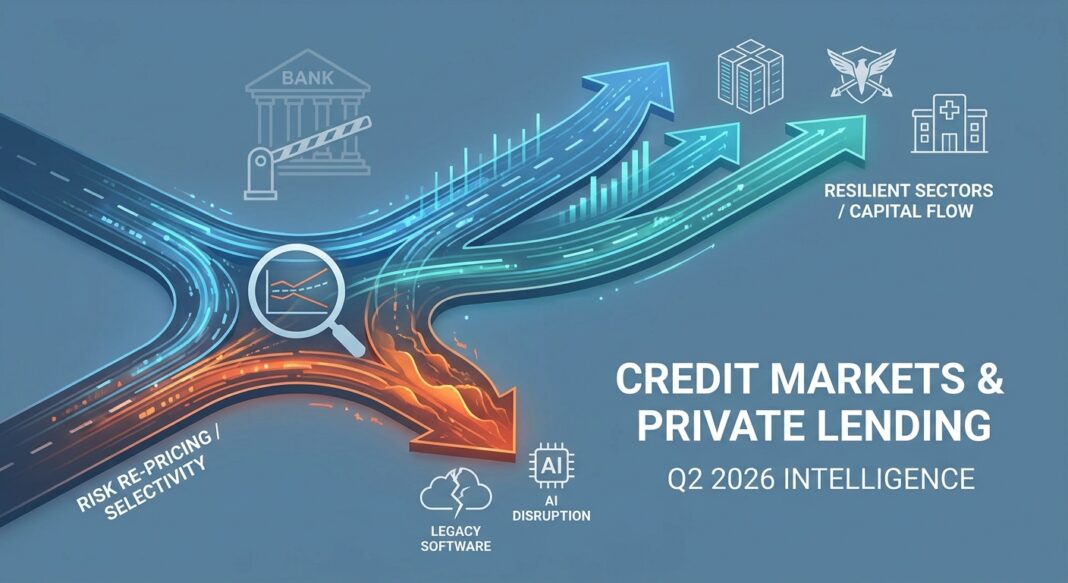
Market Headline: A Credit Cycle Inflection Point
Private credit entered Q2 2026 navigating its most turbulent environment in more than a decade. The convergence of geopolitical shock — specifically the U.S.-Iran military conflict that erupted in February 2026 — AI-driven disruption to software credit, and accelerating investor redemption requests at several large evergreen vehicles has triggered a meaningful re-pricing across the leveraged finance complex. The result is a market that has abruptly shifted from a spread-compression regime, which dominated 2024 and most of 2025, to one of active price discovery and heightened selectivity.
Spreads in private credit have re-entered the SOFR+500 bps context, up from the mid-400 bps levels that characterized the prior period. This widening is not uniform: it is concentrated in AI- and technology-exposed credits, highly levered healthcare roll-ups, and any borrower whose capital structure was underwritten to a near-zero SOFR floor. Meanwhile, lender demand remains broadly strong, and the market continues to favor high-quality borrowers, with higher risk premiums demanded for AI-, tariff-, and cycle-exposed assets.
At the macro level, heightened volatility in early 2026, driven by AI-related disruption concerns and geopolitical developments, pushed credit markets back into price discovery mode. The Federal Reserve’s pivot to a rate pause and evaluation of conditions that could warrant future rate hikes has caused the three-month average SOFR spread to hover around approximately 3.7%, with market participants expecting spreads to widen over the next six months. The twin pressures of a higher-for-longer rate environment and sector-specific stress are forcing operators, sponsors, and institutional investors to reassess underwriting assumptions with urgency.
Quantitative Market Snapshot
The following data box synthesizes the most current available metrics across the public and private credit complex as of May–June 2026.
| Metric | Current Value (Q1–Q2 2026) | Prior Period | Direction | Source |
|---|---|---|---|---|
| Private Credit Direct Lending Spread (Senior, First Lien) | SOFR + ~500 bps | SOFR + mid-400 bps (Q3–Q4 2025) | ↑ Wider | Hamilton Lane, April 2026 |
| Private Credit All-In Yield — First Lien Loans (Floor) | 8.0%–8.5% (trough range) | ~9.5%–10.5% (2023 peak) | ↓ Compressing from peak, still elevated | Morgan Stanley Investment Management, Dec 2025 |
| Middle Market B-Rated Loan Secondary Spreads vs. Year-End 2025 | ~+67 bps wider than year-end | Year-end 2025 baseline | ↑ Wider | Valuation Research Corp. (VRC), April 2026 |
| U.S. High Yield OAS (ICE BofA Index) | ~285–320 bps | ~270 bps (late 2025 tights) | ↑ Modestly wider; still well below crisis levels | Coutts / ICE BofA, March 2026 |
| Investment-Grade Corporate OAS | ~80 bps (BBB: ~100 bps; AA: ~50 bps) | Near multi-decade tights (mid-1990s levels) | ↔ Historically tight | InvestmentGrade.com / PineBridge, 2026 |
| Private Credit Direct Lending Interest Coverage Ratio (FCCR Proxy) | ~2.0x (direct lending); ~4.0x (public borrowers) | ~1.0x at peak rate stress (2023) | ↑ Recovering from trough; below public market norms | J.P. Morgan Private Bank / Cliffwater, Feb 2026 |
| U.S. High Yield Issuer Debt/EBITDA | ~4.4x | ~5.3x (2020 peak) | ↓ Declining; leverage contained | Coutts, March 2026 |
| Private Credit Estimated Default Rate (2025 Actuals) | 1.6%–4.7% (conventional + distressed LMEs) | Below 2% headline (prior years) | ↑ Rising; true rate higher when LMEs included | Moody’s, April 2026 |
| Fed SLOOS — Net Share of Banks Tightening C&I Standards (Q1 2026) | Positive net share (tighter) — firms of all sizes | Tighter in Q4 2025, Q3 2025, Q2 2025 | ↑ Persistently tightening | Federal Reserve April 2026 SLOOS |
Sources: Hamilton Lane (April 2026), Morgan Stanley IM (December 2025), Valuation Research Corp. (April 2026), J.P. Morgan Private Bank (February 2026), Coutts (March 2026), Moody’s (April 2026), Federal Reserve SLOOS (April 2026), InvestmentGrade.com / PineBridge (2026). Data reflects most recently available public disclosures. All figures are approximations based on institutional research.
Public vs. Private Credit: Rate & Spread Divergence
The structural gap between public and private credit remains significant. Annualized returns across the credit complex show mezzanine debt at approximately 11.4%, direct lending at 9.0%, distressed debt at 7.1%, leveraged loans at 5.5%, high yield at 5.2%, and investment grade at 2.4% — illustrating the persistent illiquidity premium embedded in private structures. However, the premium of direct lending versus leveraged loans, which rose sharply from early 2022 and peaked around 2023 in the 3%–4% range, has since compressed through 2024–2025, moving into the mid-teens to low 2% area by late 2025. The Q1 2026 spread widening in private credit may partially restore this premium, but selective underwriting is critical.
On the coverage ratio front, interest coverage ratios for direct lending have stabilized and are holding steady after past rate shocks, hovering around approximately 2.0x — compared with approximately 4.0x for public borrowers. This gap is a critical underwriting signal: middle market borrowers carry materially thinner fixed charge coverage cushions, making FCCR discipline a front-line KPI for lenders evaluating new commitments.
Sector Analysis: Diverging Lender Appetite & Structural Shifts
🔴 Software & Legacy SaaS: Sharply Restricted
No sector has experienced a more dramatic reassessment of lender appetite than software. Private credit funds can have sizable exposure to the software sector, with software credit often comprising 20%–30% of fund assets — far larger than software’s representation in public markets, where it makes up just 5% of the U.S. high-yield universe. This concentration has become a systemic risk flashpoint. Morgan Stanley warns that default rates in direct lending could climb to 8% as AI disruption hits the software industry, with elevated leverage and looming maturity walls within the sector potentially pushing defaults near pandemic-era peaks. VRC increased credit spread ranges across all credit instruments by 25 basis points in its March 2026 pricing matrix, with technology and software services loans continuing to price at wider-than-average premiums given risk-off conditions and lower implied enterprise values.
🟢 Industrials, Defense & Energy Infrastructure: Strong Appetite
Priority sectors attracting private credit capital for 2026 include energy infrastructure, digital infrastructure, defense and national security, and next-generation manufacturing — all requiring patient institutional capital. Industrials are being supported by increased capital spending in key growth areas including electricity capacity, construction around AI-related infrastructure buildout, defense, and energy. Lenders are actively deploying into these verticals, though macroeconomic issues around continued increases in energy costs for industrial and manufacturing businesses have caused lenders to tighten underwriting standards for energy-intensive industries.
🟠 Healthcare: Flight-to-Quality Dynamics
In healthcare, demographic shifts and non-cyclical service models continue to attract lenders seeking stable cash flows. However, the sector is not without stress. Morgan Stanley maintains a significant underweight to healthcare, which has led all sectors in loans placed on non-accrual status over the last year. The divergence lies within healthcare’s subsectors: healthcare PE and credit activity is rebounding with a "flight to quality," as investors deploy capital into scalable niches like behavioral health, value-based care, and AI-enabled pharma services, while highly leveraged healthcare roll-ups face markedly tighter terms. Highly leveraged healthcare roll-ups are among the assets identified as vulnerable by credit professionals.
🔴 AI / Technology Infrastructure: Bifurcated
Within technology, there is a sharp divide between AI-disrupted legacy software and AI-enabling infrastructure. Morgan Stanley estimates private credit could supply more than half of the $1.5 trillion needed for global data center buildouts through 2028. Banks are also adapting their AI lens to credit decisions: a moderate net share of banks reported a higher likelihood of approving C&I loans to firms benefiting from AI, while a major net share of banks reported being less likely to approve such loans to firms adversely affected by AI.
Structural Shift: Bank Retreat Deepens
The commercial banking sector’s ongoing retreat from corporate lending continues; despite the recent withdrawal of the 2013 leveraged-lending guidance by the OCC and the FDIC, regional banks continue to be cautious on leveraged lending due to potential commercial real estate exposure challenges. A broader shift toward market-based lending is underway, with banks increasingly partnering with private credit managers rather than holding risk directly on their balance sheets. Unlike prior cycles, much of the incremental leverage now resides with private lenders rather than banks with deposit bases, reducing systemic vulnerability. The April 2026 SLOOS reinforces this structural dynamic: banks reported, on net, tighter standards for all categories of non-depository financial institution (NDFI) loans over the past year, with significant net shares reporting tighter standards for NDFI loans to business credit intermediaries.
Implications for Borrowers & Institutional Investors
What This Means for Borrowers
With the Fed in rate-pause mode, SOFR has hovered around 3.7%, and while 84.4% of new-issue LBO spreads in the direct lending market priced below SOFR+550, spread pricing is likely to tick up 25–50 basis points — particularly for deals that are lower in quality or in difficult-to-finance sectors. Middle market operators with EBITDA below $30M must be especially disciplined: lenders are scrutinizing debt-service coverage tightly, with interest coverage ratios having declined to approximately 1.0x during peak rate-stress periods, where cash flow was barely covering interest payments — a scenario lenders are now actively stress-testing against in new underwriting.
Borrowers in AI-exposed or rate-sensitive sectors should anticipate case-by-case scrutiny. Lenders continue to evaluate AI-impacted borrowers on a case-by-case basis. Conversely, the most favored targets for direct lending capital are "boring and basic" lower-middle-market businesses with stable, foundational operations and long operating histories — preferably those demonstrating resilience through multiple credit cycles. Borrowers able to demonstrate predictable free cash flow, clean EBITDA with limited add-back adjustments, and FCCR above 1.5x will find a receptive lender base even in today’s more cautious environment.
What This Means for Institutional Investors & Lenders
Periods of volatility often present compelling opportunities for private credit. Banks tend to retrench, making way for better pricing and structure for private credit lenders. The current environment is rewarding disciplined platforms with sector-specific underwriting depth. Moody’s baseline economic forecast places GDP growth at roughly 1.5% — just above the historical "stall speed" below which defaults tend to accelerate — meaning even a modest growth disappointment could cause stress to surface quickly in less liquid pockets of the credit market.
Growth in private credit has been accompanied by evolving structures that can obscure underlying leverage, including covenant-lite documentation, payment-in-kind income, NAV-based lending, and layered fund-level leverage — making it difficult to estimate a market-wide measure of credit risk. Institutional allocators should scrutinize NAV facilities and PIK-heavy structures carefully, as while the headline default rate in private credit has remained below 2% for several years, once selective defaults and liability management exercises are taken into account, the "true" default rate approaches 5%.
Forward-Looking View: Next 3–6 Months
A more challenging exit environment and extended hold periods are likely to persist in the near term; that said, substantial dry powder remains available, and a stabilization in AI-related concerns or geopolitical tensions could allow markets to reopen quickly. For the private credit complex, new deal demand together with a large refinancing wave is expected to gradually overtake private credit supply, creating an imbalance that could allow lenders to preserve discipline, strengthen terms, and capture the illiquidity premium to public markets. On the public market side, with 2026 capital market forecasts as high as $2.25 trillion — a 35% year-over-year increase in high-grade bond issuance — market participants must prepare for conditions in which more bonds may finally produce wider spreads.
The structural retreat of bank lending and holding of middle-market loans shows no signs of reversing, despite regulatory relief, suggesting the private credit opportunity set remains structurally intact even as near-term volatility creates dispersion between managers. Moody’s predicts the private credit market will double to more than $3 trillion in assets under management by 2028, with growth expanding across various asset classes.
Key Market Insights: Five Actionable Takeaways
- Spread Re-Widening Creates Entry Opportunity for Disciplined Lenders. Yields have widened in the BSL market and private credit spreads are in the SOFR+500 context again, which will be yield-enhancing for lenders deploying new capital. Platforms with available dry powder and strong origination pipelines are best positioned to capture improved risk-adjusted terms.
- AI Disruption Is a First-Order Underwriting Variable. The most consequential new variable in leveraged credit markets in Q1 2026 was not macroeconomics — it was technology. An AI strategy and evaluation of AI’s potential risk on a business have emerged as a critical analytical component both in underwriting a new transaction and in evaluating private credit portfolios.
- FCCR and Debt/EBITDA Floors Are Tightening Across the Market. The most widely reported tightening actions by banks include higher premiums charged on riskier loans, stricter loan covenants, shorter maximum maturities, stricter collateralization requirements, and lower maximum sizes of credit lines. Borrowers should model FCCRs under SOFR-at-current-levels before approaching lenders.
- Sector Bifurcation Demands Active Credit Selection. The market is not uniformly stressed — infrastructure, defense, and non-cyclical services remain well-bid, while legacy software and highly leveraged healthcare roll-ups face markedly wider spreads and tighter structure. The environment calls for selectivity over simplicity; falling default rates should not be mistaken for a broad reduction in risk, and today’s market rewards issuer-level analysis and sector awareness.
- Institutional Capital Is Structurally Replacing Bank Lending. Non-bank institutional investors continue to replace deposit-funded banks as the primary source of capital for corporate lending, providing extended-maturity commitments matched to asset durations — and now finance a broad spectrum of assets including residential mortgages, infrastructure debt, equipment financing, and alternative assets. Operators seeking flexible, long-duration capital should engage private credit platforms directly rather than waiting for a bank lending recovery that may not materialize at prior levels.


