
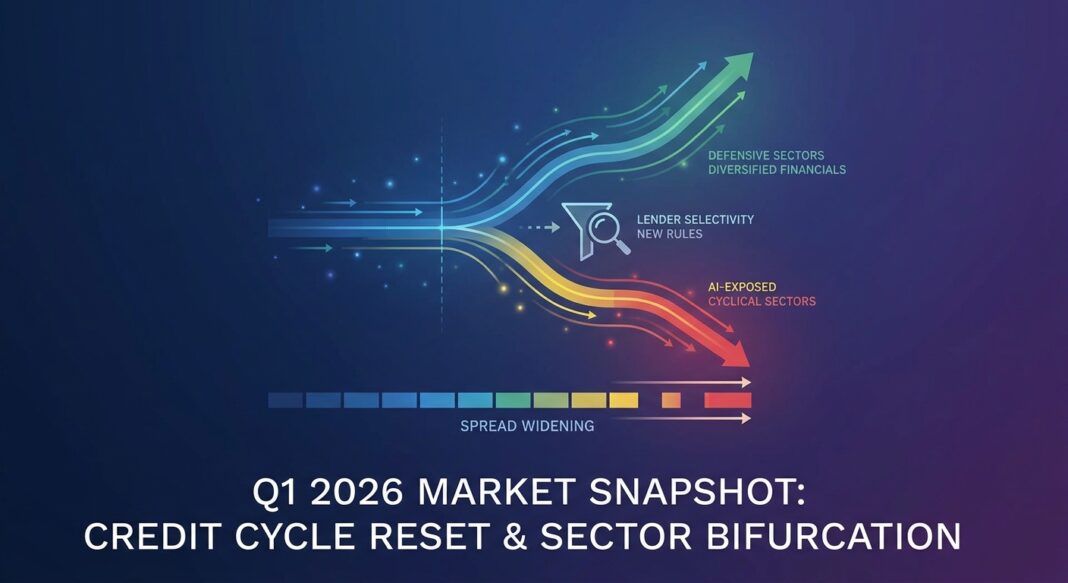
The Credit Cycle Resets: Macro Forces Drive a New Phase of Price Discovery
Private credit markets entered 2026 riding a constructive tail wind — ample dry powder, tightening spreads, and building M&A momentum from the second half of 2025. That narrative hit a wall in Q1 2026. Three compounding shocks reshaped lender behavior in rapid succession: a sharp AI-driven selloff across software and technology credits, a renewed Middle East geopolitical conflict that injected upside inflation risk into an already complicated Federal Reserve policy path, and persistent tariff and trade policy uncertainty that suppressed risk appetite across the capital stack.
The result, as documented across multiple institutional credit market reviews, is what valuationresearch.com describes as a renewed phase of price discovery — a market that is technically open but functionally selective, with pricing power shifting decisively back toward lenders for anything perceived as exposed to AI disruption, tariff sensitivity, or late-cycle cyclicality.
For institutional investors and operators, this is not merely a repricing event. It is a structural signal about where the credit cycle now stands and which sectors remain financeable on acceptable terms.
Quantitative Market Snapshot: What the Numbers Show Right Now
| Metric | Current (Q1 2026) | Prior Period | Change | Source |
|---|---|---|---|---|
| Direct Lending 1st Lien Spread (new issue) | ~500–525 bps over SOFR | ~486–497 bps (Oct–Nov 2025) | +25 bps (matrix-wide, more for tech) | valuationresearch.com |
| Software / Tech Loan Spreads (new issue) | ~75 bps AI premium on top of widened base | Year-end 2025 baseline | +~200 bps since year-end | valuationresearch.com |
| B-Rated Secondary Loan Spreads | ~67 bps wider than year-end 2025 | Year-end 2025 | Widening | valuationresearch.com |
| Total Institutional Loan Issuance (Q1 2026) | $241B | Q1 2025 (prior year) | −32% YoY; +54% QoQ from Q4 | portagepointpartners.com |
| Net New (Non-Refi) Leveraged Loan Issuance | ~$70B | Quarterly avg. prior two years | Modestly below YoY; above 2-yr avg. | sikich.com |
| M&A Deal Volume (March 2026 vs. January 2026) | −42.4% from January levels | January 2026 | Sharp intra-quarter deceleration | valuationresearch.com |
| 3-Month SOFR (end of Q4 2025) | 3.70% | Higher in H1 2025 | Lowest in 3 years post-Fed cuts | northleafcapital.com |
Data reflects Q1 2026 and Q4 2025 institutional market observations. All figures sourced from third-party research; see inline citations.
Sector Analysis: Winners, Casualties, and the AI Fault Line
The defining feature of Q1 2026 is not aggregate spread widening — it is the severity of sector bifurcation and what it reveals about where lenders now draw underwriting lines.
Software & Technology (Tightest Conditions): Software credits have become the most challenging segment of the private credit market. According to valuationresearch.com, spreads widened approximately 200 basis points from year-end 2025, and lenders are applying an additional AI-risk premium of roughly 75 basis points for borrowers with unresolved AI exposure. Borrowers unable to credibly articulate their AI positioning — either as beneficiaries or as defensively insulated — are effectively shut out of primary markets. Critically, lower implied enterprise values have pushed loan-to-value ratios higher quarter-over-quarter, forcing lenders into case-by-case credit review rather than programmatic underwriting. The launch of Anthropic’s Claude Cowork product was specifically cited as a catalyst for accelerated market repricing across syndicated loans and publicly traded BDCs, per portagepointpartners.com.
Healthcare Services (Deteriorating): Healthcare — particularly physician practice management — continues to face margin compression from elevated labor costs and constrained workforce availability. northleafcapital.com flags this as one of the sub-segments with higher expected loss rates, even though long-term demand fundamentals remain intact. Lenders are demanding stronger fixed charge coverage ratios (FCCR) and tighter maintenance covenant packages in this space.
Consumer-Facing Sectors (Selective Pressure): Softening consumer sentiment and spending are creating incremental stress for consumer-facing borrowers. Tariff pass-through risk is a live underwriting variable in manufacturing and import-dependent sectors, adding another layer of spread premium for cyclically exposed credits, as noted by antares.com.
Commercial & Professional Services, Diversified Financials (Constructive): Lender appetite remains strongest in non-cyclical, non-AI-disrupted business services, diversified financials, and compliance-driven industries. These sectors continue to benefit from tighter spreads, full market access, and more aggressive leverage multiples relative to technology. northleafcapital.com specifically identifies commercial and professional services as a zone of stronger deal flow and performance.
Core Mid-Market Direct Lending ($20M–$80M EBITDA): Structural differentiation persists between the core mid-market and the upper mid-market. The core segment retains maintenance covenants, more conservative leverage multiples, and meaningful equity cushion requirements — providing stronger downside protection. By contrast, the upper mid-market and large-cap direct lending segment face intensifying competition with the broadly syndicated loan market, compressing spreads and weakening covenant packages for larger deals, per northleafcapital.com.
Implications for Institutional Investors and Operators
For Borrowers: The cost of capital has risen materially for any company with unresolved AI, tariff, or cyclical exposure. Operators in software, healthcare services, and consumer sectors should prepare for lender due diligence that goes significantly deeper on AI business model impact, FCCR sustainability under stress, and leverage coverage relative to current enterprise values. Sponsors bringing deals to market should expect re-underwriting on AI exposure as a standalone credit variable — not just a qualitative footnote. Companies unable to demonstrate either insulation from or a credible benefit from AI disruption face meaningful execution risk.
For Lenders and Investors: The current environment validates a core mid-market, senior secured, maintenance covenant strategy. As sikich.com notes, lower-rated credits now face widening spreads and limited refinancing pathways — particularly 2021–2022 vintage deals carrying debt loads calibrated to a lower-rate world. BDC investors should be attentive to non-traded BDC redemption pressure following valuation concerns linked to technology asset write-downs. CLO issuance has remained relatively resilient but is insufficient on its own to absorb demand shortfalls in weaker credit segments.
Forward-Looking View (Next 3–6 Months): Substantial dry powder remains undeployed across private credit platforms, and a stabilization in either AI-related uncertainty or Middle East geopolitical tensions could reopen primary markets quickly, per valuationresearch.com. The Fed’s projected average base rate of approximately 3.3% over 2026–2028 — roughly 15 basis points higher than previously expected — suggests all-in yields on senior secured private credit will remain attractive in absolute terms. However, the window for aggressive leverage multiples and covenant-lite structures in mid-market deals has narrowed. Quality bifurcation will intensify: high-quality borrowers in defensible sectors will continue to access capital on competitive terms, while stressed, AI-exposed, or highly cyclical credits face a materially more restricted market.
Key Market Insights
- AI is now a standalone credit variable: Lenders are pricing an explicit AI-risk premium of approximately 75 bps for technology and software borrowers with unresolved disruption exposure — borrowers must now proactively articulate their AI positioning as part of any financing process.
- Spread widening is sector-specific, not systemic: The 200 bps widening in software contrasts with stable-to-tightening spreads in commercial services and diversified financials, confirming this is a bifurcation event, not a broad credit deterioration.
- Deal concentration is masking underlying weakness: More than 40% of Q1 institutional loan volume came from just five mega transactions — the headline volume figure obscures how thin broad-based deal activity actually is, per sikich.com.
- 2021–2022 vintage debt is the pressure point: Post-COVID vintage credits carrying higher leverage in a higher-rate environment represent the most likely source of near-term restructuring activity and should be flagged as a priority monitoring item in direct lending portfolios.
- Core mid-market remains the risk-adjusted sweet spot: The $20M–$80M EBITDA segment continues to offer stronger covenant packages, conservative leverage, and meaningful equity cushions relative to large-cap direct lending — reinforcing its position as the highest risk-adjusted zone in private credit today.


