
Where You Sit Determines What You Get
In private credit, the single most important structural question is deceptively simple: where does your capital sit in the repayment hierarchy? That hierarchy — known as the capital stack — determines who gets paid first, who absorbs losses first, and ultimately who earns what return for bearing that risk. For investors evaluating private credit funds, and for business owners structuring their next financing round, understanding subordination is not optional. It is the foundation everything else is built on.
What the Capital Stack Actually Is
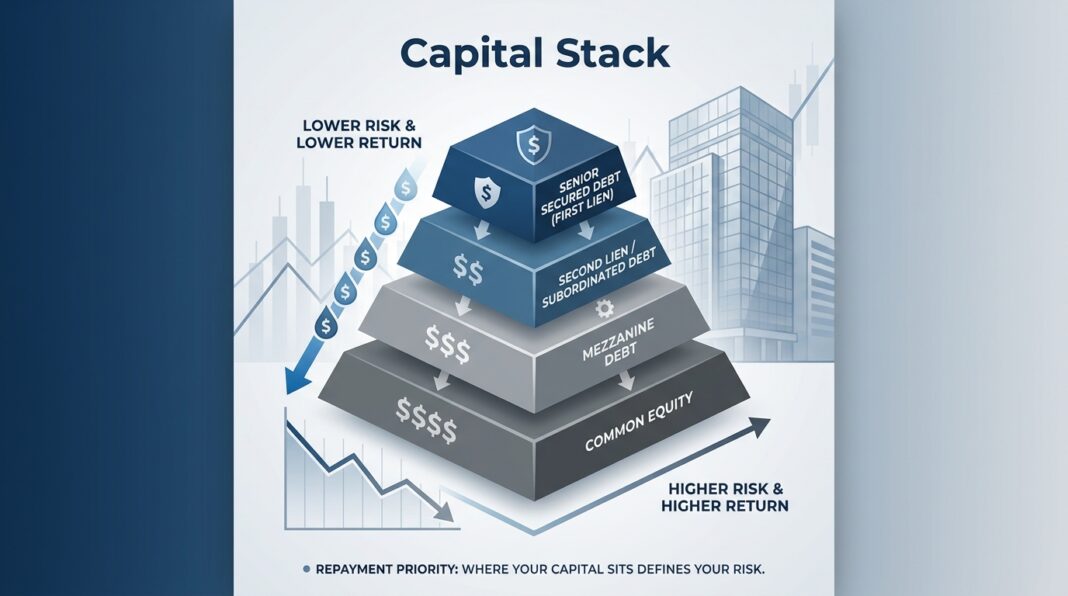
The capital stack is the ordered hierarchy of all financing sources used to fund a company, ranked by repayment priority in the event of default or liquidation. Think of it as a waterfall: in a distress scenario, water (cash) flows from the top down, and whoever is at the bottom gets wet last — or not at all.
From most senior to most junior, a typical leveraged buyout capital stack looks like this:
- Senior Secured Debt (First Lien) — Repaid first; secured by a first-priority claim on company assets. Lowest yield, lowest risk.
- Unitranche Debt — A blended single-tranche instrument combining senior and subordinated elements, commonly used in middle-market direct lending to simplify structure.
- Second Lien / Subordinated Debt — Repaid only after first-lien holders are made whole. Carries meaningfully higher interest rates to compensate for subordination risk.
- Mezzanine Debt — Sits between subordinated debt and equity; often carries equity participation features such as warrants. Higher risk, higher return.
- Preferred Equity — First equity claim, but paid after all debt in liquidation. Fixed dividend, limited upside.
- Common Equity — Last in line. Bears maximum risk, but captures all residual upside if the business thrives.
As Corporate Finance Institute explains, each layer carries a different risk-return profile, and a well-structured capital stack allows businesses to raise capital at the lowest blended cost while giving each investor class the risk exposure they are seeking.
A Concrete Example: The $50M Leveraged Buyout
Consider a private equity firm acquiring a manufacturing company for $50 million. The firm structures the deal as follows:
- $25M Senior Secured Term Loan (First Lien) — Rate: SOFR + 375 bps (~7.5% all-in). Secured by all company assets.
- $10M Second Lien Loan — Rate: SOFR + 750 bps (~11.0% all-in). Paid only after the first-lien is repaid.
- $5M Mezzanine Note — Rate: 13% cash + 2% PIK (payment-in-kind), with equity warrants. Paid after both lien positions.
- $10M Common Equity — Contributed by the private equity sponsor. Last in line; all residual value accrues here.
Now suppose the company encounters difficulty and is sold in a distressed process for only $32 million. Here is how proceeds flow:
- The $25M first-lien lender is paid in full. ✓
- The $10M second-lien lender recovers $7M of their $10M principal — a partial loss. ✗
- The $5M mezzanine holder and $10M equity sponsor receive nothing. ✗
This example illustrates subordination risk in its starkest form. The first-lien lender accepted a lower yield precisely because seniority provided structural protection. The equity sponsor accepted total loss risk in exchange for unlimited upside if the company had grown to, say, $80M in value.
Current Market Reality: Where Private Credit Sits Today
Understanding capital stack theory is more actionable when grounded in current market conditions. Several data points from early 2026 sharpen the picture:
According to Long Angle’s Private Credit Investment Guide 2026, direct lending represented 38% of private credit capital raised in H1 2025, reinforcing that senior secured, first-lien structures remain the dominant institutional preference — investors are concentrating at the top of the stack.
The same guide notes that private credit AUM reached over $2 trillion in 2025 and is projected to approach $4.5 trillion by 2030, with banks’ share of U.S. lending as a percentage of GDP declining from 59% in Q4 2008 to 44% as of Q1 2025 — structural white space that private lenders continue to fill, largely at the senior secured level.
According to Coller Capital’s Secondaries Institute (2025), global private credit AUM reached approximately $1.7 trillion at end-2024, with forecasts exceeding $2.6 trillion by 2029. That growth is concentrated in strategies offering seniority and covenant protection — not subordinated or mezzanine.
The Meketa Investment Group Private Credit Primer (April 2024) further notes that private credit financed approximately 85% of leveraged buyouts in 2023, citing Blackstone/LCD data — with most of that activity occurring in first-lien and unitranche structures where lenders maintain maximum seniority.
Default rates for senior secured direct lending have remained historically contained. According to Long Angle (2026), citing Proskauer’s Private Credit Default Index, direct lending default rates have stayed under 4% since 2021 — a testament to the structural protection afforded by first-lien positioning and tight covenant packages.
| Metric | Data Point | Source |
|---|---|---|
| Private Credit AUM (2025 est.) | >$2 trillion | Long Angle, 2026 |
| Direct Lending share of H1 2025 fundraising | 38% | Long Angle, 2026 |
| LBOs financed by private credit (2023) | ~85% | Meketa / Blackstone-LCD, 2024 |
| Direct lending default rate (post-2021) | <4% | Proskauer via Long Angle, 2026 |
| Bank lending as % of U.S. GDP (Q1 2025) | 44% (down from 59% in 2008) | Long Angle, 2026 |
Decision Framework: Two Audiences, One Structure
For Investors Evaluating Private Credit: Capital stack position is one of the first questions to ask when evaluating any private credit fund or direct lending strategy. Investors typically consider whether a fund targets first-lien, unitranche, or subordinated positions — because that choice determines both the expected loss in a default scenario and the yield premium earned for accepting subordination risk. Senior secured strategies have historically offered the best risk-adjusted returns for institutional allocators who prioritize capital preservation, while mezzanine and subordinated strategies may suit investors with higher return targets and longer time horizons who understand that their recoveries in distress will be structurally limited.
For Business Owners Seeking Capital: Where your lender sits in your capital stack has direct implications for your cost of capital and operational flexibility. Senior secured lenders typically impose tighter financial covenants, maintenance tests, and collateral requirements — but they charge you less. Subordinated and mezzanine lenders accept a weaker structural position and price that risk into a higher coupon, and sometimes into equity participation. Operators evaluate this tradeoff carefully: cheaper senior debt conserves cash flow but may constrain strategic flexibility, while more expensive subordinated capital can fund growth that senior lenders alone would not support.
Key Takeaways
- Seniority is structural protection. First-lien lenders have a contractual claim on assets before any junior capital — this is the primary reason senior secured debt carries lower yields and historically lower loss rates.
- Each layer prices its own risk. The spread premium between first-lien and mezzanine debt is not arbitrary; it directly reflects the probability and severity of loss at each position in a liquidation waterfall.
- Private credit is winning at the senior level. With banks retrenching and direct lending representing the largest share of private credit AUM and LBO financing, first-lien private credit has become a mainstream institutional asset class — not a niche one.
- Unitranche simplifies the stack. For middle-market borrowers, unitranche structures consolidate senior and subordinated tranches into one instrument with one lender — reducing execution complexity while maintaining a blended cost of capital between the two layers.
- Know your waterfall before you commit. Whether you are an LP investing in a credit fund or a CFO structuring a leveraged recap, understanding exactly where your capital sits — and what happens to it in a stress scenario — is the most fundamental due diligence step in private credit.


