
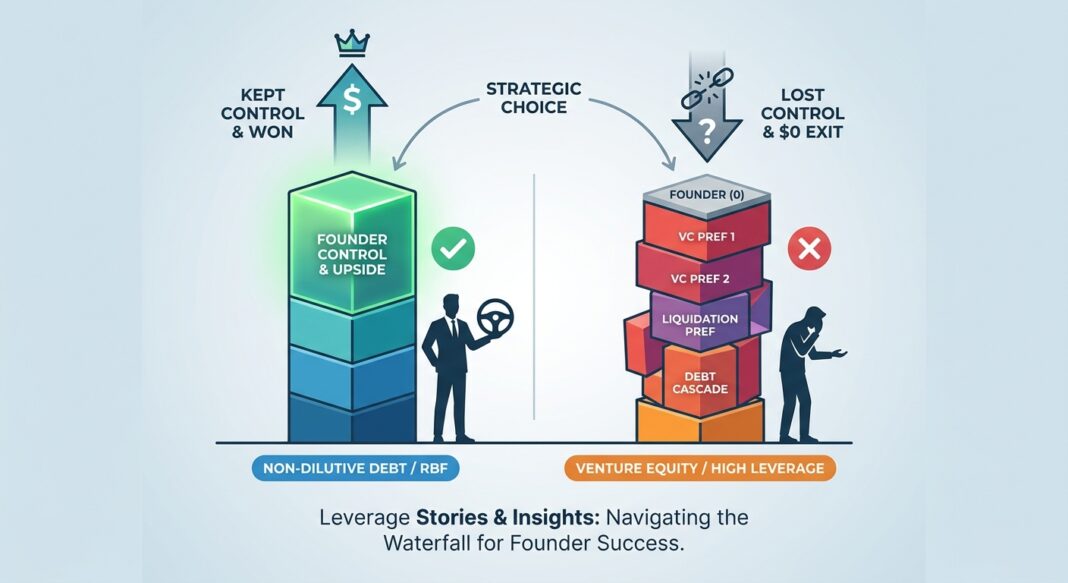
The $1 Billion Exit That Paid Founders Nothing — And the Three Who Got It Right
In January 2025, a rent-to-own startup called Divvy Homes sold to Brookfield Properties for approximately $1 billion. The founders received $0. So did most employees. So did many of the venture investors who had poured money in at a peak valuation of $2.3 billion.
Around the same time, a father-son team in Florida quietly completed their fourth successful exit in fifteen years — using a $1 million non-dilutive debt facility to triple monthly recurring revenue before selling to a Nasdaq-listed public safety firm. Their investors made money. Their team made money. They made money.
Same era. Opposite outcomes. The difference wasn’t the product, the market, or the founders’ talent. It was the capital structure they each chose — and what that structure did to the payout waterfall when the exit finally came.
This is the story that every founder carrying debt, or thinking about raising venture equity, needs to sit with before they sign anything.
Part I — The Story: Three Founders Who Chose Debt and Walked Away Whole
SafePointe: The $1M Facility That Built a Fourth Exit
Greg and Timothy Holifield had been building companies together since 2010 — a partnership born from the years Greg spent on active military duty overseas, missing his son’s high school years. When they finally had the chance to build side by side, they made it count. SafePointe, their AI-based weapons detection company, was the culmination of that journey.
By 2022, SafePointe had modest recurring revenue but a critical problem: as a hardware-enabled SaaS business, winning new government contracts required financing the upfront cost of physical equipment. Their accounts receivable lines were bloated, working capital was tight, and traditional banks didn’t understand the model.
They turned to TIMIA Capital for a $1 million non-dilutive debt facility, drawn in three tranches. No equity. No warrants. No board seats surrendered. The capital went directly into hardware fulfillment for new contracts. Within twelve months, SafePointe had tripled its monthly recurring revenue — and was acquired by SoundThinking, Inc. (Nasdaq: SSTI), a leading public safety technology firm, in a transaction that delivered meaningful returns to all stakeholders, as documented by timiacapital.com.
Greg Holifield’s reflection on the capital choice was blunt: “They think the interest rate is too high, but when there are no warrants associated with debt, it is truly fantastic money — and much cheaper than equity. I love this class of debt.” He noted that equity investors who came in alongside TIMIA made 10x their money in nine months. TIMIA’s debt cost a fraction of that in real economic terms.
Myagi: From Pandemic Pivot to Acquisition, Powered by $2.5M in Non-Dilutive Capital
Simon Turner, co-founder of the retail sales enablement platform Myagi, was two weeks away from launching a major equity round in March 2020 when the pandemic hit. The round evaporated. But something unexpected happened: demand for digital retail solutions surged, and Myagi posted its best six months of growth on record.
Rather than scrambling back to the VC circuit, Simon turned to TIMIA Capital for a $2.5 million non-dilutive investment facility in early 2021. The capital funded a referral-based sales expansion, improved software capabilities, and supported the land-and-expand customer success model. Annual recurring revenue grew from $2.4 million to $4.4 million. In 2023, Myagi was acquired by Rallyware — a performance enablement platform for large-scale sales forces — in an outcome that rewarded the founding team and preserved the company culture they had spent years building, per timiacapital.com.
Simon’s post-exit reflection on venture capital was pointed: “One thing venture capital doesn’t take into account is that many businesses have a natural cadence at which they grow. For many companies, growing too fast can be detrimental to the business as founders try to force growth in a market that can’t sustain it.”
Modigi: $400K, Six Employees, $1.7M ARR — Zero Dilution
Ken Hoppe, CEO of Modigi, built a profitable SaaS company inside the Salesforce ecosystem without a single venture dollar. When he needed working capital to hire his first salesperson and customer success manager, he used Founderpath’s revenue-based financing — $400,000 drawn against his MRR contracts, funded in under 72 hours, with no equity surrendered and no board seats created. The result: $1.7 million in ARR achieved profitably with six full-time employees, and 100% ownership retained by the founding team, as detailed by founderpath.com. Ken is targeting $3–4 million in EBITDA within 24 months.
Part II — The Decision: What Made These Founders Choose Debt?
In each case, the founders faced a recognizable fork in the road: raise venture equity and accept dilution, board influence, and growth-at-all-costs pressure — or use structured debt and retain control, ownership, and operational rhythm.
All three chose debt. And critically, they chose the right kind of debt. Non-dilutive, revenue-secured, warrant-free facilities sized against what the business could realistically service. The debt was additive — a multiplier on existing momentum — rather than a structural transformation of the company’s risk profile.
This is the distinction that matters most. Not all debt is created equal.
Part III — The Contrast: When Debt Becomes a Trap
Now consider Divvy Homes — analyzed in depth by saastr.com — as a masterclass in what happens when debt is structurally mismatched to a business model.
Divvy raised over $400 million in venture equity at a $2.3 billion peak valuation, then layered in approximately $735 million in debt financing in October 2021 — at the height of the zero-interest-rate era, when cheap money made the math look clean. Their model required purchasing homes, and debt seemed like the logical tool to scale that capital-intensive operation.
When interest rates surged in 2022, the model fractured. Three rounds of layoffs followed. New home acquisitions were paused entirely in 2023. The $1 billion Brookfield acquisition in early 2025 looked like a rescue from the outside. From the inside, the waterfall was devastating:
- $735M+ in debt repayment — first in line, no exceptions
- $20–40M in estimated transaction costs
- Remaining proceeds consumed by preferred equity liquidation preferences from Series A through D investors
- $0 remaining for common shareholders, founders, or employees
CEO Adena Hefets wrote to shareholders confirming that after debt repayment and liquidation preferences, neither common shareholders nor founder preferred shares would receive any proceeds. A billion-dollar business. A team that genuinely helped 2,000 families access homeownership. And nothing to show for it financially.
The debt wasn’t reckless in isolation — it was mismatched. The business model was fundamentally interest-rate sensitive, the debt load raised the minimum viable exit far above any realistic outcome, and the 2021 macro environment made the risk invisible until it wasn’t.
Part IV — The Lessons: A Framework for the Capital Decision
What separates the SafePointe outcome from the Divvy outcome isn’t luck. It’s a set of structural disciplines that any founder can apply before signing a term sheet.
1. Model Your Waterfall First
At every plausible exit price — $5M, $20M, $50M, $200M — what do you actually receive after debt, transaction costs, and liquidation preferences are satisfied? If you cannot answer that question today, you are flying blind. Your lenders and your investors have already run this model. You should too.
2. Size Debt to the Business, Not the Opportunity
Modigi drew $400K against $1.7M in ARR. SafePointe drew $1M against a hardware-enabled SaaS business with government contract visibility. The debt was sized to what the business could service and what the expected exit would easily clear. Divvy drew $735M against a model that required rising housing markets and low interest rates to remain solvent. The sizing was existential from day one.
3. Distinguish Additive Debt from Transformative Debt
Revenue-based financing and non-dilutive growth capital are designed to accelerate a business that is already working. They are operational multipliers. Debt that is structurally required to fund core operations — where without it the model doesn’t function — is a different instrument with a fundamentally different risk profile. Know which one you’re using.
4. Respect the Natural Cadence of Your Business
Simon Turner’s most enduring lesson from the Myagi journey was that venture capital demands growth at a pace the market may not support. Debt, used correctly, lets founders grow at the pace the business actually sustains. That rhythm protects margin, culture, and ultimately the exit multiple.
5. Non-Dilutive Doesn’t Mean Free — It Means Senior
The SafePointe and Myagi stories work because the debt was modest, well-structured, and cleared easily at exit. The Divvy story is a reminder that every dollar of debt is a senior claim that sits ahead of you in the waterfall. Non-dilutive capital preserves your ownership percentage — but it does not preserve your outcome if the exit price falls below the debt waterfall. The founders who win are the ones who internalize this distinction before, not after, they sign.
Key Insights
- Debt sized to business fundamentals — not ambition — is the difference between an accelerant and an anchor. SafePointe, Myagi, and Modigi each used debt that the business could realistically service and the exit could easily clear.
- Venture equity brings a growth mandate that can override the natural cadence of a business. Non-dilutive capital lets founders control the pace — and preserve more of the upside when the exit comes.
- The Divvy waterfall is a warning, not an anomaly. Any capital structure with $735M in senior debt requires an exit far above that threshold before founders see a dollar. Model the waterfall before you accept the term sheet.
- Revenue-based and non-dilutive debt facilities are no longer niche instruments. The global RBF market is projected to grow from approximately $9.77 billion in 2025 to $15.86 billion in 2026, reflecting broad adoption among growth-stage founders who want capital without surrendering control.
- The question isn’t debt vs. equity in the abstract — it’s which instrument best aligns with your exit range, business model sensitivity, and founder economics. The founders who ask that question before they raise are the ones who walk away whole.


