
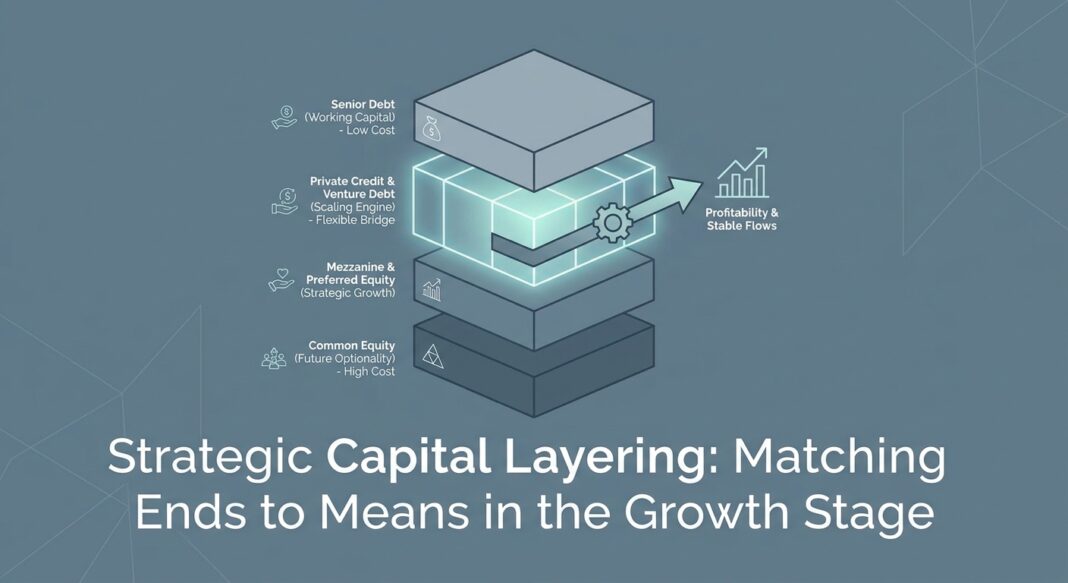
The Growth-Stage Financing Gap: Why the Right Capital Layer Changes Everything
The most consequential capital decisions a founder or operator makes are rarely at the seed stage — they happen in the messy middle: after product-market fit is proven, after the Series A is spent, and before the business generates enough free cash flow to self-fund. This is the growth stage, roughly defined as $2M–$20M in annual recurring revenue for SaaS businesses or equivalent revenue scale for product and services companies. It is also where the wrong capital structure causes the most lasting damage.
The core challenge is a mismatch between what the business needs (capital to scale a repeatable go-to-market engine) and what founders reflexively reach for (another equity round). Equity is the right tool when you are buying optionality and funding experiments. Once your unit economics are validated — customer acquisition cost is predictable, gross margins are stable, net revenue retention is healthy — you are no longer buying optionality. You are financing a scaling engine. That is a debt problem, not an equity problem. The distinction dictates how much of your exit you retain.
Mapping the Capital Stack to Growth-Stage Use-of-Proceeds
Before approaching any capital source, operators must map the specific use-of-proceeds to the capital type best suited to fund it. The capital stack runs from lowest cost and highest seniority at the top to highest cost and lowest seniority at the bottom. Each layer has an appropriate use case:
- Senior Bank Debt (Prime + 2–4%) — Working capital lines, equipment financing, real assets. Banks underwrite against collateral and cash flow coverage. For growth-stage companies without significant tangible assets, direct bank access is limited. Where it is available, it is always the first layer to fill.
- Non-Bank Senior Debt / Private Credit (8–13% all-in) — Scaling the proven go-to-market engine, funding incremental headcount in sales and marketing, financing inventory build-out. Private credit funds have moved aggressively into the $5M–$30M loan range, competing on speed and covenant flexibility. As noted by sources tracking private credit deployment, funds raised over $200B in 2024 and have been actively moving downmarket to capture growth-stage opportunities previously left to venture debt.
- Revenue-Based Financing / Venture Debt (10–18% effective cost + warrants) — Bridge capital between equity rounds, extending runway to a higher-valuation milestone. Venture debt typically requires existing institutional VC sponsorship and is sized at 20–35% of the most recent equity round. Revenue-based financing works without equity backers but requires demonstrable recurring revenue — typically $50K+ monthly recurring revenue with sub-5% monthly churn.
- Mezzanine / Subordinated Debt (14–20% cash + PIK, often with warrant coverage) — Acquisition financing, management buyouts, recapitalizations where senior debt alone cannot reach required proceeds. Mezzanine sits junior to senior debt but senior to equity, absorbing more risk in exchange for a blended return via cash interest, PIK accretion, and equity participation.
- Preferred Equity / Structured Equity (18–25%+ target return) — Situations requiring equity-like flexibility without common equity dilution at current valuation. Preferred equity pays a fixed dividend and carries liquidation preferences but does not require a mandatory repayment schedule. Used when the business cannot service additional debt but needs capital that sits outside the debt stack.
- Common Equity / Venture Capital (25%+ IRR target) — Funding unproven hypotheses, entering new markets, building genuinely new product lines. Equity is the right instrument when the business is buying future optionality, not financing a repeatable system.
The Access vs. Cost Trade-Off: What Growth-Stage Operators Get Wrong
The most common structural error at the growth stage is defaulting to equity because it is accessible, not because it is appropriate. An equity round at a $20M valuation that raises $5M costs a founder 20% of the company — on a $100M exit, that is $20M in exit value surrendered. Debt capital serviced at 15% annually on $5M over four years costs approximately $3M in total interest. The difference is $17M in founder wealth, before accounting for option pool refreshes and subsequent round dilution.
The access vs. cost framework forces a discipline: exhaust the cheapest capital layer that your business qualifies for before stepping down the stack. Qualification criteria differ by layer. Senior bank lenders underwrite to coverage ratios and collateral. Private credit lenders underwrite to ARR growth, gross margin, and churn. Revenue-based lenders want cohort data and MRR trajectory. Mezzanine providers want EBITDA or clear line-of-sight to EBITDA. Understanding what each layer underwrites tells you which layers are accessible to your business today and which require milestone progression to unlock.
The Gap Capital Playbook: Four Steps from Quantification to Close
Step 1 — Quantify the Gap with Precision
Define the specific funding gap before approaching any capital source. This means building a bottoms-up model that shows: current cash position, 18-month cash flow projection under base and stress scenarios, the specific use-of-proceeds (headcount, marketing spend, inventory, acquisition price), and the milestone that the capital is designed to reach. Lenders and investors underwrite the gap, not your ambition. A precise gap figure — “we need $4.2M to fund 14 months of sales team expansion to reach $5M ARR at 90% confidence” — is fundable. “We need growth capital” is not.
Step 2 — Prepare Lender-Grade Materials
Growth-stage capital processes require materials calibrated to the underwriting criteria of the target capital layer. For debt providers, this means 24 months of bank statements, accrual-basis financials, a detailed ARR bridge, cohort retention analysis, and a unit economics dashboard showing CAC, LTV, payback period, and gross margin by cohort. For structured equity providers, add a cap table with full dilution analysis and a three-scenario exit model. Debt providers do not fund pitch decks — they fund documented cash flow visibility.
Step 3 — Run a Parallel Process Across Three to Five Sources
Contact multiple capital providers simultaneously across the relevant layers of the stack. For a growth-stage company needing $5M–$10M, this typically means approaching two to three private credit or revenue-based lenders, one to two venture debt providers if VC-backed, and potentially one mezzanine provider as a fallback. Running parallel processes creates negotiating leverage. Never reveal that a single provider is your only option — this signals weakness and compresses term quality.
Step 4 — Negotiate Structure, Not Just Headline Amount
The headline loan amount is the least important term to negotiate. The terms that define the economic outcome are: the repayment percentage or amortization schedule (affects operating cash flow flexibility), covenant package (revenue floors, minimum liquidity requirements, and EBITDA covenants that can trigger technical defaults), prepayment provisions (critical if you plan to refinance on better terms after hitting milestones), warrant coverage (on venture debt, 0.5–1.5% warrant coverage is standard; push to the low end and negotiate exercise price at current fair market value), and PIK vs. cash interest split (PIK preserves near-term cash but compounds the repayment obligation — model both scenarios at exit). As frameworks from capital market practitioners note, the fight over covenant structure is often more consequential than the fight over interest rate. A covenant-light structure at 14% can be worth more than a covenant-heavy structure at 11%.
Key Takeaways
- Stage determines instrument: Growth-stage capital with validated unit economics is a debt problem first, an equity problem only when debt capacity is exhausted.
- Use-of-proceeds drives layer selection: Working capital belongs in senior debt; acquisition financing belongs in mezzanine; experiment capital belongs in equity. Mismatching instrument to purpose is the most expensive structural error in private markets.
- Exhaust the cheapest layer first: Every dollar of equity issued before debt capacity is fully utilized represents a structural subsidy to future investors at the founder’s expense.
- Parallel processes create leverage: Running three to five capital providers simultaneously against a precisely quantified gap produces materially better terms than sequential single-provider processes.
- Covenant structure outlasts the interest rate: Negotiate the covenant package as aggressively as the pricing — the operational constraints of a tight covenant package compound negatively across the life of the facility in ways that a 100bps rate difference does not.


