
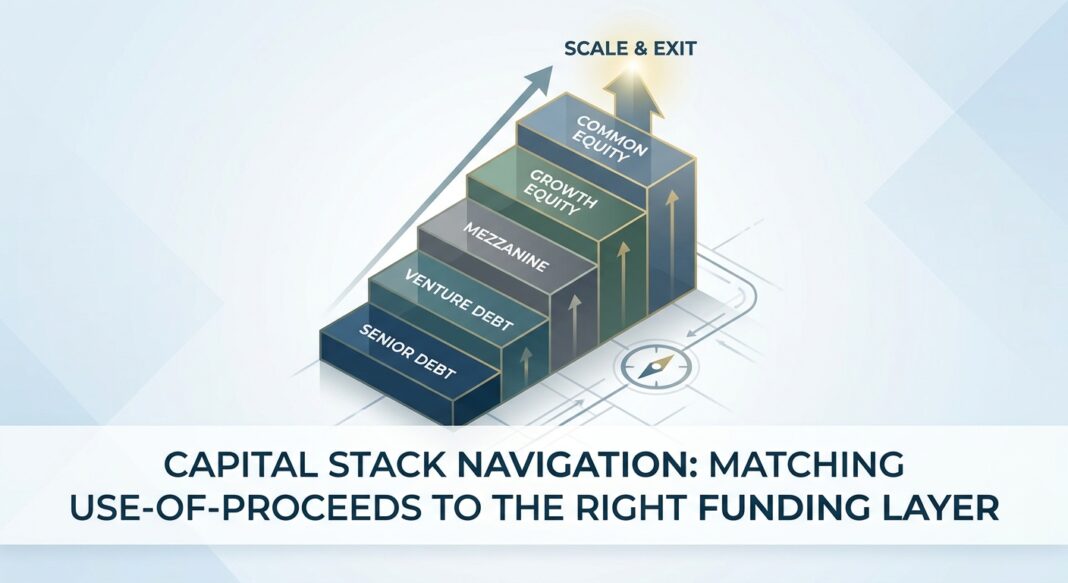
The Growth-Stage Financing Gap: Too Big for the Bank, Too Small for the Buyout Fund
A company crossing $3M–$10M in annual recurring revenue occupies one of the most structurally awkward positions in the capital markets. The business has demonstrated product-market fit, is generating measurable cash flow, and needs capital to scale — but it sits in a no-man’s land between the bank’s credit appetite and the institutional private equity threshold. This is the growth-stage financing gap, and navigating it requires a deliberate, layered approach to the capital stack rather than a reflexive reach for the nearest term sheet.
The core challenge at this stage is a use-of-proceeds mismatch. Growth capital typically funds one or more of the following: sales and marketing headcount, working capital to support revenue ramp, product development, or bolt-on acquisition. Each of these purposes carries a different cash flow profile, a different collateral quality, and therefore a different optimal funding instrument. Treating them as interchangeable leads to expensive, poorly structured capital — or no capital at all.
The Cost of Capital Spectrum: Banks to Equity at the Growth Stage
Before structuring a solution, operators must map where each instrument sits on the risk-return spectrum and what it actually costs — not just in rate, but in dilution, control, and covenant burden. At the growth stage, the accessible universe typically spans the following layers:
| Instrument | Typical Cost | Dilution | Best Use-of-Proceeds |
|---|---|---|---|
| Senior Bank Debt (revolver / term) | Prime + 2–4% | None | Working capital, equipment, receivables |
| SBA 7(a) / SBA 504 | Prime + 2.75% (capped) | None (personal guarantee) | Fixed assets, owner-occupied real estate |
| Revenue-Based / Non-Dilutive Growth Debt | 12–20% effective annual rate | None | S&M spend, payroll bridge, MRR-backed growth |
| Venture Debt | 8–13% + 0.5–2% warrant coverage | Minimal (warrants only) | Runway extension between equity rounds |
| Mezzanine / Subordinated Debt | 14–20% (cash + PIK) | Low–Moderate (equity kicker) | Acquisitions, recapitalizations, gap fill |
| Preferred Equity | 12–18% dividend + liquidation preference | Moderate | Balance sheet strengthening, pre-institutional bridge |
| Growth / Venture Equity (Series A–B) | 20–30%+ IRR hurdle implied | High (20–30% per round) | Product, market expansion, team building |
The practitioner’s rule: match the instrument’s repayment profile to the cash conversion cycle of the use-of-proceeds. Working capital — which cycles within 30–90 days — belongs in a revolving credit facility, not a five-year term note. A strategic acquisition generating long-dated synergies can support longer-tenor mezzanine or subordinated debt. Confusing these creates structural fragility from day one.
As frameworks from capitalxo.com and swingbridgellc.com reinforce, each layer of the capital stack interacts with the layers above and below it. Adding subordinated debt increases total leverage, which can trigger covenant violations on senior facilities and change a senior lender’s risk calculus. The stack must be designed as a system, not assembled instrument by instrument.
Structuring the Gap: Access vs. Cost Trade-Offs at the Growth Stage
The growth-stage capital structure decision is fundamentally a negotiation between three competing variables: cost of capital, dilution of ownership, and operational flexibility. The optimal structure minimizes the blended cost while preserving enough covenant headroom and control to actually execute the growth plan.
A worked example: A B2B SaaS company at $5M ARR, growing 80% year-over-year with 75% gross margins, needs $4M to fund a 12-person sales team build-out and $1M to bridge to a Series B in 18 months. The founding team is unwilling to raise equity at the current implied valuation.
- Layer 1 — Senior revolver ($1M): Drawn against contracted ARR or receivables at Prime + 3%. Services the working capital component. Repaid as collections normalize.
- Layer 2 — Revenue-based growth loan ($3M): Repaid as a percentage of monthly revenue (typically 3–6%) over 24–36 months. No equity. No board seat. Effective rate of 14–18% annually reflects the revenue-linked repayment structure, as providers such as those profiled on angelinvestorsnetwork.com typically underwrite $50K+ MRR with sub-5% monthly churn.
- Layer 3 — Venture debt bridge ($1M, 12-month tenor): Issued concurrently with a minimal warrant package (0.5–1%) to cover the Series B bridge. Converts or repays at the equity close.
Total blended cost on this $5M stack: approximately 15–17% annually. Total equity dilution before the Series B: under 1%. The founder retains full governance control. That is the structural dividend of deliberate stack architecture versus a reflexive equity raise.
The Gap Capital Playbook: Quantify, Prepare, Run the Process
Sourcing gap capital without a process is how companies end up with expensive, poorly structured paper signed under time pressure. The playbook has four steps:
Step 1: Quantify the Need Precisely
Lenders underwrite to specific use-of-proceeds. Vague requests for “growth capital” create friction and signal unsophisticated borrowers. Build a bottoms-up model showing: (a) the specific cash outflows by month tied to the use-of-proceeds, (b) the revenue and cash flow response to those investments, and (c) the payback period for the capital deployed. If sales headcount takes six months to ramp and generate revenue, the model must reflect that J-curve in cash burn before debt service capacity grows.
Step 2: Prepare Lender-Grade Materials
Growth capital lenders — whether revenue-based, venture debt, or private credit — evaluate repayment probability, not vision decks. Standard materials include: 24 months of bank statements, accrual-basis P&L, balance sheet, cohort-level revenue retention data, CAC/LTV analysis, and a forward cash flow model with three scenarios. Clean books are a precondition, not a formality. Lenders treat messy financials as an operational risk signal and decline before diligence completes.
Step 3: Run a Parallel Process Across Instrument Types
Apply to three to five lenders simultaneously across different instrument categories. This serves two purposes: it compresses the timeline (each process runs 30–60 days), and it creates genuine competitive tension on price and terms. Sequencing lenders one at a time eliminates your negotiating leverage entirely. As noted across lendity.com and vcbeast.com, growth-stage processes run materially faster than institutional equity raises — use that speed advantage to control the timeline.
Step 4: Model the Full-Stack Impact Before Signing
Before accepting any term sheet, stress-test the capital stack at three revenue scenarios: base, downside (30% revenue miss), and severe downside (50% miss). Does debt service remain serviceable? Do covenants get triggered? Does the repayment percentage on revenue-based instruments create a cash drain that chokes the growth it was meant to fund? Structure collapses under stress, not in base cases.
Negotiation Guidance: The Five Terms That Actually Matter
Founders and operators routinely over-index on headline rate and under-negotiate the structural terms that govern behavior under stress. Five points deserve the most attention:
- Repayment percentage (revenue-based instruments): The difference between 5% and 8% of monthly revenue is immaterial when revenue is rising — and catastrophic when it contracts. Push for the lower percentage and accept a modestly higher payback cap instead.
- Prepayment penalty: Eliminate it where possible. Prepayment flexibility lets you refinance into cheaper capital if growth accelerates or if a strategic equity round closes early.
- Covenant design: Maintenance covenants (tested monthly or quarterly against a fixed threshold) create constant default risk. Incurrence covenants (triggered only by a specific action) provide materially more operating room. Know which type is in the agreement before you sign.
- Warrant coverage and strike price: On venture debt and mezzanine, warrant coverage of 0.5–1% is standard. Anything above 2% warrants pushback. Negotiate strike price at current fair market value — not at a discount that front-loads dilution.
- Personal guarantee: Growth-stage debt secured by business assets and revenue should not require a personal guarantee. This is a negotiating point, not a fixed market standard. If a lender insists and cannot be moved, it is a signal about their confidence in the underlying credit — which should inform your own confidence in the structure.
Key Takeaways
- Match instrument to use-of-proceeds: Working capital belongs in revolvers. Long-dated synergies belong in term debt or mezzanine. Mismatching creates structural fragility before operations begin.
- The capital stack is a system: Each new layer changes the risk calculus for every layer above and below it. Model the full stack under stress before committing to any single instrument.
- Run a parallel, competitive process: Applying to multiple instrument types simultaneously compresses timelines and creates the negotiating leverage that sequential processes destroy.
- Structural terms matter more than headline rate: Covenant design, prepayment flexibility, and warrant coverage determine how the capital behaves under pressure — which is exactly when it matters most.
- Non-dilutive instruments preserve more exit value than they cost: At typical growth-stage valuations, the dilution avoided by using structured debt rather than equity frequently exceeds the total interest cost by a multiple — making the blended cost of capital calculation a founder’s most important financial exercise.


