
The Growth Stage Capital Challenge: Too Big for the Bank, Too Early for the Market
A company generating $8M–$15M in annual revenue occupies a structurally awkward position in the capital markets. It has outgrown the simple bank line of credit that funded its early working capital needs, but it has not yet reached the scale, predictability, or public profile to access broadly syndicated leveraged loans or public high-yield bonds. This is the growth stage gap — and it is precisely where capital structure decisions carry the highest strategic consequence.
At this stage, the use-of-proceeds is almost never one-dimensional. A growth-stage business is simultaneously managing working capital cycles, funding organic sales expansion, considering a bolt-on acquisition, and perhaps beginning to think about how founders eventually monetize. Each of those objectives draws on a different layer of the capital stack — and confusing them is one of the most expensive mistakes an operator can make.
The Cost of Capital Spectrum: What Each Layer Actually Costs You
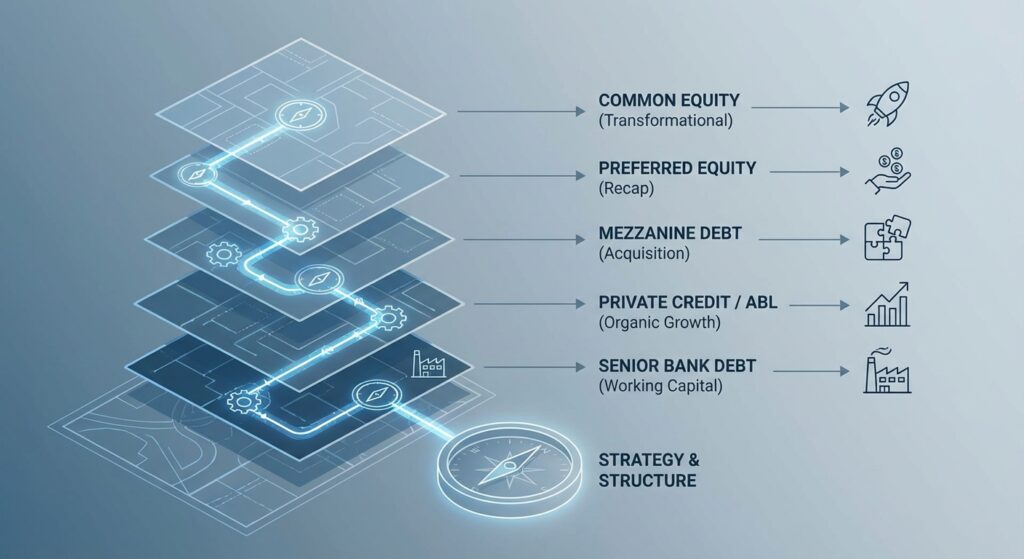
The capital stack is best understood as a risk-return hierarchy. As outlined by corporatefinanceinstitute.com, each layer carries a distinct risk profile that directly determines its price. From cheapest to most expensive, the growth-stage spectrum looks like this:
- Senior Bank Debt (Revolving Credit + Term Loan A): Typically SOFR + 175–300 bps for well-collateralised borrowers. Requires real assets, strong DSCR (usually 1.25x minimum), and covenant compliance. Covers working capital and capital expenditure with predictable repayment. This is the foundation layer — use it first, use it fully, but understand its ceiling.
- Asset-Based Lending (ABL): Priced similarly to senior bank debt but sized against a borrowing base — accounts receivable, inventory, and eligible assets. As noted by capitalxo.com, ABL suits businesses with strong asset cycles but lumpy EBITDA, such as distributors, manufacturers, and seasonal retailers.
- Private Credit / Unitranche: Direct lenders price unitranche facilities at SOFR + 450–650 bps for growth-stage borrowers, blending what would otherwise be a senior/mezzanine split into a single instrument. The cost is higher than bank debt, but the execution speed, covenant flexibility, and hold size ($10M–$100M) make it the dominant tool for sponsor-backed and founder-owned growth companies in 2025–2026.
- Mezzanine / Subordinated Debt: Cash interest of 10–13%, often with a PIK (payment-in-kind) component of 2–4% and a small equity kicker via warrants covering 1–3% of fully diluted equity. Mezzanine fills the gap when total leverage exceeds what senior lenders will underwrite — typically deployed to fund acquisitions or recapitalisations where the acquisition target’s EBITDA is not yet in the run rate.
- Preferred Equity: Return expectations of 14–18%, structured with a liquidation preference and sometimes a participating feature. Used when debt capacity is exhausted but the founder is not ready to sell common equity at current valuations.
- Common Equity (Private): The most expensive capital in absolute return terms — growth equity investors target 25–35% IRR — but carries no mandatory cash service obligation. As adaptcfo.com notes, common equity investors accept last-in-line payment risk in exchange for uncapped upside. Use it when the business is funding something genuinely experimental or transformational — not to refinance existing debt.
Structural Breakdown: Matching the Use-of-Proceeds to the Right Layer
The cardinal rule of capital stack design is that the instrument should match the risk profile and duration of the asset or initiative it funds. Here is how that mapping works in practice for a growth-stage business:
| Use of Proceeds | Optimal Layer | Why It Fits |
|---|---|---|
| Working capital / receivables | ABL revolver / senior bank line | Self-liquidating; assets cycle back to cash within 30–90 days |
| Equipment / capex | Senior term loan / equipment finance | Asset life matches loan amortisation; lender has tangible collateral |
| Organic growth / hiring / go-to-market | Unitranche / private credit | Cash-flow based; lender underwrites forward EBITDA; no hard collateral required |
| Bolt-on acquisition | Senior + mezzanine or unitranche with delayed-draw tranche | Blends leverage capacity; mezzanine bridges the equity gap at deal close |
| Founder partial liquidity / recap | Preferred equity or structured growth equity | Provides founder monetisation without a full control sale; preserves upside |
The Gap Capital Playbook: Quantify, Prepare, Run, Negotiate
Once the use-of-proceeds is mapped to the right layer, the execution process follows four disciplined steps.
Step 1 — Quantify the Gap: Start with a rolling 13-week cash flow model, then extend to a 36-month operating forecast. Identify the precise moment and magnitude of the capital shortfall. Do not round up aggressively — lenders underwrite to the model, and over-borrowing increases covenant risk. Size the facility to cover the need plus a 15–20% operational buffer, not to the maximum leverage the market will permit.
Step 2 — Prepare the Materials: A credible capital raise at the growth stage requires: (a) three years of audited or reviewed financials, (b) a detailed use-of-proceeds schedule tied directly to the operating forecast, (c) a management presentation that explains the business model, competitive moat, and growth thesis, and (d) a debt capacity analysis showing pro-forma leverage ratios and DSCR at close and across the forecast period. As lendity.com highlights, growth-stage founders frequently under-prepare this materials package, which compresses the quality of lender competition and ultimately hurts pricing.
Step 3 — Run a Structured Process: Approach at least three to five lenders across different parts of the capital stack simultaneously — one or two traditional banks, two direct lenders, and one mezzanine or preferred equity provider. This creates genuine competition even if the intention is to use a single-tranche unitranche. Term sheets from competing lenders give you leverage on pricing, OID (original issue discount), and covenant flexibility. Never negotiate from a single term sheet.
Step 4 — Negotiate the Structure: The five most negotiable terms in a growth-stage deal are: (1) the leverage covenant level and step-down schedule, (2) the equity cure right (the ability to inject equity to cure a covenant breach), (3) the definition of EBITDA — specifically which addbacks are permitted, (4) the call protection or prepayment premium schedule, and (5) the size and composition of the permitted acquisition basket. Founders and operators frequently spend all their negotiating energy on the interest rate, which is the least flexible element. Covenant design and basket sizes have far more day-to-day operational impact.
Key Takeaways
- Match instrument to purpose: Working capital belongs on a revolver; growth investment belongs in a cash-flow term loan; acquisition gaps belong in mezzanine. Mismatching raises the blended cost of capital and increases structural stress.
- Use the full spectrum deliberately: The cheapest capital (senior bank debt) should be exhausted before moving up the cost-of-capital ladder. Each incremental layer is more expensive — use it only when the return on the funded initiative justifies it.
- Competition creates structure: Running three to five lenders in parallel is the single most effective lever a borrower has on pricing and terms. A sole-sourced deal is a gift to the lender, not the borrower.
- Covenant design is the real negotiation: Interest rate spreads compress over a deal’s life; restrictive covenants do not. Prioritise headroom on leverage ratios, EBITDA definitions, and permitted baskets over a 25 bps reduction in spread.
- Equity is a last-resort growth tool, not a first call: As vcbeast.com illustrates through the full funding arc from seed to IPO, each equity round compounds dilution irreversibly. Reserve common equity for moments when it genuinely unlocks a step-change in enterprise value — not to plug a gap that structured debt could fill at a fraction of the ownership cost.


