
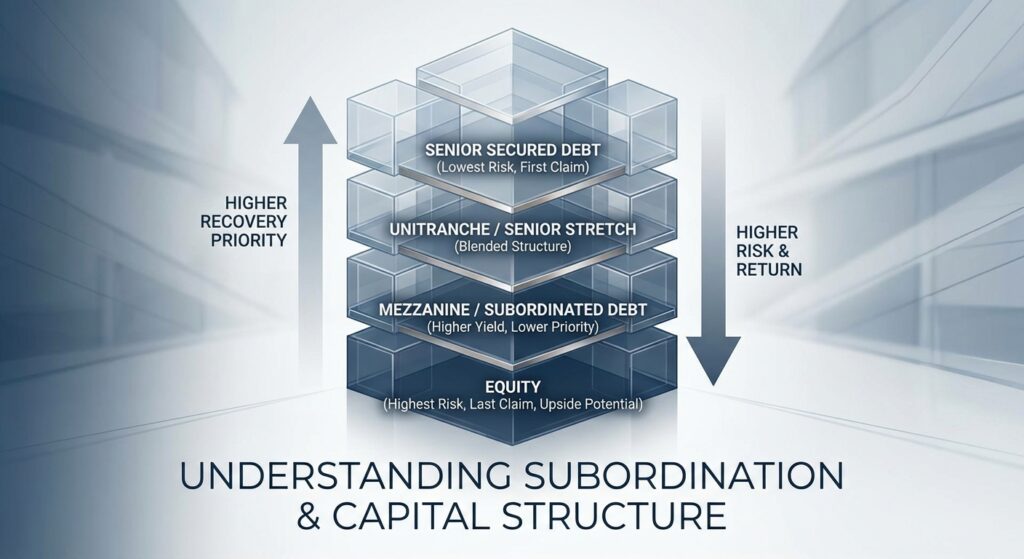
Where You Sit Determines What You Get
In private credit, the single most important structural question is not the interest rate on a loan — it is where that loan sits in the capital stack. Position within the stack determines who gets paid first when cash flows are tight, who recovers first if a borrower defaults, and therefore how much risk a lender is actually taking on. Understanding subordination — the legal and contractual ordering of claims — is the foundational concept that separates sophisticated capital allocation from guesswork.
Every business that uses external funding has a capital stack, whether its owners designed it deliberately or not. As CapitalXO describes it, senior lenders sit at the top with first claim on cash flows and collateral, equity holders sit at the bottom absorbing risk first and getting paid last, and mezzanine or subordinated instruments fill the middle. That ordering is not arbitrary — it directly drives the cost of each layer of capital. Senior debt is cheapest because it carries the least risk. Equity is the most expensive because investors demand higher returns to compensate for being last in line.
The Four Layers and How They Function
A complete capital stack typically contains four primary layers, each with distinct risk characteristics and return expectations:
- Senior Secured Debt: First-lien loans backed by specific collateral (assets, receivables, intellectual property). In a liquidation event, these creditors are paid before anyone else. Lowest yield, highest recovery rates.
- Unitranche / Senior Stretch: A blended structure that combines first- and second-lien economics into a single facility, increasingly common in the middle market. More on this below.
- Mezzanine / Subordinated Debt: Sits below senior debt in priority. Lenders here accept a higher probability of impairment in exchange for higher coupon rates, often with equity warrants or PIK (payment-in-kind) features attached.
- Equity: Common and preferred equity holders are last in line. They bear the first losses but capture all the upside if the business performs well. Highest expected return, highest volatility.
A Concrete Example: The $50M Middle-Market Buyout
Consider a private equity firm acquiring a manufacturing company for $50 million. The capital structure might look like this:
- $30M — Senior Secured Term Loan (60% of capital) at SOFR + 550 bps (roughly 10.3% all-in as of early 2026). First-lien claim on all assets. If the company is sold or liquidated, this tranche is repaid first.
- $10M — Mezzanine Note (20% of capital) at 14–16% (cash or PIK). Subordinated to senior debt. Recovers only after the senior lender is made whole.
- $10M — Equity (20% of capital) contributed by the PE sponsor. No contractual return. Absorbs the first $10M of value loss before either debt tranche is impaired.
Now stress-test the structure: if the business declines in value to $35M, the senior lender is still fully covered. The mezzanine holder recovers $5M of their $10M — a 50% loss. The equity holder is wiped out entirely. This is subordination in action: the same economic event produces radically different outcomes depending on position. The senior lender’s $30M equity cushion (the $20M in junior capital sitting below them) provided meaningful downside protection.
Why This Matters in the Current Market
Private credit has grown into a $2+ trillion asset class globally, and that growth has made capital stack discipline more important than ever — not less. According to Long Angle’s Private Credit Investment Guide 2026, bank lending as a share of U.S. GDP has fallen from 59% in Q4 2008 to 44% as of Q1 2025, and private credit managers have stepped in to fill that void. As direct lenders increasingly originate the full capital structure — rather than simply participating in a syndicated stack alongside banks — their stack-positioning decisions carry outsized consequences.
The stress testing playing out in early 2026 reinforces this. According to Capital Founders OS (March 2026), Cambridge Associates data shows private credit default rates running at 1.45% versus 3.37% for broadly syndicated loans — a meaningful outperformance that is partly attributable to the structural protections built into senior direct lending positions. When loans are well-secured and sit at the top of a properly cushioned stack, recovery rates remain strong even when defaults occur.
However, Atlas Peak Research (March 2026) notes that market stress in early 2026 has concentrated in vehicles where illiquid middle-market loans were packaged inside semi-liquid structures — an important reminder that structure risk is not limited to credit quality. How capital is layered matters at the fund level, not just the deal level.
Decision Framework: Investors and Operators
For Investors Evaluating Private Credit: Stack position should be the first filter, not an afterthought. Senior secured direct lending offers the most structural protection: first-lien claims, documented covenants, and the equity cushion of junior capital absorbing initial losses. Investors considering mezzanine or subordinated strategies should evaluate the size of that cushion carefully — how much junior capital sits below them, and at what enterprise value does their position become impaired? With SOFR at approximately 4.3% in early 2026, senior direct lending can deliver 10–12% all-in yields without requiring investors to reach down the risk curve into subordinated or equity-like instruments. Understanding what they are giving up in stack seniority for any incremental yield is a critical analytical discipline.
For Business Owners and Operators Raising Capital: The capital stack is a system, not a series of isolated financing decisions. Adding a mezzanine layer to reduce equity dilution makes mathematical sense only if the blended cost of that debt-plus-mez structure is lower than the implied cost of additional equity. Operators should map the full stack before approaching any single lender — knowing what’s already senior to a proposed loan helps them anticipate what terms a new lender will require, and whether the overall structure remains serviceable under a realistic stress scenario.
Key Takeaways
- Position determines protection: Senior secured lenders benefit from the equity cushion of all junior capital beneath them. The thicker that cushion, the more insulated the senior position from real economic losses.
- Yield reflects seniority: Moving down the stack from senior to mezzanine to equity increases expected return — but also increases the probability and magnitude of loss in a stress scenario. Investors should evaluate whether incremental yield compensates for that structural exposure.
- The equity cushion is the lender’s margin of safety: A 20% equity contribution in a buyout means the business must lose more than 20% of its enterprise value before the senior lender’s principal is at risk. This is the practical application of loan-to-value discipline.
- Private credit’s edge is structural, not speculative: The lower default rates observed in direct lending versus broadly syndicated loans reflect not just underwriting quality, but the structural protections — covenants, collateral, and seniority — built into well-constructed stacks.
- Operators should design the stack, not assemble it by accident: Each financing decision interacts with every other layer. A deliberate, architecturally sound capital structure minimizes blended cost of capital, preserves operational flexibility, and avoids covenant conflicts between competing lenders.


