
The Underwriting Question Every Credit Officer Must Answer
Imagine you are underwriting a $40 million senior secured term loan to a specialty manufacturing company with $10 million in trailing twelve-month EBITDA. The sponsor is projecting 12% revenue growth over the next three years. The deal prices at 4.5x total leverage. It looks clean on paper.
Now ask the harder question: What happens when the cycle turns?
History is unambiguous on this point. Middle market companies are disproportionately exposed to revenue volatility, customer concentration, and input cost shocks. According to the Basel Committee on Banking Supervision’s 2025 updated Principles for the Management of Credit Risk, sound credit-granting processes must evaluate not just a borrower’s current financial condition but its capacity to service debt under adverse economic scenarios — a discipline the Committee identifies as central to maintaining portfolio integrity across credit cycles. (bis.org)
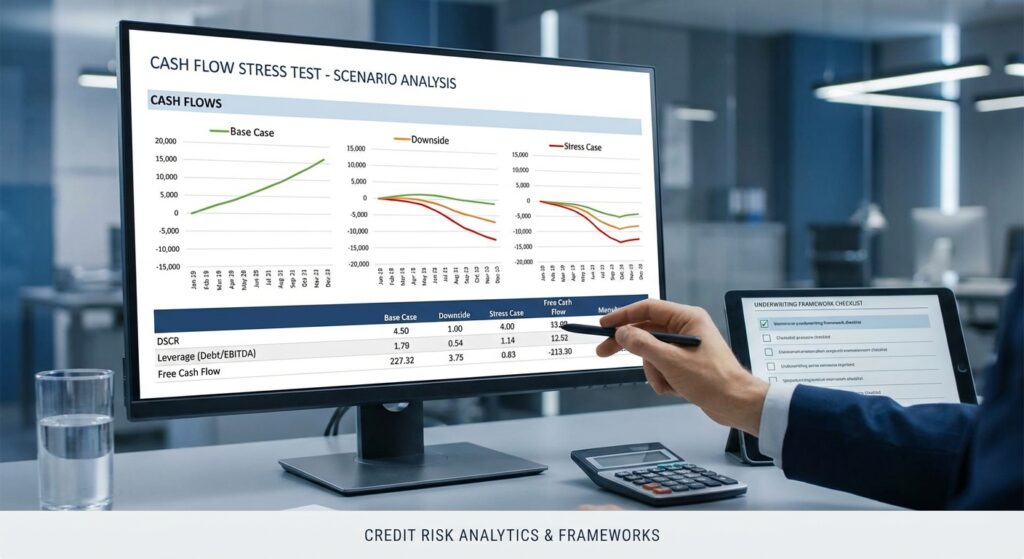
Stress testing cash flows is not a box-checking exercise. It is the single most important tool a credit underwriter has for distinguishing a resilient capital structure from a fragile one. This guide walks through a practitioner-level framework for building, running, and interpreting stress scenarios — with a worked example anchored to a $10 million EBITDA manufacturing borrower.
The Analytical Framework: Three-Scenario Cash Flow Architecture
Institutional credit teams typically structure stress testing around three discrete scenarios built off a rigorously constructed base case. Each scenario applies independent or correlated shocks to revenue, margins, working capital, and capital expenditures. The framework is not speculative — it is calibrated to observed historical downturns in the borrower’s sector.
Step 1 — Build a Clean Base Case
The base case is not the sponsor’s model. It is your model, anchored to audited historical financials, normalized for non-recurring items, and validated against industry benchmarks. For a $10 million EBITDA specialty manufacturer, this means:
- Adjusting for owner compensation above market rate (common in sponsor carve-outs and founder-owned businesses)
- Reversing one-time restructuring charges only when supported by documentation
- Normalizing working capital seasonality over a full operating cycle
- Verifying capital expenditure run-rates against maintenance capex disclosures in the CIM and fixed asset schedules
The CFA Institute’s credit analysis curriculum identifies expected exposure, probability of default, and loss given default as the three core inputs to any credit risk model — all three are downstream of how clean your base case cash flow is. (cfainstitute.org)
Step 2 — Define the Three Scenarios
| Scenario | Revenue Shock | EBITDA Margin Impact | Rationale |
|---|---|---|---|
| Base Case | +5% YoY growth | Flat at 22% | Conservative sponsor case with no credit given to growth initiatives |
| Downside Case | −10% YoY decline | −200 bps compression | Mild recession, freight and raw material cost inflation |
| Stress Case | −25% YoY decline | −450 bps compression | Severe demand shock, modeled on 2008–2009 industrial sector drawdowns |
Walking Through the Calculations
Using our $10 million EBITDA manufacturer as the anchor, here is how each scenario flows through to debt service capacity. Assume $40 million total debt at a blended cash interest rate of 8.5%, $1.5 million mandatory amortization annually, and $2.0 million normalized maintenance capex.
Key Metrics at Each Scenario
| Metric | Base Case | Downside | Stress |
|---|---|---|---|
| EBITDA | $10.0M | $8.4M | $6.1M |
| Total Leverage (Debt/EBITDA) | 4.0x | 4.8x | 6.6x |
| Interest Coverage (EBITDA/Interest) | 2.94x | 2.47x | 1.79x |
| Debt Service Coverage Ratio (DSCR) | 1.55x | 1.30x | 0.94x |
| Free Cash Flow After Debt Service | +$2.3M | +$0.9M | −$0.4M |
The stress case is the critical signal: a DSCR below 1.0x means the borrower cannot service debt from operating cash flow alone. In this scenario, the company would require revolver draws, asset sales, or equity cures to remain current — all of which introduce execution risk and subordinate lender control.
As documented in LBO debt capacity research, total leverage in most current middle market deals ranges from 4.0x to 5.0x EBITDA — a meaningful compression from the 6.0x-plus levels seen in the prior low-rate cycle. This tighter underwriting standard exists precisely because stress scenarios like the one above expose the fragility of over-levered structures. (ibinterviewquestions.com)
What Institutional Lenders Look For — and Where Deals Break Down
Experienced credit officers evaluate stress test outputs through a specific lens: not whether the borrower survives the base case, but how much cushion exists before a covenant is breached in the downside, and whether the lender retains meaningful remedies if the stress case materializes.
📊 Credit Performance Reference Points
- The Basel Committee’s 2025 credit risk principles emphasize that banks must stress test credit portfolios under both idiosyncratic and systemic scenarios, with particular attention to concentration risk and correlated defaults. (bis.org)
- CFA Institute credit modeling frameworks identify that loss given default (LGD) for senior secured middle market loans is materially influenced by collateral coverage ratios and the lender’s ability to enforce remedies at covenant breach — not just at default. (cfainstitute.org)
- Deals with maintenance covenants set at 35%+ headroom to base case EBITDA provide lenders with an early-warning trigger well before cash flow stress becomes a liquidity event.
- A risk-based enhanced due diligence approach — endorsed by the Financial Action Task Force and adopted across institutional lending — requires that underwriters not only model financial scenarios but also assess borrower operational controls, management depth, and governance quality as non-financial stress amplifiers. (wns.com)
Common Red Flags in Stress Test Reviews
- Aggressive revenue recovery curves: Sponsors frequently model a V-shaped recovery in Year 2 of a downside. Experienced lenders flatten these curves and test for L-shaped or prolonged trough scenarios.
- Fixed cost rigidity ignored: Manufacturing and healthcare services businesses often have high fixed cost bases. A 10% revenue decline can produce a 25–35% EBITDA decline when operating leverage is not modeled correctly.
- Capex treated as fully discretionary: Maintenance capex cannot be deferred indefinitely. Lenders should sensitize for deferred capex catch-up costs in Year 3 and Year 4 of a stress scenario.
- Working capital treated as neutral: In a revenue contraction, receivables collection slows and inventory liquidation can impair margins. Cash flow models that ignore working capital drag in downturns systematically overstate liquidity.
Credit Underwriting Checklist: Cash Flow Stress Testing
- ✅ Normalize trailing twelve-month EBITDA — remove all non-recurring items with supporting documentation; do not rely on management-prepared adjustments without independent verification.
- ✅ Validate revenue assumptions — confirm customer concentration, contract duration, renewal rates, and pricing power; identify the top five customers and model their individual loss impact.
- ✅ Map fixed vs. variable cost structure — calculate contribution margin and break-even revenue threshold to determine how quickly EBITDA deteriorates in a volume decline.
- ✅ Segregate maintenance from growth capex — require borrower to provide itemized capex schedules; confirm with engineering or operational due diligence where available.
- ✅ Model working capital dynamically — build a monthly cash flow model for the first twelve months to identify seasonal liquidity troughs and revolver dependency.
- ✅ Calculate covenant headroom at each scenario — identify the EBITDA level at which the maintenance leverage covenant is breached; ensure downside case provides at least 20–30% headroom.
- ✅ Test debt service coverage below 1.0x — if the stress case produces a DSCR below 1.0x, document what remedies are available: equity cure rights, asset sale baskets, revolver availability.
- ✅ Document scenario assumptions transparently — every stress test input must be tied to a verifiable historical precedent or sector benchmark, not internal modeling convention.
Key Takeaways
- 🔹 The base case is not the stress test. Institutional credit discipline requires running a true downside and a severe stress scenario — not optimistic, base, and slightly-less-optimistic cases.
- 🔹 DSCR below 1.0x in the stress case is a structural warning. It signals the debt load is dependent on a benign environment and leaves the lender without meaningful cash flow protection in a downturn.
- 🔹 Operating leverage is as important as financial leverage. A high fixed-cost business at 4.0x debt/EBITDA can be more fragile than a variable-cost business at 5.0x when revenue contracts.
- 🔹 Covenant headroom is an early warning system, not a technicality. Maintenance covenants set with meaningful tightness relative to base case EBITDA give lenders intervention rights before liquidity deteriorates.
- 🔹 Cash flow stress testing must connect to recovery analysis. If cash flows fail in the stress case, the next question is: what does the lender recover, and over what timeline? Collateral coverage and liquidation value analysis should run in parallel with every stress test.


