
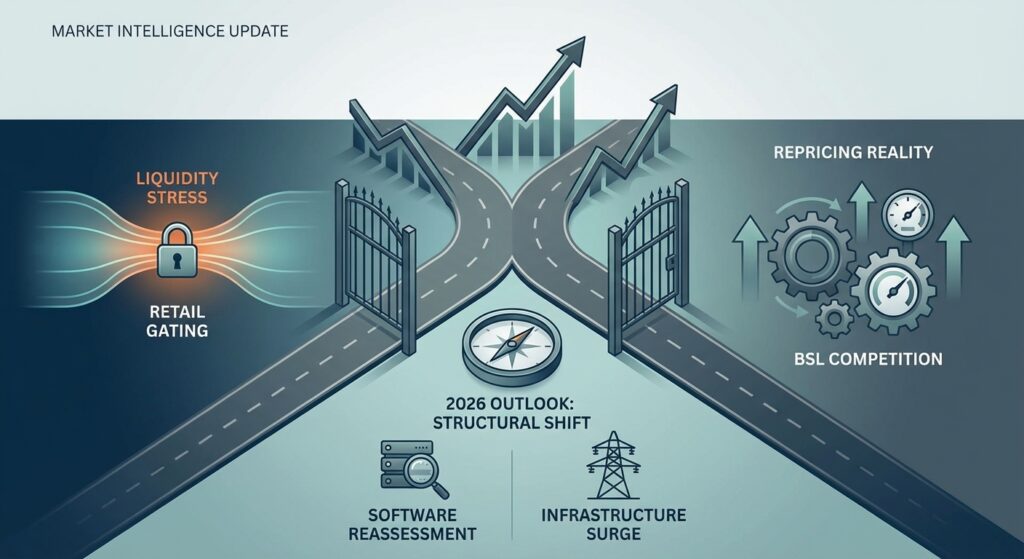
Market Headline: The Great Repricing and the Liquidity Test
As of late March 2026, the global private credit market—now estimated at $3.5 trillion—is navigating a pivotal transition from unchecked expansion to a structural reality check. While the asset class remains robust, cracks have emerged in specific segments, most notably within wealth-channel products and the software sector. The narrative has shifted from “yield at any cost” to “liquidity and valuation credibility.”
The defining development of Q1 2026 has been the divergence between institutional drawdown funds, which remain stable, and semi-liquid “evergreen” structures catering to retail investors. Following the closure of a major $1.6 billion redemption window by a leading manager in February, market participants are acutely focused on liquidity mismatches. Simultaneously, the broadly syndicated loan (BSL) market has roared back with record repricings, forcing private lenders to compete aggressively on terms or retreat to more complex, lower-middle-market deals.
Quantitative Snapshot: Q1 2026 Market Metrics
| Metric | Current Level | Change / Context | Source |
|---|---|---|---|
| Private Credit Default Rate | 2.46% (Proskauer Index) | Up from 1.84% in Q3 2025; rising stress. | LongYield |
| Software Loan Maturity | 46% maturing < 4 years | Valuation reassessment creates refinance risk. | LongYield |
| Borrower Leverage Stress | 40% with Negative FCF | High dependence on PIK toggles/refinancing. | LongYield |
| Deployable Capital | $592.8B (2024 Full Year) | Record levels; continued pressure to deploy. | LongYield |
| Global Market Size | ~$1.34T (US), ~$2T (Global) | Estimates vary by definition (AUM vs. Committed). | Atlas Peak |
Sector Analysis: The Software Reset and Power Surge
Software & Technology: Historically the bedrock of private credit portfolios, software is now identified as a primary “pressure point.” Lenders are reassessing valuations for recurring-revenue businesses that lack near-term profitability. With 46% of software loans facing maturities within four years and valuations under scrutiny, the “mark-to-model” reliance is being tested. Lenders are demanding tighter covenants and lower attachment points for new deals.
Power & AI Infrastructure: Conversely, capital is flocking toward physical infrastructure supporting Generative AI. The power sector is seeing robust lending activity as data center demand outstrips supply, offering lenders tangible asset backing compared to intellectual property-heavy tech deals. Volatility tied to AI developments has added complexity, but also opportunity for lenders capable of underwriting complex physical transitions.
Semi-Liquid Wealth Products: The “retailization” of private credit is facing its liquidity test. Unlike closed-end institutional funds (5-8 year locks), these evergreen vehicles offered quarterly liquidity that is now being gated in some instances. This structural mismatch is causing a flight to quality, with allocators scrutinizing “liquidity sleeves”—the portion of the fund held in liquid assets to meet redemptions.
Implications for the Quarter Ahead
For Borrowers: The resurgence of the BSL market offers a lifeline for large-cap borrowers to refinance expensive private debt, driving a wedge between large-cap and mid-market execution. For middle-market firms, however, credit availability remains tight, particularly for those with negative free cash flow reliant on Payment-in-Kind (PIK) structures. Expect lenders to push for genuine cash interest coverage over PIK flexibility in 2026.
For Investors/Lenders: The “beta” trade in private credit is effectively over. Performance dispersion between top-quartile managers and the rest is widening significantly. Investors must scrutinize portfolios for “PIK toggles” that artificially inflate income (now exceeding 8% of income for some BDCs) and verify valuation methodologies. The risk has shifted from pure credit default to liquidity and valuation credibility.
Key Market Insights
- Liquidity Bifurcation: Institutional drawdown funds remain stable, while semi-liquid retail funds face redemption stress and potential gating.
- Software Repricing: The valuation reset in software tech is the primary credit risk, replacing general economic cyclicality.
- BSL Competition: Public markets are aggressively taking market share back from private credit via repricings, compressing spreads at the upper end.
- Hidden Leverage: A significant portion of reported yield is coming from PIK (non-cash) income, masking borrower cash flow strain.
- Infrastructure Rotation: Lender appetite is rotating from asset-light software to asset-heavy power and AI infrastructure projects.


