
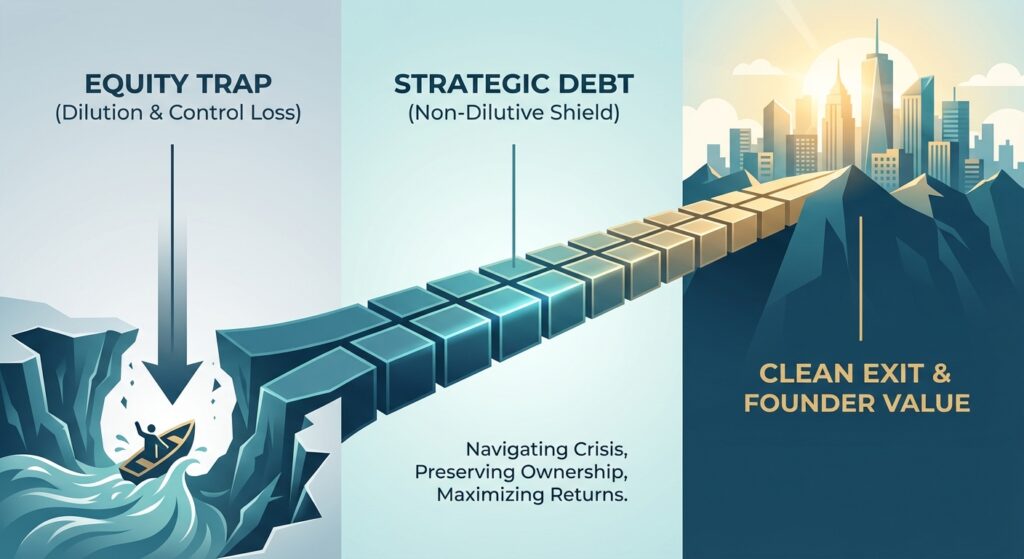
The Equity Trap vs. The Debt Solution
In the high-stakes world of venture-backed technology, the narrative is often binary: raise the next round of equity or die. But for founders who have already achieved product-market fit and revenue traction, the automatic pivot to a Series A or B can sometimes be a strategic error—especially during market dislocations. Raising equity when valuations are compressed isn’t just expensive; it permanently impairs the cap table.
The story of retail sales enablement platform Myagi, and its co-founder Simon Turner, illustrates a third path: using non-dilutive capital to bridge the gap between a growth stall and a successful exit.
The Situation: A Pandemic Curveball
Entering 2020, Myagi was positioned for a classic venture growth trajectory. The company, which provided a digital platform to connect brands and retailers for sales training, had planned a significant equity raise in March 2020. Then the COVID-19 pandemic hit.
As global markets froze, the appetite for equity deployments in retail-adjacent tech wavered. For many founders, this scenario triggers a “down round”—raising cash at a lower valuation than the previous round to keep the lights on. A down round is often devastating for early employees and founders, as anti-dilution provisions from existing investors can wash out common stock value.
However, the business fundamentals told a different story. The pandemic actually accelerated the need for digital retail solutions as in-person sales calls vanished. Myagi experienced its best six months of growth to date. They had the revenue and the opportunity, but they needed cash to capitalize on it without suffering the massive dilution of raising equity in a panicked market.
The Decision: $2.5 Million in Non-Dilutive Capital
Instead of forcing an equity round at a disadvantageous time, Turner and his team looked at the leverage markets. In early 2021, they secured a $2.5 million investment facility from timiacapital.com.
The calculus here is distinct from venture capital. Equity investors bet on 100x outcomes and require ownership/control in return. Debt investors, particularly in the revenue-based financing (RBF) or venture debt space, look at the predictability of Annual Recurring Revenue (ARR), churn rates, and gross margins. They are betting on the company’s solvency, not just its exorbitant growth.
By choosing debt:
- Control remained with the founders: No board seats were ceded, and no new voting rights were diluted.
- The cost was capped: While debt carries interest (and sometimes warrants), the total repayment is finite. Equity dilution is theoretically infinite if the company becomes a unicorn.
- Execution speed: Unlike the 6-9 month roadshow often required for institutional equity, debt facilities based on metrics can often close in weeks.
The Outcome: A Clean Exit
Myagi deployed the capital to enhance its software capabilities and double down on its referral-based sales model. The capital injection allowed them to bridge the gap and prove their post-pandemic value proposition.
Roughly two years later, Myagi wasn’t just surviving; it was acquired by Rallyware. Because the founders had not diluted their ownership stake during the critical 2020-2021 window, the proceeds from the exit flowed more efficiently to the founders and early team rather than being absorbed by a stack of liquidation preferences from late-stage investors.
As Turner noted in the retrospective, “Debt is a powerful tool for capital-efficient businesses when used under the right circumstances.”
Broader Principles: Beyond SaaS
This principle of “Revenue Finance” extends beyond pure software plays. UnityLab (formerly Unity Laundry Systems) provides another instructional data point. Founded by Jonathan Benjamin, UnityLab disrupted commercial appliance purchasing for small businesses.
Similar to Myagi, UnityLab reached a point where it had validated its concept and was generating revenue but needed capital to expand inventory and operations. Rather than seeking early venture capital, which would have valued the hardware-heavy business at a discount compared to software peers, Benjamin utilized revenue-based financing from sagegrowthcapital.com.
The result? UnityLab grew 10x over four years, serving over 25,000 customers. By matching their financing instrument (debt) with their asset needs (working capital/inventory), they avoided the mismatch of using expensive equity dollars to fund inventory cycles.
Key Insights for Founders
When evaluating the choice between a new equity round and a credit facility, consider the following framework:
- The “Cost of Equity” Calculation: Founders often view equity as “free money” because it lacks monthly payments. However, if you sell 20% of your company for $2M, and you later exit for $100M, that capital cost you $20M. Interest payments on a $2M loan are a fraction of that cost.
- Metric Suitability: Private credit works best when you have predictable cash flows (SaaS ARR) or tangible assets (Inventory/Accounts Receivable) to lend against. If you are pre-revenue or structurally unprofitable, equity is still the correct tool.
- Bridge to Value: Leverage is most effective when used as a bridge to a specific valuation milestone. Myagi used it to bridge from “pandemic uncertainty” to “strategic acquisition.”
- Preserving Optionality: Debt sits senior to equity, but it leaves the cap table clean. This makes M&A cleaner, as there are fewer classes of preferred stock with blocking rights or complex payout hurdles to satisfy during an acquisition negotiation.


