
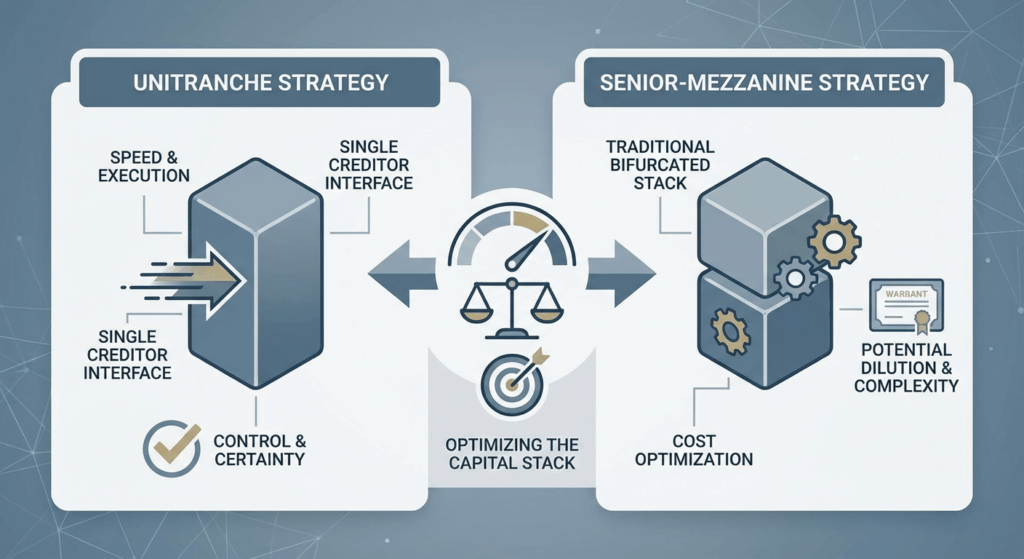
The Strategic Trade-off: Speed vs. Cost of Capital
For middle-market operators and private equity sponsors, the 2025-2026 financing landscape has crystallized into a binary choice: ease of execution via unitranche facilities or cost optimization via traditional senior-mezzanine structures. As deal timelines compress and competition for high-quality assets remains fierce, the capital structure itself has become a distinct competitive advantage.
The central financing challenge today is balancing the higher blended cost of a single credit facility against the structural complexity, intercreditor negotiations, and potential equity dilution associated with multi-tranche stacks. With middle-market unitranche issuance reaching record levels—estimated at over $210 billion in 2024—the market has shifted decidedly toward streamlined structures, yet they are not a universal panacea.
This analysis breaks down the mechanics of modern unitranche facilities, compares them against senior-subordinated alternatives, and outlines current market terms for borrowers navigating this choice.
Structure Breakdown: The Unitranche Mechanism
A unitranche facility combines senior and subordinated risk into a single debt instrument with a blended interest rate. While the borrower signs one credit agreement and pays one interest rate, the backend is often structured with a “First Out/Last Out” (FOLO) mechanism via an Agreement Among Lenders (AAL).
Component Mechanics
- Single Interface: The borrower deals with one administrative agent and one set of covenants.
- Blended Pricing: The rate reflects the weighted average risk of the underlying senior and junior capital providers.
- Backend Tranching: Behind the scenes, a commercial bank may take the “First Out” (lower risk, lower return) position, while a private credit fund takes the “Last Out” (higher risk, higher return) position. The borrower is generally not a party to this allocation.
Detailed Example: Project “Velocity”
Consider a hypothetical software company with $10 million in EBITDA and a $100 million Enterprise Value (EV) seeking $55 million in total leverage (5.5x) for a buyout.
The Unitranche Term Sheet
- Facility Size: $55 million
- Interest Rate: SOFR + 550 bps (Cash Pay)
- Original Issue Discount (OID): 98.0 (2% upfront fee)
- Amortization: 1.0% per annum
- Call Protection: 102/101/Par (Non-call 1 year, 2% fee year 2, 1% fee year 3)
- Covenants: Covenant-lite (Incurrence-based only, e.g., Max Leverage Ratio tested only upon new debt issuance or material actions).
In this structure, the borrower pays a single roughly 9-10% coupon (depending on SOFR spot rates). There are no warrants, no separate mezzanine lender to manage, and the entire $55 million is funded at closing with a single legal workstream.
Comparison: Unitranche vs. Senior-Mezzanine
The alternative—a bifurcated senior and mezzanine stack—offers lower cash interest on the senior portion but introduces structural friction and potential equity dilution.
Scenario B: The Senior-Mezz Alternative
- Senior Tranche ($35M): Bank term loan at SOFR + 350 bps.
- Mezzanine Tranche ($20M): Unsecured notes at 12% fixed cash + 2% PIK.
- Equity Kicker: Warrants for 5% of fully diluted equity to sweeten the mezzanine return.
The Trade-offs
1. Speed and Certainty:
Recent data indicates a significant divergence in execution timelines. Median sign-to-fund times for unitranche deals are approximately 45 days, compared to 70 days for senior-mezzanine structures [financely-group.com]. The unitranche removes the need to negotiate a complex intercreditor agreement between two distinct lender classes.
2. Cost vs. Dilution:
While the senior-mezz spread (weighted average) might appear lower initially, the “all-in” cost must account for warrants. In the example above, giving up 5% equity in a company that doubles in value can be significantly more expensive than paying an extra 150-200 bps in cash interest on a unitranche facility.
3. Covenant Flexibility:
Traditional bank senior debt typically imposes maintenance covenants (e.g., quarterly Total Leverage and Fixed Charge Coverage ratios). Modern unitranche structures, often provided by private credit funds, increasingly favor “incurrence-based” covenants, which only test ratios when the borrower takes specific actions like making an acquisition or paying a dividend [linkedin.com].
Current Market Terms (2025-2026)
Market data from late 2025 and early 2026 highlights the following standard terms for middle-market issuers:
- Unitranche Spreads: SOFR + 475–575 bps remains the standard clearing range for healthy credits [financely-group.com].
- Senior Debt Spreads: Banks are pricing senior secured term loans tighter, generally at SOFR + 250–450 bps, though with stricter amortization and governance [breakwaterma.com].
- Loan-to-Value (LTV): Unitranche providers are comfortable up to 55–65% LTV, whereas senior bank lenders typically cap exposure at 40–50%, requiring a mezzanine gap-filler for higher leverage deals.
- Fees: Upfront fees for unitranche facilities hover between 1.5% and 2.0%, while standalone mezzanine debt is more expensive, often commanding 2.0–2.5% closing fees plus exit fees or PIK toggles.
Structuring Guidance for Operators
When negotiating a facility in the current environment, borrowers should focus on three critical “flex” points beyond just the interest rate.
1. “Incremental” or “Accordion” Facilities
Ensure the credit agreement allows for pre-approved incremental debt capacity. This allows you to execute “buy-and-build” strategies without a full refinancing. Unitranche providers are typically more willing to scale with the platform than traditional banks.
2. Definition of EBITDA
In a covenant-lite or loose-covenant structure, the battleground is the EBITDA definition. Negotiate for “Pro Forma Adjusted EBITDA” that gives credit for cost savings from acquisitions before they are fully realized. This “add-back” capability creates head-room under leverage caps.
3. Call Protection vs. Flexibility
Lenders want yield maintenance. You want exit flexibility. A standard compromise is a 3-year soft call (e.g., 102, 101, Par). Try to negotiate a “portability” clause or a refinancing exception if the refinancing is done via an IPO or a change of control transaction, which can save millions in exit fees.
Key Takeaways
- Speed Premium: Unitranche deals close ~25 days faster than multi-tranche structures, reducing deal risk.
- Dilution Defense: Choosing a higher cash interest rate (Unitranche) over warrants (Mezzanine) preserves equity upside for sponsors and founders.
- Hidden Mechanics: The “Agreement Among Lenders” (AAL) in unitranche deals dictates the relationship between First-Out and Last-Out participants; while borrowers don’t sign this, its terms affect voting rights in a restructuring [jdsupra.com].
- Covenant Trends: The market has shifted toward incurrence-based covenants for private credit, providing operational breathing room compared to bank maintenance covenants.
- Leverage Capacity: Unitranche providers are currently offering up to 65% LTV, displacing the need for separate junior capital layers in many buyouts.


