
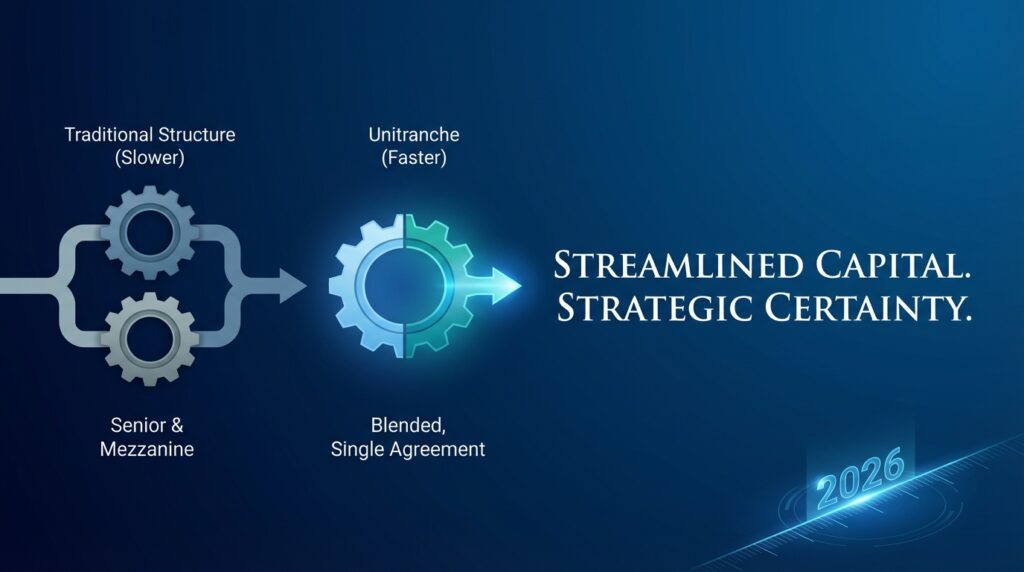
The Financing Challenge: Speed vs. Cost Efficiency
In the high-velocity middle market of 2026, private equity sponsors and corporate borrowers often face a binary decision: prioritize the lower cost of capital found in bifurcated structures (senior plus mezzanine) or opt for the execution speed and certainty of a unitranche facility. This choice defines the capital strategy for the majority of leveraged buyouts today.
While traditional bank syndications can offer lower headline interest rates, they come with execution risk, rating agency requirements, and intercreditor complexities. Conversely, unitranche financing—a hybrid loan structure combining senior and subordinated debt into a single instrument—has cemented itself as the dominant solution for sponsors valuing speed. Recent market data indicates that unitranche executions are closing nearly a month faster than their multi-lender counterparts, a premium that sophisticated borrowers are increasingly willing to pay.
Structure Breakdown: Components and Mechanics
A unitranche facility effectively bundles senior and junior risk into one loan document with a single blended interest rate and one schedule of amortization. The borrower interfaces with a single agent, simplifying administration.
The “Hidden” Bifurcation: The Agreement Among Lenders (AAL)
While the borrower signs one credit agreement, the lenders often bifurcate the risk behind the scenes. This is governed by an Agreement Among Lenders (AAL), which creates a “first-out” and “last-out” waterfall. The first-out lenders (often banks) take the lower-risk, lower-return portion, while the last-out lenders (private credit funds) absorb the higher risk for higher yield. Crucially, the borrower is not a party to the AAL, shielding them from inter-lender disputes.
Detailed Deal Example
Consider a $100 million enterprise value (EV) software company seeking a $55 million financing package to support a buyout.
- Facility Size: $55 million unitranche term loan.
- Leverage: 5.5x Total Net Leverage (based on $10M EBITDA).
- Pricing (Blended): SOFR + 550 basis points (bps).
- OID / Upfront Fee: 2.0% (98.00 issue price).
- Amortization: 1.0% per annum (minimal required principal repayment).
- Call Protection: 102 / 101 / Par (Soft call protection for 2 years).
- Covenants: Financial maintenance covenant set at 30-35% cushion to the closing EBITDA (e.g., Max Leverage of 7.15x).
In this structure, the “first-out” tranche might surely be priced at SOFR + 350 bps, while the “last-out” tranche effectively earns mezzanine-like returns (e.g., SOFR + 900 bps) to arrive at the blended SOFR + 550 bps rate visible to the borrower.
How It Compares: Unitranche vs. Senior-Mezzanine
The primary alternative to unitranche is a traditional Senior-Mezzanine structure, where a bank provides a senior term loan and a separate fund provides junior capital. Recent analysis from mid-2025 highlights the following trade-offs:
- Speed of Execution: Unitranche deals show a median “sign-to-fund” timeline of 45 days. In contrast, Senior-Mezz structures average 70 days due to the need for two separate credit committees and the negotiation of a complex intercreditor agreement.
- Dilution: Mezzanine debt often requires an “equity kicker” (warrants), typically costing sponsors 3-5% of post-money equity. Unitranche facilities generally avoid warrant coverage entirely, preserving equity upside for the sponsor and management.
- Certainty: A unitranche lender can often hold the entire facility size (or a significant majority), eliminating the “market flex” risk common in syndicated deals where terms can change if the debt doesn’t clear the market.
Current Market Terms (2025-2026)
As of recent reporting, the private credit market has stabilized around specific terms for middle-market issuers. Borrowers and investors should benchmark against the following standards:
- Pricing Spreads: The typical unitranche spread currently ranges from SOFR + 475 to 575 bps. This represents a distinct premium over senior bank debt (SOFR + 325–400 bps) but is significantly cheaper than standalone mezzanine debt.
- Loan-to-Value (LTV): Lenders are currently comfortable with LTV ratios between 55% and 65% for unitranche facilities, providing deeper liquidity than traditional bank loans which typically cap out at 40-50% LTV.
- Fees: Upfront fees generally range from 1.5% to 2.0% of the facility amount.
- Deal Sizes: The market has seen a rise in “mega-unitranche” facilities, with private lenders increasingly arranging deals exceeding $2 billion, proving this structure is no longer limited to the lower middle market.
Sources: Financely Group, Private Equity Bro.
Structuring Guidance & Negotiation Points
For Operators and Sponsors
When negotiating a unitranche facility, focus on the incremental facility (or “accordion”) features. Since you are locked into a single lender or small club, ensuring pre-agreed terms for future add-on acquisitions is critical to avoid being held hostage to repricing later. Additionally, push for “holiday” periods on financial covenants or “equity cure” rights that allow you to inject cash to fix covenant breaches without triggering a default.
For Investors
The strength of a unitranche position relies heavily on the definition of EBITDA. With “add-backs” becoming increasingly aggressive, investors must scrutinize the difference between Adjusted EBITDA (which governs covenants) and Cash Flow EBITDA (which pays the interest). Structurally, ensuring the AAL provides clear voting rights during a restructuring is paramount, as last-out lenders can sometimes be “silent” in enforcement actions despite holding the riskiest paper.
Key Takeaways
- Speed Premium: Borrowers pay ~100-150 bps more in interest for a 25-day faster closing timeline and higher execution certainty.
- Simplicity: One credit agreement and one agent reduce ongoing administrative burden and legal costs compared to multi-tranche structures.
- Equity Preservation: Unitranche avoids the warrant dilution common in mezzanine financing.
- Scale: The structure now supports deals from $20M EBITDA up to mega-cap transactions ($2B+ facilities).
- Hidden Mechanics: The Agreement Among Lenders (AAL) dictates the risk-return split behind the scenes; while borrowers don’t sign it, its terms influence lender behavior during distress.


