
The Execution Premium: Why Sponsors Choose Unitranche in 2026
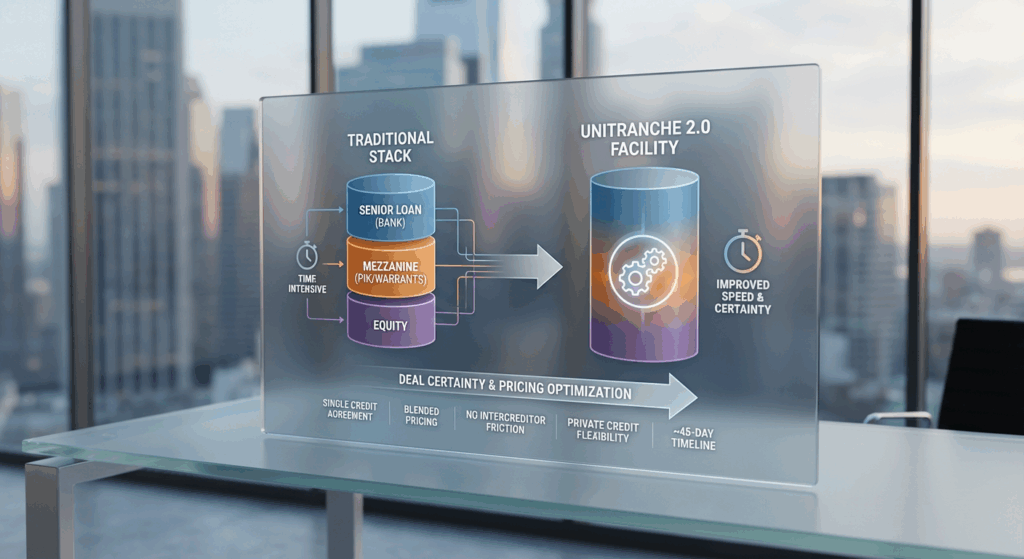
In the high-velocity M&A environment of early 2026, the structural debate for middle-market sponsors has largely shifted from “cost of capital” to “certainty of close.” While traditional bank-led execution remains cheaper on a headline basis, the unitranche facility—a hybrid loan structure combining senior and subordinated risk into a single instrument—has become the dominant vehicle for private equity buyouts, particularly for platform acquisitions with aggressive timelines.
The value proposition is distinct: trading a blended interest rate premium for speed, bilateral relationship management, and the elimination of intercreditor friction. This analysis breaks down the mechanics of the modern unitranche facility, current market terms, and the strategic trade-offs between this “one-stop” solution and the traditional layered capital stack.
Structure Breakdown: The “Invisible” Tranche
Technically, a unitranche loan is a single debt facility documented under one credit agreement with one interest rate and one schedule of amortization. However, the simplicity facing the borrower masks internal complexity among the lenders.
The Mechanical Components
- Single Credit Agreement: The borrower signs one document. There is no public intercreditor agreement (ICA) between a senior bank and a junior lender.
- Agreement Among Lenders (AAL): This is the critical backend document. It bifurcates the loan into “First Out” (lower risk, lower return) and “Last Out” (higher risk, higher return) tranches behind the scenes. The borrower is typically not a party to the AAL.
- Blended Pricing: The borrower pays a single spread (e.g., SOFR + 550 bps). The agent bank collects this and sweeps the appropriate yields to the First Out and Last Out lenders based on the AAL.
Deal Example: $100M SaaS Acquisition
Consider a hypothetical software company with $10M EBITDA being acquired for $100M (10x multiple). The sponsor requires $55M in debt financing (5.5x leverage).
Option A: Unitranche Structure
- Total Facility: $55M
- Pricing: SOFR + 550 bps (Cash pay)
- Upfront Fee: 1.75%
- Amortization: 1% per annum
- Covenants: Leverage covenant set at 30% cushion (approx 7.15x)
- Closing Timeline: 4 weeks
Option B: Traditional Senior + Mezzanine
- Senior Tranche ($40M): SOFR + 350 bps (Commercial Bank)
- Mezzanine Tranche ($15M): 12% Cash + 2% PIK + 5% Warrant coverage (Mezz Fund)
- Closing Timeline: 8-10 weeks (requires intercreditor negotiation)
In this scenario, the Unitranche offers a higher cash interest burden than the Senior slice of Option B, but avoids the dilution of warrants and the PIK accrual of the Mezzanine piece. More importantly, it removes the execution risk of coordinating two distinct credit committees.
Comparative Analysis & Trade-Offs
The choice between unitranche and a stratified capital structure typically pivots on three variables: dilution sensitivity, timeline, and flexibility.
Speed and Certainty
Recent data indicates a massive efficiency gap. Market reports from 2025 suggest the median “sign-to-fund” timeline for unitranche deals is approximately 45 days, compared to 70 days for senior-mezzanine structures [Financely Group]. In a competitive auction, saving 25 days can be the difference between winning and losing the asset.
Cost vs. Dilution
While unitranche spreads are generally 50 to 100 basis points wider than the weighted average cost of a senior/junior split, they rarely include equity kickers. Traditional mezzanine structures often require warrants that can cost sponsors 3-5% of post-money equity [Financely Group]. For sponsors confident in high equity returns, paying a higher cash interest rate (via unitranche) is often preferable to sharing the upside via warrants.
Flexibility
Unitranche lenders—typically unregulated private credit funds—are essentially asset managers rather than deposit-takers. This allows for significantly more flexibility regarding “add-backs” to EBITDA and covenant holidays compared to regulated commercial banks, which are constrained by regulatory oversight.
Current Market Terms (Q1 2026)
The private credit market has matured significantly, with AUM surpassing $2.1 trillion in 2025 [Private Equity Bro]. As of March 2026, the following terms define the core middle market:
- Spreads: SOFR + 475 to 575 bps remains the standard for quality assets [Financely Group].
- Leverage: Total leverage is holding steady around 5.0x to 5.5x EBITDA for cash-flow positive businesses [Private Equity Bro].
- Loan-to-Value (LTV): Lenders are comfortable up to roughly 60% LTV, a significant step up from the 40-50% typical of senior bank loans [Financely Group].
- Portability: An increasingly common feature, allowing a sponsor to sell the company without triggering a mandatory debt repayment, provided the buyer meets certain credit criteria.
Structuring Guidance for Operators
When negotiating a unitranche facility, borrowers should focus capital not just on the rate, but on the “guardrails” of the agreement.
For Borrowers (Sponsors/CFOs)
- Define EBITDA Aggressively: Since the leverage multiple is the primary governor of the loan, the definition of “Adjusted EBITDA” is the most critical negotiation point. Push for broad add-backs for synergies and transaction costs.
- Accordion Features: Ensure the facility includes an uncommitted “accordion” feature/incremental facility. This allows you to raise additional debt for bolt-on acquisitions under the same documentation without a full refinancing.
- No AAL Exposure: Ensure that the Borrower is shielded from disputes between the First Out and Last Out lenders. You want to deal with one agent, regardless of internal lender disagreements.
For Lenders (Allocators)
- Focus on the AAL: If you are a participant lender, the Agreement Among Lenders is vital. Understand your voting rights—specifically, can the “First Out” provider waive covenants without “Last Out” consent? This “silent waiver” risk can leave junior participants exposed.
Key Takeaways
- Speed Premium: Sponsors effectively pay an extra 50-100 bps in spread to close ~25 days faster than traditional bank processes.
- Dilution Defense: Unitranche avoids the warrant coverage often demanded by mezzanine lenders, preserving equity upside for the sponsor.
- Structure Simplicity: A single credit agreement reduces legal fees and administrative burden post-close.
- Leverage Capacity: Current markets support ~5.0x-5.5x leverage, higher than standalone bank financing (approx 3.5x).
- Contractual Privacy: The risk allocation between lenders is handled privately in the AAL, shielding the borrower from inter-lender dynamics.


