
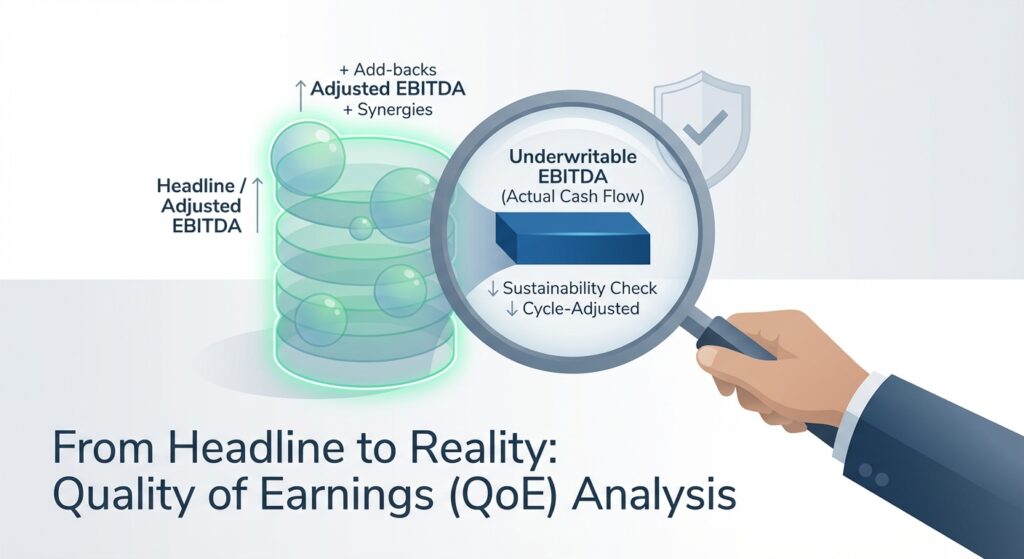
The Underwriting Challenge: Headline vs. Reality
In credit underwriting, “headline EBITDA” is rarely a proxy for true debt service capacity. Borrowers and intermediaries frequently present Adjusted EBITDA figures that include aggressive add-backs, pro-forma synergies, and non-recurring optimizations. For the prudent lender, relying on these unaudited figures without rigorous validation is a primary driver of default risk.
The role of Quality of Earnings (QoE) analysis is to bridge the gap between management’s reported figures and the actual cash flow available to service debt. As emphasized in the 2025 Principles for the Management of Credit Risk by the Basel Committee, a sound credit-granting process requires clearly establishing the borrower’s capacity to repay under varying conditions, rather than relying solely on collateral or optimistic projections.
The Framework: From Reported to Underwritable EBITDA
A rigorous QoE analysis moves beyond basic accounting to assess the sustainability and quality of revenue streams. The objective is to calculate “Underwritable EBITDA”—the metric upon which leverage covenants and coverage ratios should be based.
The Methodology
The normalization process involves three distinct layers of adjustment:
- Dilution Adjustments: Removing non-cash items (stock-based compensation, unrealized FX gains/losses) that distort cash flow.
- Normalization Adjustments: Correcting for one-time events, such as litigation costs, disaster recovery, or severance payments, to reveal run-rate performance.
- Pro-Forma Adjustments: The highest risk category, involving credit for future cost savings or synergies that have not yet been realized.
According to Fitch Ratings’ 2025 Corporate Rating Criteria, projections and historical analysis should ideally encompass a full economic cycle (typically three to five years) to ensure the financial profile is robust against market fluctuations. Lenders must verify whether earnings spikes are structural or merely cyclical.
The Analysis: A $10M EBITDA Manufacturing Example
Consider a hypothetical manufacturing borrower, “Alpha Corp,” presenting a TTM (Trailing Twelve Months) Adjusted EBITDA of $12.5 million to support a $40 million senior debt facility (3.2x leverage).
Step 1: The Bridge
Upon review of the Confidential Information Memorandum (CIM) and financial deck, the underwriter identifies the following components in the $12.5M figure:
- Reported EBITDA: $8.0 million
- Owner’s Excess Salary (Add-back): +$1.5 million (owner retiring, replaced by manager at $300k)
- Inventory Write-down (Add-back): +$0.5 million
- “Projected” Plant Efficiencies (Add-back): +$2.5 million
Step 2: The Stress Test
The underwriter applies a strict QoE lens:
- Owner’s Salary: VALID. Replacing a $1.8M owner compensation package with a $300k professional CEO salary creates $1.5M in real cash flow.
- Inventory Write-down: INVALID. If the company has written down inventory three times in five years, this is an recurring operational cost, not a one-time event.
- Projected Efficiencies: PARTIALLY INVALID. The $2.5M in efficiencies relies on unproven machine upgrades. A conservative lender might credit only 20% ($0.5M) or zero until demonstrated.
Step 3: Calculating Underwritable EBITDA
Reported: $8.0M
+ Salary Adj: $1.5M
+ Allowed Efficiencies: $0.0M (Conservative approach)
= Underwritable EBITDA: $9.5 million
Impact: At $9.5M EBITDA, the requested $40M debt facility represents 4.2x leverage, significantly higher than the marketed 3.2x. This pushes the deal from a “standard approval” to a “high-risk exception” or requires a reduction in loan proceeds.
Industry Standards & Data
Institutional standards for asset quality and credit risk have tightened following the volatility of the mid-2020s. The FDIC’s Risk Management Manual (Oct 2025) highlights that a bank’s asset quality rating is heavily influenced by the “quantity of existing and potential credit risk.” Examiners are specifically looking for management’s ability to identify risk, rather than just manage it post-event.
Common Red Flags in QoE
- Changing Definitions: Borrowers measuring EBITDA differently across periods (e.g., shifting rent strictly to “financing” activities to boost operating income).
- orphan Subsidiaries: Earnings derived from entities that do not guarantee the loan.
- Aggressive Capitalization: Treating software development or routine maintenance as CapEx rather than OpEx to inflate EBITDA.
Underwriting Checklist
To ensure a comprehensive risk assessment, underwriters should utilize the following checklist during the due diligence phase:
- Revenue Recognition: Are current year revenues driven by channel stuffing or extended terms?
- Customer Concentration: Does the top customer represent >20% of Gross Profit? If lost, does EBITDA turn negative?
- Management Adjustments: Are “one-time” fees appearing every year in the audit?
- Cash Conversion: Does EBITDA map to Operating Cash Flow (OCF)? (e.g., EBITDA – CapEx – Change in Working Capital). A divergence >10% is a warning sign.
- Fixed Charge Coverage: Using Underwritable EBITDA, is the Fixed Charge Coverage Ratio (FCCR) >1.25x under a downside scenario (e.g., 15% revenue decline)?
Key Takeaways
- EBITDA is an opinion; Cash is a fact. Always reconcile Adjusted EBITDA to operating cash flow.
- Defend the denominator. Leverage multiples are meaningless if the EBITDA figure is inflated.
- Cycle-neutral underwriting. As per Fitch (2025), analyze performance heavily weighted against the borrower’s weakest year in the last cycle.
- Synergies represent execution risk. Do not lend against cost savings that have not yet been implemented.
- Asset quality drives rating. Regulatory frameworks (FDIC, Basel) increasingly penalize lenders for failing to identify “potential” risk in credit structures.


