
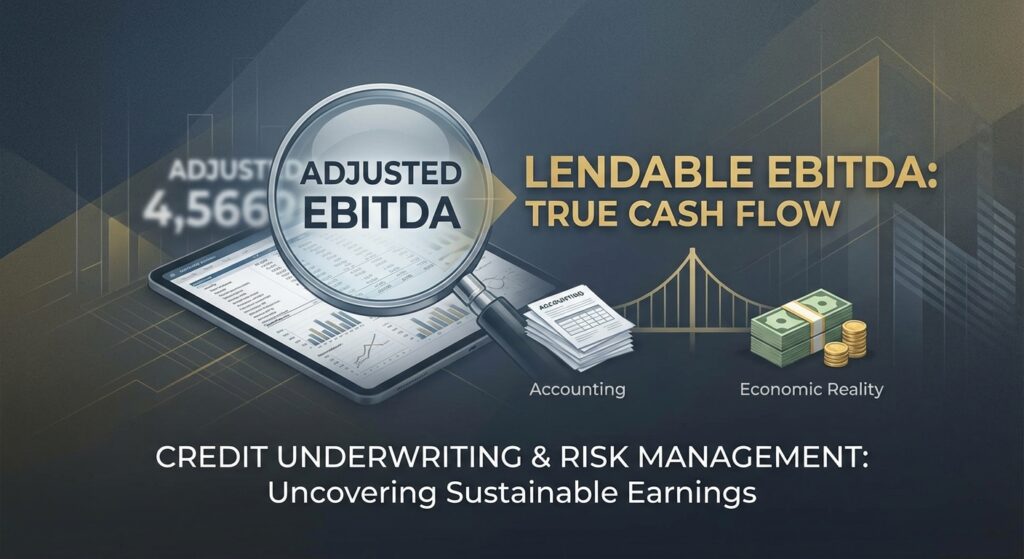
In the high-stakes environment of 2026 corporate credit, the gap between "Adjusted EBITDA" presented in a Confidential Information Memorandum (CIM) and the actual cash flow available for debt service has never been wider. For underwriters, the primary challenge is no longer just assessing market risk; it is deconstructing the aggressive add-backs and normalizations that inflate borrower earnings. This article outlines a rigorous framework for Quality of Earnings (QoE) analysis, moving beyond headline numbers to calculate sustainable Lendable EBITDA.
The Framework: From Accounting to Economic Reality
Credit underwriting differs fundamentally from equity valuation. While equity investors may pay for "blue sky" growth and synergies, a lender’s priority is capital preservation. A robust QoE framework bridges the gap between reported Net Income and "Lendable EBITDA"—the proxy for cash flow that can reliably service interest and amortization.
The underwriting bridge follows a standard methodology, yet requires forensic judgment at each step:
- Reported EBITDA: The starting point, derived from GAAP decision-making.
- Standard Normalizations: Adjustments for non-recurring items (e.g., litigation costs, disaster recovery).
- Pro-Forma Adjustments: Theoretical earnings from future events (e.g., synergies, cost savings).
- Lendable EBITDA: The underwriter's final, hair-cutted number used for leverage calculations.
According to fitchratings.com, projections typically span a three-to-five-year horizon, but historical performance remains the anchor. The analysis must distinguish between financial flexibility (the ability to cut costs) and phantom earnings (savings that have not yet materialized).
The Analysis: Stress-Testing the Add-Backs
Consider a hypothetical mid-market manufacturing borrower, "TechMFG Corp," seeking $60 million in senior debt.
- Headline Adjusted EBITDA (Borrower View): $15.0 million
- Proposed Leverage: 4.0x ($60M / $15M)
Upon review of the QoE diligence pack, the $15.0 million includes $3.5 million in add-backs. The underwriter must dissect these line items:
- Management Synergies ($2.0M): The borrower claims they will save $2M by closing a warehouse post-merger.
- Risk: Execution risk. This is future cash, not current cash.
- Underwriting Action: Standard practice is to cap synergies (e.g., at 10-15% of EBITDA) or haircut them by 50% unless strictly documented.
- Adjusted Value: $1.0M.
- "One-Time" Consulting Fees ($1.0M): Fees paid to restructuring consultants.
- Risk: If the company is in perpetual restructuring, these are recurring operating costs.
- Underwriting Action: Review 3 years of financials. If similar fees appear annually, reject the add-back.
- Adjusted Value: $0.0M (Deemed recurring).
- Owner Personal Expenses ($0.5M): Personal travel and vehicles run through the business.
- Risk: Low. These costs stop immediately upon transaction close.
- Underwriting Action: Verify against general ledger.
- Adjusted Value: $0.5M.
The Lender’s Reality:
Starting EBITDA ($11.5M) + Accepted Add-backs ($1.5M) = $13.0M Lendable EBITDA.
True Leverage: $60M / $13.0M = 4.6x.
By rejecting dubious add-backs, the underwriter reveals that the deal is nearly three-quarters of a turn more levered than advertised. In a 10% downside scenario, leverage could quickly spiral above 5.0x, potentially breaching covenants.
Industry Standards and Red Flags
Institutional guidelines emphasize the "sound credit-granting process" recently reiterated by the Basel Committee. The bis.org 2025 principles highlight the necessity of independent assessment, warning against over-reliance on borrower-generated projections. Lenders must evaluate the quality of the portfolio, especially under stress.
Credit professionals should watch for these specific red flags in 2026:
- "Community Adjusted" Metrics: Adjustments that ignore the economic cost of doing business, such as excluding stock-based compensation in cash-poor tech firms.
- Poor Cash Conversion: When Adjusted EBITDA is high, but Operating Cash Flow (OCF) is low or negative. If EBITDA doesn’t convert to cash, it cannot service debt.
- Covenant-Lite Drift: Structuring definitions of EBITDA in credit agreements to automatically allow all future add-backs without lender consent.
The European Central Bank’s bankingsupervision.europa.eu SREP methodology also underscores the importance of monitoring "past due progressive share" and potential deterioration in performing exposures, grounded in realistic risk parameters.
Underwriting Checklist
To ensure rigor in QoE analysis, utilize the following diligence workflow:
- Bank Statement Verification: Do the cash balances reconcile with reported P&L margins?
- Third-Party QoE Report: Has a reputable accounting firm validated the "quality" of the earnings? (Focus on the Net Working Capital peg).
- Customer Concentration: Is EBITDA dependent on a single contract? (Stress test the loss of the top customer).
- CapEx Normalization: Is "Growth CapEx" actually "Maintenance CapEx" disguised to inflate Free Cash Flow?
Key Takeaways
- Cash is King: EBITDA is an accounting opinion; cash flow is a fact. Always bridge to Free Cash Flow.
- Skepticism on Synergies: Future cost savings should rarely be fully credited in starting leverage.
- Identify Recurring "One-Timers": If an expense happens every year (e.g., restructuring, lawsuits), it is an operating cost.
- Watch the Covenant Definitions: The definition of EBITDA in the legal documentation is as important as the number itself.
- Stress Test Leverage: Always calculate leverage based on Lendable EBITDA, not the borrower’s Adjusted EBITDA.


