
The Financing Challenge
For middle-market operators and private equity sponsors in 2026, the primary financing friction is no longer just access to capital, but the trade-off between execution speed and cost of capital. As global private credit assets under management surged past $2.1 trillion in 2025, the “Jumbo Unitranche” has firmly displaced traditional syndicated loans and mezzanine stacks for complex leveraged buyouts (LBOs).
The structural challenge is straightforward: A sponsor acquiring a $100 million enterprise value (EV) software company needs 5.0x leverage. A traditional senior/mezzanine split requires negotiating two separate credit agreements, an intercreditor deed, and managing two lender relationships. The unitranche offers a single document and one blended rate, but often at a premium. Understanding when to pay that premium—and how to structure the “Agreement Among Lenders” (AAL) that sits behind it—is critical for modern CFOs and deal partners.
Structure Breakdown: Components and Mechanics
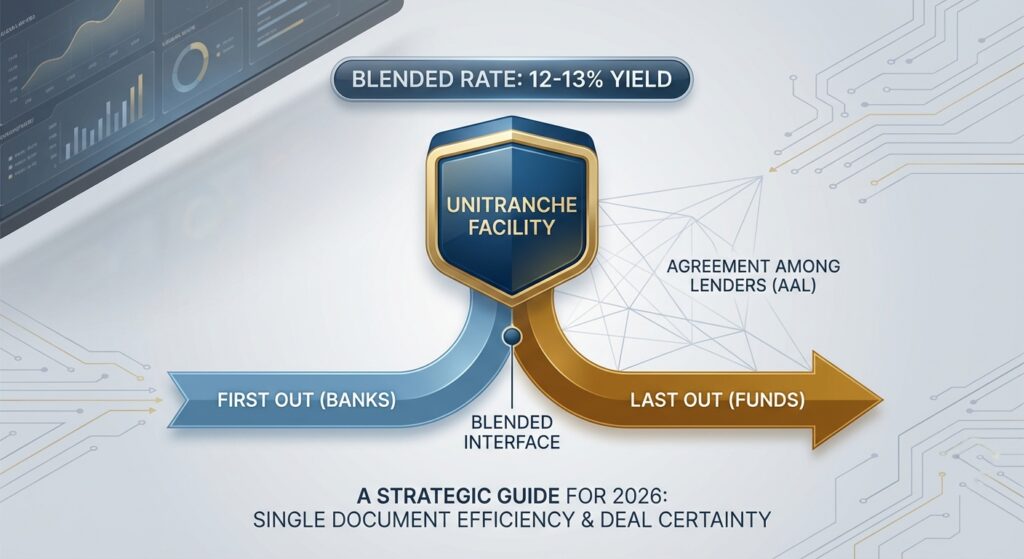
A Unitranche Facility is a hybrid loan structure that combines senior and subordinated debt risk into a single debt instrument with one interest rate (the blended coupon) and a single set of loan documents. While the borrower deals with a single administrative agent, the risk is often bifurcated behind the scenes.
The “First Out / Last Out” (FOLO) Mechanism
The innovation of the unitranche lies in the Agreement Among Lenders (AAL). This private contract—invisible to the borrower—splits the loan into tranches:
- First Out Tranche: Lower risk, lower return (often held by banks or conservative BDCs). Gets paid first in a waterfall.
- Last Out Tranche: Higher risk, higher return (held by credit funds or hedge funds). Absorbs the first dollar of loss after equity.
Deal Example: $50M Unitranche Term Sheet
Consider a hypothetical SaaS acquisition with the following terms typical of the current vintage:
- Total Facility: $50,000,000 Term Loan B
- Blended Pricing: SOFR + 625 bps (Floor 1.00%)
- OID (Original Issue Discount): 98.0 (2% upfront fee)
- Leverage: 5.0x Total Net Leverage
- Amortization: 1.0% per annum
- Call Protection: 102/101/Par (Soft Call)
Behind the scenes, the lenders might structure this as:
- First Out ($30M): Priced at SOFR + 450 bps.
- Last Out ($20M): Priced at SOFR + 885 bps.
- Result: Only the blended rate (S+625) appears in the credit agreement, simplifying administration for the borrower.
How It Compares: Unitranche vs. Syndicated & Mezzanine
The unitranche structure trades cost for control and certainty.
Vs. Broadly Syndicated Loans (BSL)
Syndicated loans generally offer lower interest rates (often 50-100 bps cheaper) but carry “execution risk.” In a BSL process, the arranger can invoke “market flex” terms to change pricing or covenants if the loan doesn’t clear the market. Unitranche deals are bilateral; the terms signed at the term sheet stage are generally what you close with. This certainty of close is why sponsors pay the premium.
Vs. Senior + Mezzanine
In a traditional stack, a senior lender (First Lien) and a mezzanine lender (Second Lien or Unsecured) have an Intercreditor Agreement. This creates complexity during restructurings or consents. If the borrower needs a waiver, they must ask two distinct classes of creditors. In a unitranche, the borrower asks one Agent. However, the rigidity of the AAL means the “Last Out” lender often controls voting rights on material decisions, effectively acting as the “fulcrum security” holder.
Current Market Terms (2025-2026 Context)
Following the aggressive expansion of private credit through 2025, market standards have calcified around specific metrics:
- Pricing: New private credit deals in the core middle market are pricing with all-in yields between 12% and 13%.
- Leverage Profiles: Total leverage remains disciplined around 5.0x EBITDA, though specialized SaaS or recurring revenue loans may stretch higher based on ARR (Annual Recurring Revenue).
- The Speed Premium: Market data suggests sponsors accept a spread premium of 50 to 100 basis points over BSL pricing to secure a 30-45 day faster closing timeline, avoiding the risk of “hung deals.”
- Mega-Unitranches: We are seeing a rise in “Jumbo” facilities exceeding $2 billion, facilitated by clubs of massive direct lenders (e.g., Ares, Blackstone, Blue Owl) pooling capital to take down take-privates that were previously the domain of Wall Street banks.
Structuring Guidance & Negotiation
For Operators (Borrowers)
When negotiating a unitranche, focus on incremental facilities (accordions). Because unitranche lenders are typically hold-to-maturity investors, they are motivated to deploy more capital as you grow. Negotiate pre-baked terms for “add-on” acquisitions so you don’t have to re-price the entire facility when you need another $20M for M&A.
Additionally, scrutinize the “defined terms” within EBITDA. Since financial covenants (often Maintenance Covenants in the lower middle market) are tight, the definition of “Adjusted EBITDA” is often more valuable than a 25 bps reduction in spread.
For Investors (Lenders)
The AAL is paramount. In a bankruptcy scenario, the distinction between “lien subordination” and “payment subordination” matters. Unitranche lenders must ensure the AAL clearly dictates “buyout rights”—the right of the Last Out lender to buy out the First Out positions to seize control of the workout process without obstruction.
Key Takeaways
- Single Instrument Efficiency: Unitranche consolidates multiple risk tranches into one Credit Agreement, reducing legal costs and administrative burden.
- The AAL is Key: The real structuring happens in the Agreement Among Lenders, creating synthetic seniority (First Out/Last Out).
- Speed Premium: Borrowers fundamentally pay ~50-100 bps extra for deal certainty and speed (eliminating syndication risk).
- Bilateral Relationship: Easier covenant waivers and amendments due to fewer counterparties compared to syndicated loans.
- Scale: With facilities now reaching $2B+, unitranche is no longer just a small-cap solution; it is a viable alternative for large-cap take-privates.


