
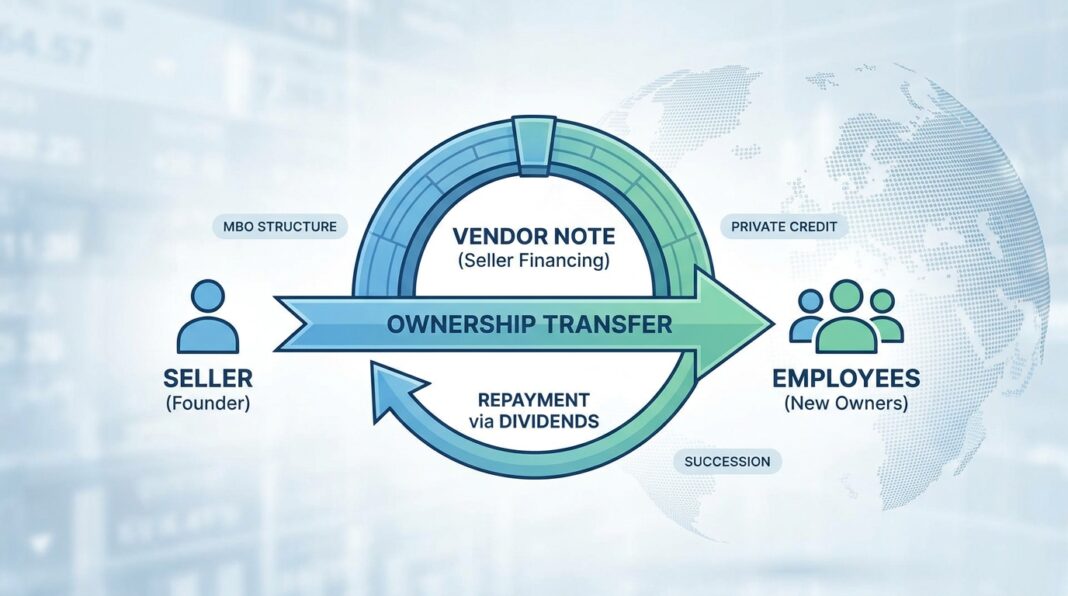
Selected angle: Family business succession with private credit, through a vendor-financed employee buyout.
The Story
In December 2025, Gunvor’s managers faced a succession problem with a financing problem attached. Co-founder and majority owner Torbjörn Törnqvist agreed to sell his stake to company employees and step down as CEO. The timing followed a failed attempt to acquire Lukoil assets and a period of heightened scrutiny of Gunvor’s ownership and Russian links. The company described the buyout as a reset. The ownership question was immediate: could the business move to a broader employee partnership without bringing in an outside controlling investor?
The transfer was not funded through a conventional sponsor-led buyout disclosed with a bank debt package and a public equity check. Reuters reported in February 2026 that Törnqvist provided employees with a vendor loan of more than $4 billion. Reuters’ reporting and calculation put the group’s implied value at about $5 billion. The purchase price and repayment terms were not in Gunvor’s original announcement, so those figures should be treated as reported estimates, not audited transaction disclosures. Reuters said employees would repay the vendor loan from annual dividends over 10 years, with an extension possible.
That financing choice made the seller a lender as well as a departing owner. It gave employees a route to ownership without a disclosed private-equity sponsor taking a controlling stake. But it also put future distributions to employees in competition with repayment to the former owner and with the trading company’s need to fund inventory, logistics and counterparties. Reuters reported the vendor-loan structure and valuation estimate; the company separately confirmed the employee-led ownership transition.
The Decision
The apparent alternatives were strategic, not just financial. A third-party sale could have brought cash to Törnqvist and outside capital to the business, but likely would have introduced a new controlling owner and its governance priorities. A conventional leveraged buyout could have used bank or private-credit debt, but would have required the company or acquisition vehicle to service that debt from cash flows. An employee purchase funded by a seller note transferred ownership while leaving the seller exposed to the company’s future ability to pay.
The reported structure was unusually concentrated: a vendor loan above $4 billion against a roughly $5 billion implied valuation, with repayment expected over a decade from dividends. The loan’s exact interest rate, security, covenants, amortization schedule and employee equity contributions have not been publicly detailed in the sources cited here. Those omissions matter. A headline loan amount alone cannot establish the transaction’s effective leverage or its risk allocation.
Separately, on November 24, 2026, Centalion, Gunvor’s new name, announced a $2.65 billion multicurrency European revolving credit facility. It has a $2.01 billion 364-day tranche with three possible 364-day extensions and a $640 million three-year tranche with one possible extension. The company said the facility would support general corporate and working-capital needs and refinance tranches under its 2024 and 2025 facilities. This is operating liquidity, not the employee buyout loan. The distinction is central: a trading business can require large revolving facilities to finance daily activity even as its owners face a separate long-term purchase obligation. Centalion’s November 24, 2026 release sets out the facility’s tranches and uses.
The Outcome
The immediate result was a change in ownership without a publicly announced sponsor taking control. The company later adopted the Centalion name, saying its employee partnership had approved the change after the December 2025 management buyout. On November 24, 2026, its bank group increased the European revolving facility from its initial launch amount. Centalion’s CFO said existing banks increased commitments and new lenders joined after the buyout. These are signs of continuing lender access, not proof that the vendor loan has been repaid or that the employee owners have earned a realized return.
There is a caution in the earnings record. Reuters reported that Gunvor’s net profit fell 85% in 2025 to $104 million. That reported result makes a dividend-dependent repayment plan sensitive to earnings volatility. Commodity trading profits can move sharply by year, while a seller note still needs a contractual payment schedule. The 2026 revolving facility may support working capital, but it does not erase the vendor loan or establish that cash is available for distributions.
The counterfactual cannot be priced from public information. There is no disclosed offer from a financial sponsor, no reported dilution percentage under an equity alternative and no public comparison of debt service under a conventional buyout. What can be said is narrower: the seller note avoided a publicly disclosed sponsor-control transaction, while leaving repayment risk tied to future company distributions. The new RCF expanded and refinanced operating capacity; it was not disclosed as a source of purchase-price funding. Centalion confirmed the rebrand and employee-partnership context, while Reuters reported the 2025 profit decline.
The Lessons
Vendor financing can bridge a gap between a seller who wants liquidity and employees who want ownership but cannot fund the full purchase price upfront. It can preserve operating independence and keep equity inside the workforce. It does not make the purchase inexpensive. The seller-note principal remains a claim on future cash, and a dividend-funded repayment structure links owner distributions to the company’s ability to generate surplus liquidity.
Gunvor’s case also shows why acquisition capital and operating capital must be underwritten separately. A long-dated vendor note funds the ownership transfer; short-dated revolving lines fund working capital and must often be renewed. Centalion’s November 2026 facility has a 364-day tranche alongside a three-year tranche, so extension options and refinancing access are part of the liquidity picture. A company may have strong bank support and still face a mismatch between near-term liquidity needs and long-term ownership debt.
For readers studying a similar transition, start with the cash flow available after operating needs, maintenance investment, collateral requirements and minimum liquidity. Then test seller-note payments against a downside year, not just a normalized year. Review whether distributions are discretionary or required, what security and covenants apply, how much refinancing depends on annual bank renewals, and whether employees share ownership broadly enough to support governance. If those details are undisclosed, avoid inferring a leverage multiple or calling the debt sustainable. In Gunvor’s case, the public record shows an ownership transfer, a reported vendor loan and a later upsized revolver. It does not yet show the full debt documents or the final economic outcome for employee owners.
Key Insights
- A vendor note can finance succession without a disclosed sponsor taking control, but payment risk remains with future cash generation.
- Reuters reported a vendor loan above $4 billion and an implied value near $5 billion, but key pricing and covenant terms are not public.
- Dividend-funded amortization competes with working capital, investment and liquidity reserves, especially after a weak earnings year.
- Centalion’s $2.65 billion revolving facility supports corporate and working-capital needs; it is distinct from the reported buyout loan.
- Separate acquisition debt from operating liquidity, and stress both repayment capacity and refinancing access under weaker conditions.


