
Opening: A Credit Line Is Not the Same as Cash
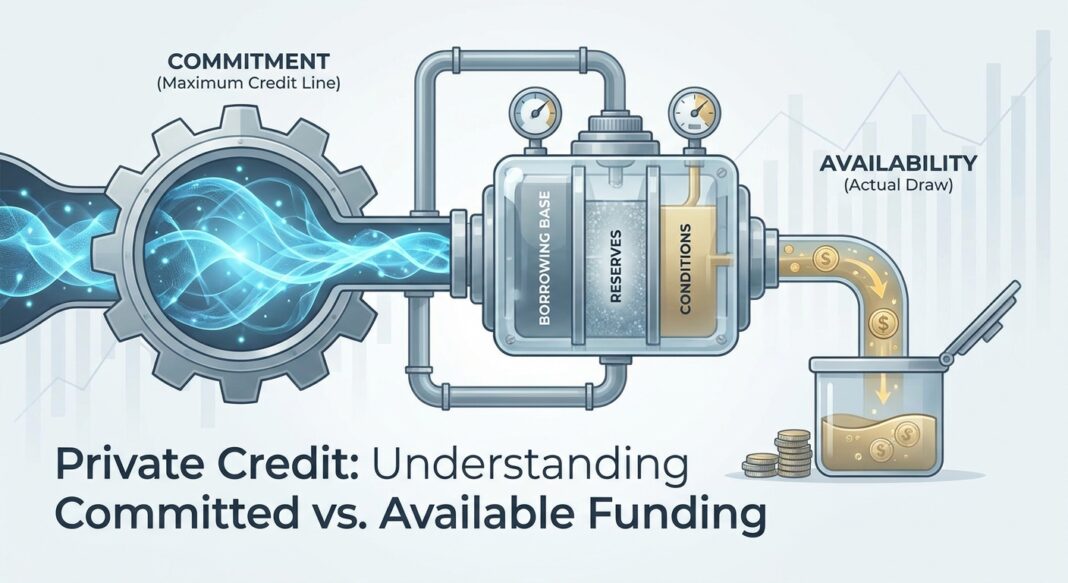
A revolving credit facility is designed to provide flexible borrowing: a company draws funds when cash is needed, repays them, and can borrow again during the facility term. But a stated commitment does not always mean the full amount is immediately available. Borrowing-base calculations, draw conditions, reserves, and default provisions can reduce or suspend access.
This distinction matters to both investors and operators. For a lender, an undrawn revolver is a potential exposure that may be drawn precisely when a borrower is under pressure. For a business, treating the headline facility size as guaranteed liquidity can leave a cash forecast short. The key question is not only “How large is the commitment?” It is “How much can be drawn today, under what conditions, and what can change that amount?”
The Concept: Commitment Versus Availability
A committed revolver is a lending agreement under which a lender agrees to make loans up to a stated limit during a defined period, subject to the contract’s terms. The borrower generally pays interest on drawn amounts and may pay a commitment fee on the unused portion. A borrowing base is a separate limit calculated from eligible collateral, often accounts receivable and inventory, after applying advance rates and reserves.
Availability is typically the lowest applicable cap, less amounts already borrowed and other obligations. Those caps may include the total commitment, the borrowing base, a sublimit for a particular use, and any contractual draw conditions. A borrower may also need to repeat representations, deliver a borrowing notice, comply with covenants, and have no continuing event of default. Certain facilities allow the lender to stop further advances after specified triggers.
So “committed” describes the lender’s contractual funding obligation, not an unconditional promise to fund in every circumstance. A borrowing-base revolver can be legally committed while the amount currently drawable changes with collateral values and eligibility. A cash-flow revolver may have no borrowing base, but it still depends on conditions in the agreement.
How It Works: A Borrowing-Base Example
Illustrative example: A distributor signs a $5 million committed revolver. Its borrowing base allows advances against eligible receivables and inventory. Assume the agreement applies an 80% advance rate to eligible receivables and 50% to eligible inventory.
- Eligible receivables of $4 million produce $3.2 million of availability.
- Eligible inventory of $2 million produces $1 million.
- The gross borrowing base is $4.2 million. A $500,000 reserve for dilution, customer concentration, or other specified risks reduces it to $3.7 million.
The drawable amount is the lower of the $5 million commitment and $3.7 million borrowing base. If $2.2 million is already drawn, current availability is $1.5 million, assuming no letters of credit or other deductions.
Now assume $750,000 of receivables becomes ineligible under the agreement because of aging or a dispute. At an 80% advance rate, the borrowing base falls by $600,000, to $3.1 million. With $2.2 million already drawn, remaining availability is $900,000. If the borrowing base falls below existing borrowings, the borrower may have to repay the excess or provide more eligible collateral, depending on the contract.
The example shows why operators track eligibility and reserves, not just gross receivables. Investors examine how quickly the formula can shrink, which party determines eligibility, and whether advance rates or reserves can change under stated conditions.
Current Market Relevance
The Federal Reserve’s October 2026 Senior Loan Officer Opinion Survey, released November 2 and covering bank lending changes during Q3 2026, provides current context for revolver terms. Among banks reporting on C&I lending to large and middle-market firms, 10.2% said premiums charged on riskier loans tightened somewhat, while 5.0% reported somewhat tighter collateralization requirements. These are respondent shares, not market-wide loan pricing estimates. Federal Reserve, October 2026 SLOOS Table 1.
For small-firm C&I facilities, 5.2% of respondents reported somewhat tighter risk premiums, and 5.1% reported somewhat tighter collateralization requirements. The same survey found 8.6% reported somewhat greater use of interest-rate floors for large and middle-market C&I loans. On covenant terms for large and middle-market borrowers, 10.2% reported tightening somewhat while 16.9% reported easing somewhat, a mixed result rather than a uniform tightening trend. Federal Reserve, October 2026 SLOOS Table 1.
Capital supply is also expanding, but fundraising does not automatically translate into available credit for any one borrower. Preqin reported that global private-credit fundraising reached $185 billion through Q3 2026, equal to 95% of the full-year 2025 total, in its November 8 update. The Federal Reserve survey describes banks, not private-credit lenders, so it is a useful comparison for credit conditions rather than a direct measure of private-credit revolver terms. Preqin, Private Credit Q3 2026 Quarterly Update, November 8, 2026.
Decision Framework: Questions for Investors and Operators
For investors: Read the availability formula alongside the stated commitment. Identify eligible collateral definitions, advance rates, reserves, reporting frequency, and who can determine whether collateral qualifies. Review draw conditions, default triggers, cure periods, and any lender discretion to block advances. Stress-test a delayed-customer-payment scenario and a collateral-value decline. Ask whether a borrower can still access the revolver when its liquidity need is greatest.
For operators: Forecast liquidity using current borrowing-base availability, not the facility headline. Model receivables aging, customer disputes, seasonal inventory, and reserve changes. Confirm the borrowing certificate process and the time needed to submit support. Compare the revolver’s term and renewal date with the period of need. A committed line can be useful for working-capital swings, but it is a poor substitute for permanent capital if the business expects to remain fully drawn.
For both audiences, reconcile the lender’s availability calculation to the company’s cash forecast at each reporting date. A small gap between the two can become material when collections slow or inventory becomes harder to liquidate.
Key Takeaways
- A commitment is a contractual ceiling, not necessarily the amount currently drawable.
- Borrowing-base eligibility, advance rates, and reserves determine collateral-based availability.
- Existing drawings, letters of credit, and other deductions reduce remaining capacity.
- Stress-test access under weaker collections and tighter collateral eligibility, not only repayment capacity.
- Operators should forecast against live availability; investors should test whether funding remains accessible under stress.


