
Opening: A Fund-Level Loan, Not a Portfolio-Company Loan
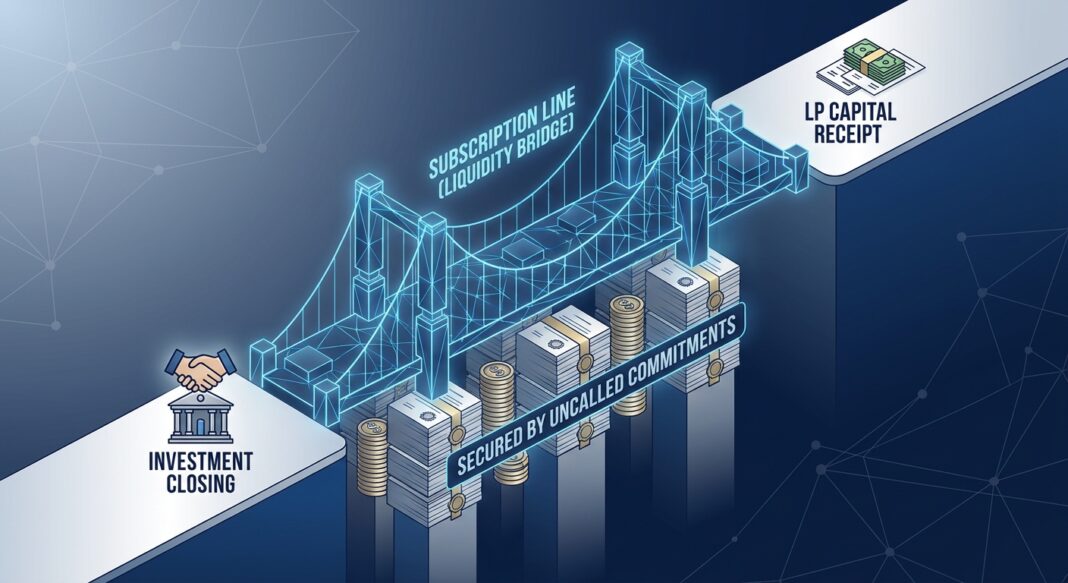
A subscription line is a revolving loan to an investment fund, secured primarily by the fund’s right to call capital that its limited partners (LPs) have committed but not yet contributed. It bridges the gap between an investment closing and the cash collection that follows a capital call. For a private credit fund, that timing can matter when a borrower needs funding before an administrative call process is complete.
The distinction is fundamental: the lender underwrites the fund’s contractual claims against eligible investors, not the operating company’s EBITDA or its pledged assets. The fund’s subscription line is therefore a separate layer of borrowing above the portfolio loans. It can make deployment more efficient, but it does not create new investor capital or improve a portfolio borrower’s ability to repay.
For LPs, the facility changes when their commitments are called and adds fund-level leverage to understand. For business owners, it can affect the speed with which a fund closes an investment, but it is not debt available directly to the operating company.
The Concept: Uncalled Commitments as Credit Support
When an LP commits to a closed-end fund, it signs documents agreeing to contribute capital when the manager issues a valid capital call. A subscription facility, also called a capital-call line or sub-line, lets the fund borrow against some of those uncalled commitments. The lender’s collateral typically includes rights to issue capital calls, receive contributions, and enforce payment, subject to the fund documents and facility agreement.
The lender does not usually lend against every dollar of commitments at face value. It defines which investors qualify, applies advance rates, and may impose concentration limits. A large commitment from one investor may count less than several diversified commitments. Certain investors may be excluded because of credit quality, jurisdiction, legal restrictions, or limits in the fund documents. These adjustments create the borrowing base, the amount of eligible collateral that supports current availability.
Unlike a term loan, a subscription line is generally revolving: the fund can draw, repay, and draw again within agreed limits. The expected repayment source is a capital call, not operating cash flow from the portfolio company. A line may reduce the frequency of calls or align funding with closings. It also adds interest expense and can affect how fund performance is reported if investment cash flows occur before LP contributions.
How It Works: An Illustrative $40 Million Draw
Assume a private credit fund has $500 million of total LP commitments and $300 million remains uncalled. The lender’s eligibility rules and concentration limits reduce the eligible commitment base to $240 million. If the agreed advance rate is 25%, the borrowing base supports up to $60 million of outstanding debt, assuming no other limits bind.
The fund draws $40 million to fund a $40 million loan to a portfolio company. It may then issue a capital call to LPs, receive contributions, and repay the subscription line. The portfolio company owes its $40 million loan to the fund under its own credit agreement. Separately, the fund owes the $40 million facility draw to its subscription-line lender. These are distinct obligations, supported by different sources of repayment.
For a simple cost illustration, assume the fund borrows $40 million for 90 days at an all-in annual rate of 8%, using a 360-day convention. Interest would be approximately $800,000: $40 million multiplied by 8% and by 90/360. This is a hypothetical calculation, not a quoted market rate. The fund must compare that financing cost and any facility fees with the operational benefit of bridging the capital call.
The structure has limits. If LP contributions are delayed, disputed, or legally unavailable, repayment can be impaired. If remaining eligible commitments fall, the borrowing base may shrink and require repayment or additional collateral. A subscription facility does not eliminate the LP’s obligation to fund a valid call; it changes the sequence in which cash is borrowed, called, and repaid.
Current Market Relevance
Current fundraising and bank-credit data provide context, but neither should be mistaken for a measure of subscription-line availability. Preqin’s November 8, 2026 Q3 update reported that private credit fundraising reached $185 billion through September 30, 2026, equal to 95% of the full-year 2025 total. Europe-focused funds accounted for 72% of Q3 fundraising and 44% of capital raised globally through the first three quarters. Preqin also reported that 79% of surveyed investors planned to commit to just one private credit fund over the next 12 months. These figures describe fundraising and investor plans, not the amount of uncalled commitments available as collateral.
The Federal Reserve’s October 2026 SLOOS, released November 2, 2026, said banks tightened standards for loans to nondepository financial institutions, including private equity funds, during Q3. That finding concerns bank lending to a broad group of financial borrowers; it does not establish that subscription-line terms tightened by the same amount. Facility terms still depend on the LP base, fund documents, lender appetite, and transaction structure.
Borrower financing costs also show why fund-level and company-level credit must be kept separate. PitchBook LCD reported on November 20, 2026 that Q3 new-issue LBO spreads averaged 520 basis points for direct lending and 307 basis points for broadly syndicated loans. Over the three months ended October 31, 2026, syndicated lenders financed $24.25 billion of new-issue LBO debt, compared with $9.34 billion from direct lenders. These are company-level loan-market measures, not subscription-facility pricing. They show that capital availability and price vary by financing channel, while the fund’s line addresses a different need: timing LP contributions.
Decision Framework for LPs, Managers, and Operators
For LPs and fund investors: review the fund’s governing documents and facility terms. Identify the maximum permitted borrowing, eligible collateral, maturity, repayment triggers, and any restrictions on using the line. Ask how the manager reports investment-level and fund-level cash flows, because borrowing can change the timing of contributions and distributions and therefore influence reported performance metrics. Assess the concentration and collectability of the LP commitments supporting the facility, not only the fund’s headline commitment total.
For fund managers: compare the line’s total cost with the operational value of faster closings, smoother cash management, and fewer ad hoc calls. Model a delayed-call case and a reduced borrowing-base case. Confirm that fund documents authorize the borrowing, the collateral grant, and the capital-call enforcement rights. The facility is most useful as a short-duration bridge with a clear repayment plan, rather than as a substitute for sufficient LP equity commitments.
For portfolio-company operators: distinguish the fund’s liquidity tool from your company’s financing. A subscription line may help a lender fund an investment promptly, but it does not reduce the company’s loan balance, interest burden, or covenant obligations. When discussing deal certainty with a prospective lender, ask about the fund’s ability to close and its funding mechanics, while evaluating your own debt against business cash flow and repayment capacity.
Key Takeaways
- A subscription line is fund-level borrowing secured mainly by eligible, uncalled LP commitments.
- The borrowing base is usually lower than total commitments because lenders apply exclusions, advance rates, and concentration limits.
- It bridges the timing of investment funding and capital calls; it does not create permanent equity or operating-company repayment capacity.
- LPs should examine fund-level leverage, call rights, repayment triggers, and performance reporting effects.
- Managers should underwrite delayed calls and reduced availability, then use the facility only with a defined repayment source.


