
Market Headline
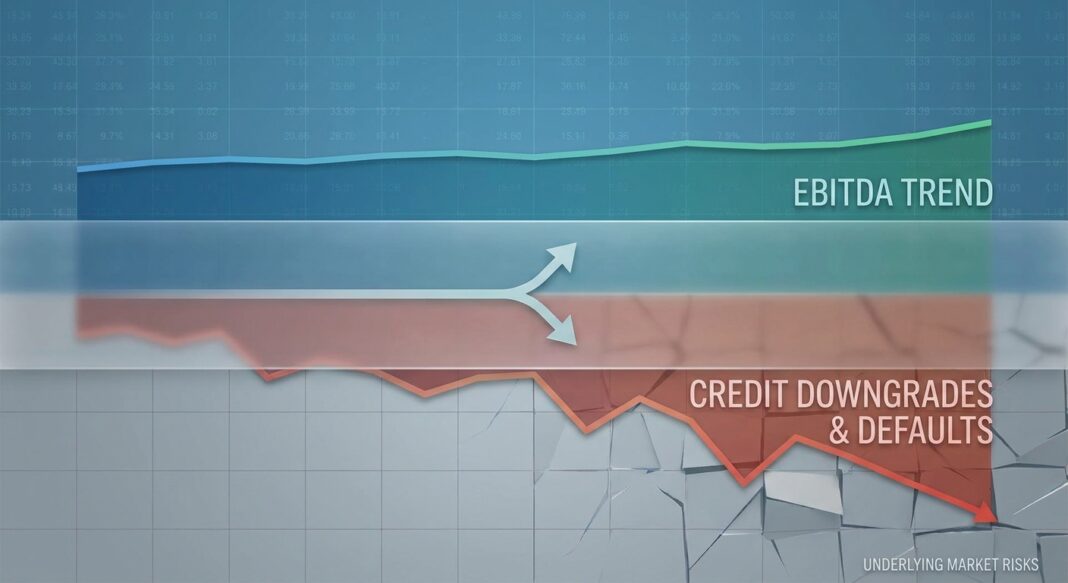
The clearest credit-cycle signal is a widening gap between market access and borrower resilience. Public markets repriced quickly in November: the ICE BofA U.S. high-yield option-adjusted spread reached 3.72% on November 24, up from 2.69% on August 24. Yet new-issue syndicated loan pricing remained substantially below direct-lending pricing in the latest full-quarter data. That divergence is not evidence of broad private-market distress by itself. It does show that liquidity and borrower quality increasingly determine the financing channel.
Loan-level indicators are less reassuring than aggregate revenue growth. KBRA’s October monitor found its middle-market default rate rose to 3.9% by count, while the three-month downgrade rate reached 16.6%. Houlihan Lokey’s Q3 data also showed falling interest coverage and higher defaults, concentrated among smaller borrowers. Banks reported unchanged C&I standards for large and middle-market firms, but tighter standards for small firms and riskier loans. The market is selective, not closed: cash conversion, scale, and refinancing options now separate borrowers more clearly than headline EBITDA growth.
Quantitative Snapshot
The table uses the latest available monthly or quarterly release as of November 26, 2026. Direct-lending and syndicated spreads below refer to new-issue LBO loans, not identical borrower pools.
| Metric | Latest reading | Prior comparison |
|---|---|---|
| Direct-lending LBO spread | 520 bps, Q3 2026 | 494 bps, Q2 2026. PitchBook LCD, November 2026 |
| BSL LBO spread | 307 bps, Q3 2026 | 332 bps, Q2 2026. PitchBook LCD, November 2026 |
| U.S. high-yield OAS | 3.72%, November 24, 2026 | 2.69%, August 24, 2026. FRED, ICE BofA series |
| U.S. PE-backed direct-lending volume | $27 billion, Q3 2026 | Up 16% from Q2, down 47% year over year. Carlyle, Q4 2026 Global Market Pulse |
| Private-credit defaults, all borrowers | 1.5% of outstanding principal, Q3 2026 | 0.8% in Q2 2026. Houlihan Lokey includes technical as well as payment defaults. Houlihan Lokey, November 19, 2026 |
| Median leverage, smaller-company vintages | 3.8x for 2026-vintage small-borrower deals | 4.3x for 2025 vintage. Houlihan Lokey, Q3 2026 |
Flows have improved from the first-quarter outflow but remain modest: loan funds recorded a $1.7 billion net inflow in Q3, following $1.2 billion in Q2 and a $7.0 billion outflow in Q1, according to Carlyle’s October 2026 credit review. The Morningstar LSTA U.S. Leveraged Loan Index payment-default rate was 0.55% in October, according to PitchBook LCD’s November 5 update. That is not directly comparable with Houlihan Lokey’s broader private-credit measure, which includes technical defaults.
Sector Analysis
Software is seeing a clear reduction in private-equity-backed direct-lending allocation, although operating performance and financing appetite are not the same measure. Northleaf reported software at 15% of direct-lending originations by volume through Q3 2026, down from 22% in 2025. Its November 2 market update attributed the pullback to AI-disruption concerns and more selective lender supply. This is a portfolio and underwriting rotation, not proof that all software borrowers are deteriorating.
Healthcare and consumer credit show more immediate performance pressure. In Houlihan Lokey’s Q3 dataset, healthcare defaults were 7.1% by borrower count and 4.6% by principal, concentrated in provider platforms built through acquisition. Consumer defaults were 4.6% by count and 2.5% by principal. These figures point to integration execution, labor and operating costs, and cash-flow durability as key underwriting variables; sector labels alone do not explain outcomes.
Asset-based finance is gaining transaction activity where lenders can underwrite identifiable collateral or receivables. The Secured Finance Network recorded 279 secured-finance transactions in Q3, up 24.6% from Q2. Technology led with 26 deals, manufacturing had 23, and transportation had 22. Factoring transactions rose to 69 from 53 in Q2. These are secured-finance deal counts, not direct-lending originations, but they indicate demand for working-capital structures beyond cash-flow loans. Meanwhile, the Federal Reserve’s October SLOOS reported tighter standards across CRE categories and tighter standards for small-business C&I loans, while large and middle-market C&I standards were basically unchanged.
Implications
For borrowers: The wider private-versus-syndicated spread gap increases the value of financing optionality, but only borrowers with sufficient size, reporting quality, and market access can readily switch channels. Small and core-middle-market companies should prepare lender-ready monthly cash reporting, a near-term maturity schedule, and a downside case that distinguishes recurring EBITDA from add-backs. Coverage deserves particular attention: Houlihan Lokey’s median borrower interest coverage fell to 1.68x in September from 1.73x in June, while the share below 1.0x rose to 15.1% from 13.9%. Its sensitivity analysis puts median coverage at 1.55x after a 100-basis-point base-rate increase, and at 1.26x after a 25% EBITDA decline at current rates. Operators should test both rate and margin shocks against cash interest, fixed charges, and covenant headroom before pursuing incremental debt.
For lenders and institutional investors: A 520-basis-point average spread does not offset weak structure or volatile cash generation automatically. Cohort analysis should separate borrower scale, vintage, sector, and amendment history. Monitor payment defaults alongside downgrades, non-accruals, PIK usage, and loans marked below par; each measure captures a different stage of stress. For the next three to six months, a sustained public spread widening could improve private lenders’ negotiating position, but subdued buyout activity and uneven fund flows limit the number of new loans that can be originated. Refinancing demand and asset-based structures may provide activity, while small-borrower underwriting and acquisition-heavy healthcare remain more exposed to cash-flow misses.
Key Market Insights
- Private-credit LBO spreads widened in Q3 while syndicated spreads tightened, with the gap now affecting channel choice.
- Q3 defaults rose in the private-credit datasets, but each provider uses a different definition. Do not compare headline rates without checking methodology.
- Smaller borrowers face tighter bank standards and higher private-credit default incidence; scale is a material underwriting variable.
- Software allocation is contracting, while technology, manufacturing, and transportation activity in secured finance is increasing.
- Near-term credit monitoring should prioritize cash interest coverage, covenant headroom, and refinancing capacity over EBITDA growth alone.


