
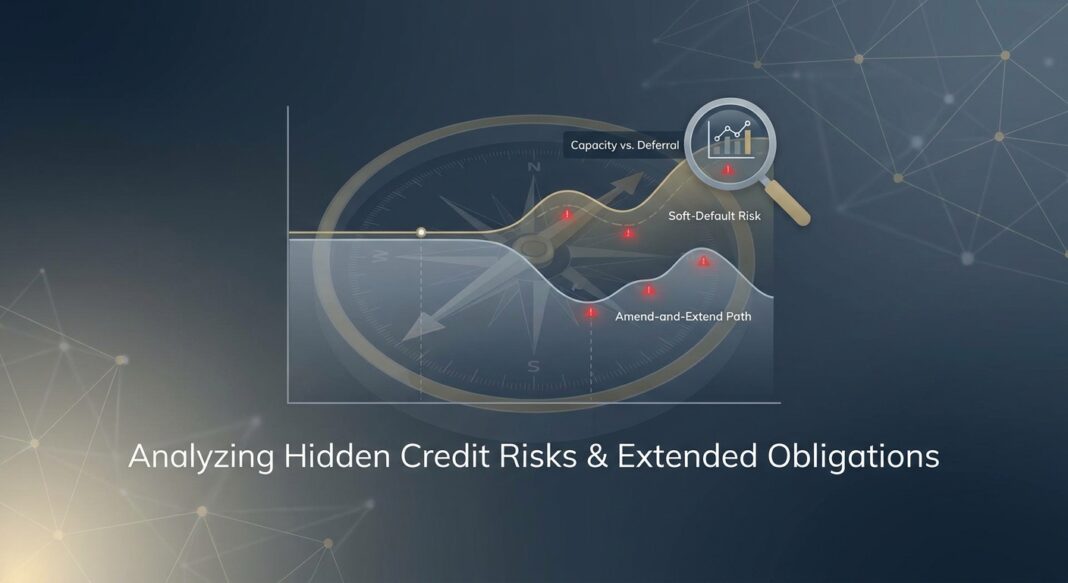
Soft-Default Underwriting: Quantifying Amend-and-Extend Risk
Opening: The underwriting question
When a borrower cannot repay principal on schedule, but a lender agrees to extend maturity, capitalize interest, or exchange debt at a discount, has the credit improved, or has the default simply moved out of view? That distinction matters at origination. A loan can remain current on cash interest while liquidity weakens, principal grows through payment-in-kind (PIK) interest, and repayment becomes dependent on another refinancing.
Underwriting should therefore measure not only the stated maturity date, but also the borrower’s capacity to meet obligations without another amendment. A soft credit event is not the same as a missed payment or bankruptcy, and rating-agency definitions differ. But the underlying pressure can be visible earlier in cash conversion, debt service, covenant headroom, and lender concessions. The practical test is whether the borrower can delever from internally generated cash under a downside case, rather than rely on a sponsor contribution or capital-market access. Below is a framework for measuring that dependence before closing, then monitoring it through the loan life.
The framework: Underwrite the path to repayment
Start with a debt schedule that captures every funded and contingent obligation: first-lien and junior debt, revolving availability, leases where relevant, seller notes, and accrued PIK. Reconcile the schedule to executed agreements and the quality-of-earnings work. Calculate total debt / lender-adjusted EBITDA, cash interest coverage, fixed-charge coverage, and free cash flow after cash interest, taxes, maintenance capital expenditure, and working-capital investment. A headline EBITDA interest-coverage ratio can overstate capacity when cash taxes, capex, or seasonal cash needs consume the remaining margin.
Next, align each debt maturity and amortization requirement with forecast cash generation. Measure the percentage of opening debt repaid from cumulative free cash flow before maturity. Show refinancing as a separate, conditional source, not as operating repayment. Model PIK separately: it reduces current cash interest but increases principal and future leverage. Track covenant headroom using the exact contractual EBITDA definition, including caps on add-backs, pro forma synergies, and debt netting. Calculate headroom both in dollars and as the percentage decline in EBITDA that triggers a breach.
For an illustrative borrower with $10 million EBITDA and $60 million debt, opening leverage is 6.0x. If annual cash interest is $7.5 million, cash-interest coverage is 1.33x. Assume cash taxes of $1 million, maintenance capex of $2 million, working-capital use of $1 million, and scheduled amortization of $1.5 million. Cash remaining after those items is negative $3 million. Despite positive EBITDA, the company cannot fund scheduled debt service from the stated operating cash flow. That is the first signal to test, not a prediction of default.
The analysis: Quantify deterioration and amendment dependence
Run a downside case against the same starting debt schedule. Suppose EBITDA falls 15% to $8.5 million, while a 200-basis-point rate increase adds $1.2 million of annual cash interest on $60 million of fully floating-rate debt. Cash interest rises to $8.7 million and coverage falls to 0.98x. If $1.5 million of interest is instead paid in kind, current cash coverage may look better, but principal becomes $61.5 million before any other debt movement. Leverage on stressed EBITDA then reaches approximately 7.2x ($61.5 million divided by $8.5 million).
Then test the actual covenant. If the maintenance leverage covenant is 7.0x, the stressed case breaches it. If the agreement has no maintenance test, that does not remove the risk; it may only delay the point at which the lender receives formal warning. Build a month-by-month liquidity forecast that includes the revolver borrowing base, minimum cash, seasonal working capital, and the date available liquidity falls below an internal trigger. Compare projected cash generation with amortization and the maturity wall. An amendment case should identify exactly what changed: principal haircut, coupon, PIK toggle, maturity extension, collateral, or covenant relief. Record the lender’s resulting exposure and revised downside recovery assumptions. A maturity extension without a credible deleveraging path is time, not repayment capacity.
Industry standards: What lenders should recognize
In its October default update, published November 19, 2026, Moody’s Ratings reported six speculative-grade corporate issuer defaults during October, five involving distressed exchanges. There were 98 defaults year to date through October, compared with 107 in the same period of 2025. Moody’s reported a 4.3% trailing-12-month global speculative-grade default rate at October month-end, against a 4.2% long-run average. The same report identified Symplr Software’s amend-and-extend transaction on about $2 billion of loans as October’s largest default. These are agency-rated global issuer statistics, not a private-credit portfolio default estimate; distressed-exchange treatment affects the count. See the Moody’s October 2026 default update.
As a separate, shorter-period signal, S&P Global Ratings reported four defaults in the week covered by its November 23, 2026 credit update, up from one the prior week; two were bankruptcy-related. A weekly count is not an annualized rate and should not be compared directly with Moody’s trailing rate. The S&P weekly update shows why event type belongs in portfolio reporting.
For underwriting discipline, the OCC’s 2025 statement says banks should assess repayment purpose, capacity to delever, historical performance versus projections, and refinancing availability throughout the loan life. It also says purchased participations require independent credit evaluation. These principles support a lender practice: document the base-case repayment source, run downside cases, and preserve independent monitoring rather than treating an amendment as proof of recovery. The OCC’s Leveraged Lending Comptroller’s Handbook also calls for stress testing forecasts at origination and on an ongoing basis, and comparing actual results with projections.
Underwriting checklist
- Reconcile all debt, accrued PIK, leases, seller obligations, revolver commitments, and maturities to signed documents and borrower reporting.
- Obtain monthly actuals, trailing-twelve-month financials, a 13-week cash forecast, annual projections, borrowing-base certificates, and covenant-compliance calculations.
- Rebuild cash flow after cash interest, taxes, maintenance capex, working capital, and scheduled amortization. Tie assumptions to historical seasonality and invoice-level or customer-level evidence where material.
- Calculate leverage, cash-interest and fixed-charge coverage, liquidity runway, covenant headroom, and cumulative debt paydown under base and downside cases.
- Ask management what financing action is required if the downside case occurs. Identify lender consent thresholds, sponsor support conditions, and any maturity that depends on refinancing.
- Document sources, definitions, model sensitivities, covenant tests, reporting frequency, and escalation triggers. Flag missed reporting, rising PIK, repeated forecast misses, and requests to extend or waive terms for immediate review.
Key takeaways
- Cash coverage after recurring operating needs is more informative than EBITDA alone.
- PIK can defer cash payment while increasing leverage and future refinancing risk.
- Track maturity extensions and distressed exchanges as credit events, not automatic cures.
- Measure covenant headroom using the executed EBITDA definition and a downside case.
- Require an evidenced path to deleveraging that does not depend solely on refinancing.


