
Angle: Growth funded with structured, non-dilutive acquisition capital. Historical case study.
The Story
In 2013, Greg Geronemus and David Rosner were first-time operators looking to buy a business, not launch a venture-backed startup. Their target, smarTours, sold packaged international trips to consumers. It generated about $30 million in revenue and $5 million in EBITDA, but it had only seven employees. Its founder remained deeply involved in running the operation, creating meaningful key-person risk for new owners.
That risk made the company harder to finance with a conventional buyout template. A buyer could not assume that the founder’s relationships and operating knowledge would transfer smoothly. The business also had a cash-flow feature that mattered to lenders: customers paid before travel, while many suppliers were paid later. That timing could support debt service, but it did not eliminate the risk of a sudden drop in bookings or disruption to the trips themselves.
Geronemus and Rosner faced a familiar acquisition problem. The company was large enough to require meaningful capital, yet a full-equity purchase would demand a much larger investor check and give outside investors a correspondingly larger claim on future value. The seller’s willingness to finance part of the purchase created another path: use a seller note and senior debt to bridge the price, while limiting the initial equity requirement. The structure was not debt instead of equity. It was debt used to make the equity contribution smaller.
In an interview published by Acquiring Minds on November 17, 2025, Geronemus described how the searchers bought, operated, and ultimately exited the business. Their result turned on more than leverage: entry price, seller financing, operational handover, and a timely sale all mattered.
The Decision
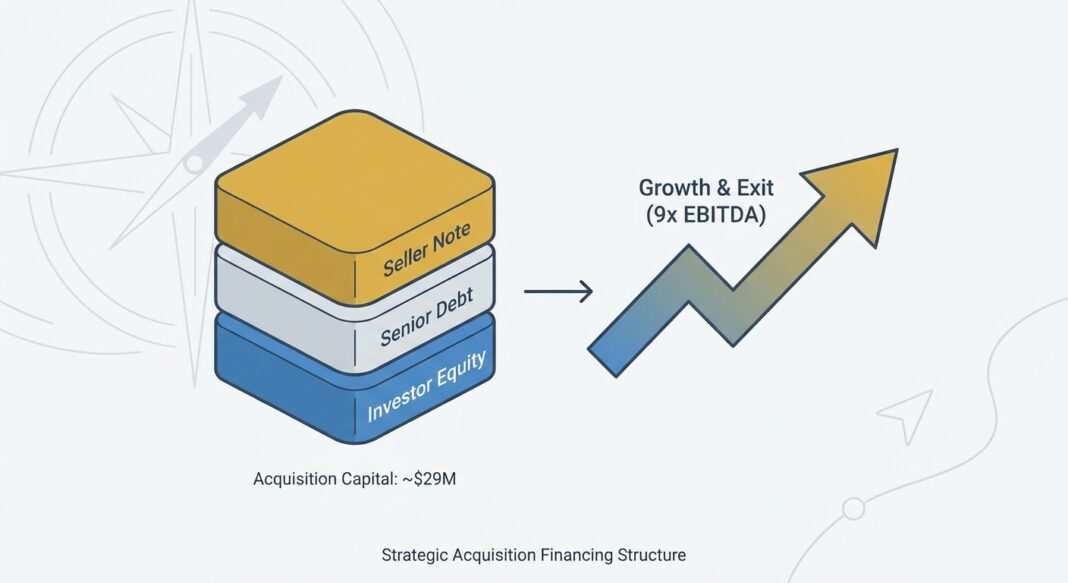
The acquisition price was approximately $29 million, close to 5x the company’s $5 million EBITDA. The reported closing structure included about $14.5 million of seller financing, $5 million of senior debt from an SBIC lender, and $10 million of investor equity. Transaction fees required additional funding. The seller note carried a reported 4% interest rate. The senior loan sat ahead of the seller note in the repayment hierarchy, while the equity absorbed the first loss.
Those layers assigned different risks to different capital providers. The bank-like senior lender had priority over the seller note. The seller accepted a deferred claim rather than receiving the full price in cash at closing. The investors funded the residual equity and held the upside after debt claims. The founders operated the company and participated in that equity pool, but public sources do not disclose their exact ownership percentages.
The alternative was not simply “debt or equity.” The buyers could have tried to raise more equity, negotiated a lower price, or walked away. As a clearly labeled arithmetic counterfactual, if the $14.5 million seller note had instead been replaced dollar-for-dollar with equity, total equity capital would have risen from the reported $10 million to roughly $24.5 million before fees. That comparison says nothing about the valuation or control terms a new investor would have demanded. It does show why seller financing mattered: it reduced the cash equity needed to complete the purchase.
The seller note also preserved a direct economic link between seller and company performance. That did not make the note risk-free or guarantee cooperation. It did mean the seller’s payment claim depended on the borrower meeting its obligations after control changed.
The Outcome
Over four years, the new owners built a larger management team and reduced dependence on the former owner. They tested digital marketing, but found that direct mail performed better with the company’s older customer base. They also developed sales through universities and religious organizations. The operating changes mattered because the original business’s small headcount and founder dependence were not just management concerns. They were credit risks.
By 2017, revenue had grown to nearly $50 million and EBITDA to about $7.5 million, according to Geronemus’s account to Acquiring Minds. Debt fell from roughly $19.5 million to around $4 million. Summit Park announced a recapitalization of smarTours on November 1, 2017, with Geronemus and Rosner continuing as co-CEOs. In the interview, Geronemus reported a $67.5 million transaction value, equivalent to 9x EBITDA, about four turns above the entry multiple. He said investors received $62.5 million in proceeds, plus nearly $4 million in distributions during ownership.
The counterfactual is limited but useful. Without the seller note, the buyers would have needed more equity, a lower purchase price, or a different financing source. The actual structure let the equity group own a claim on the business while the company paid down debt from cash flow. That improved returns on the invested equity, but it also increased fixed obligations and made liquidity more important.
The later history supplies a caution. Under Summit Park’s ownership, smarTours filed for Chapter 11 protection in 2020 after the pandemic crushed travel demand. Bloomberg Law reported the filing and listed up to $10 million of assets and up to $50 million of liabilities. The earlier acquisition produced a strong reported investor outcome; it did not make the travel business immune to a severe demand shock.
The Lessons
First, match the financing to the cash cycle, not just the purchase multiple. smarTours collected customer payments ahead of trips and paid suppliers later. That working-capital pattern supported borrowing in ordinary conditions. It could not protect the company from cancellations, refunds, or bookings collapsing across the travel market.
Second, seller financing can reduce the equity check and make a succession or acquisition feasible when the seller accepts deferred proceeds. The note is still debt. Its interest, maturity, payment schedule, subordination, and default remedies affect the company’s room to invest and withstand a weak quarter. A seller who carries paper remains a creditor, not automatically a business partner.
Third, leverage works best when the purchase price leaves room for operating setbacks and the business can service debt without relying on aggressive growth assumptions. The smarTours buyers did not simply borrow and wait for multiple expansion. They built a management layer, reduced key-person concentration, and tested customer-acquisition channels. Debt paydown then lowered the balance-sheet risk before the 2017 transaction.
For operators reviewing a similar structure, begin with a downside cash-flow case. Identify the minimum cash needed for operations, stress revenue and working capital, and test debt service after realistic capital spending and taxes. Then compare seller debt, senior debt, and equity by total cost, control rights, repayment priority, and dilution. Ask what happens if the planned exit is delayed or unavailable. A seller note can preserve equity ownership, but it cannot substitute for durable cash generation.
The broader point is balance. Equity has no mandatory principal repayment, but it transfers ownership and future value. Debt avoids that dilution, but it places a fixed claim ahead of owners. smarTours shows the upside of structuring around the company’s cash profile and the risk of assuming that a successful ownership period removes the underlying sector exposure.
Key Insights
- Seller financing supplied half of the approximately $29 million purchase price and reduced the initial equity requirement.
- The reported stack was $14.5 million seller debt, $5 million senior debt, and $10 million investor equity, plus transaction costs.
- Operational professionalization addressed key-person risk and supported growth from about $5 million to $7.5 million in EBITDA.
- Debt declined from roughly $19.5 million to $4 million before the 2017 transaction, while the reported exit valuation reached 9x EBITDA.
- Strong historical returns do not eliminate downside risk: the business later filed for Chapter 11 after a severe travel-demand shock.


