
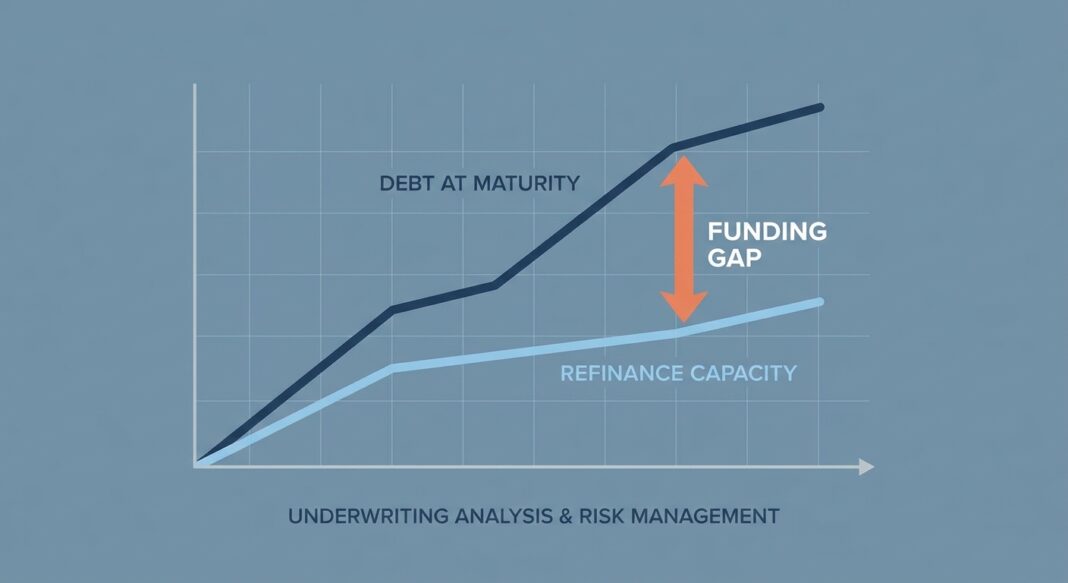
Refinancing-Runway Underwriting: Quantify the Maturity Funding Gap
The underwriting question
Can the borrower repay or refinance its debt at maturity if earnings fall, cash interest stays elevated and lenders offer less leverage than the current capital structure assumes? A company can show positive EBITDA, meet near-term interest and still arrive at maturity without a financeable balance sheet. Underwriting should therefore test both survival through the loan term and the source of repayment at the contractual maturity date.
The key risk is treating refinancing as an automatic exit. It is a conditional source of repayment, dependent on future earnings, market capacity, collateral value, lender appetite and the borrower’s debt load. In the current private-credit data, many reported default events involve forms of relief before bankruptcy. Fitch’s October 2026 data record maturity extensions under stress and interest deferrals or PIK conversions as substantial portions of observed default events. Those events do not all mean insolvency, but they show why a maturity schedule belongs in initial underwriting, not just annual portfolio review.
The framework: build a maturity repayment bridge
Start with a complete debt schedule by legal borrower and guarantor. Reconcile term loans, revolvers, leases, seller notes, equipment debt, hedging obligations, earn-outs and any debt at unrestricted or non-guarantor subsidiaries. Record amortization, cash and PIK interest, springing maturities, call protection, extension options, covenant tests and required lender consents. Reconcile contractual terms to the credit agreement and payoff letters, not only the CIM or management’s debt summary.
Next, establish lender-adjusted EBITDA from verified historical results, then create a downside case with explicit revenue, margin, working-capital and capex assumptions. Calculate debt/EBITDA, cash interest coverage (EBITDA less cash taxes, maintenance capex and working-capital needs, divided by cash interest), and fixed-charge coverage if scheduled principal, rent or other fixed obligations are material. EBITDA interest coverage alone can overstate liquidity because EBITDA is not cash available for debt service.
Then test the maturity. Estimate debt outstanding at that date after scheduled amortization and any permitted draws. Compare it with conservative refinancing capacity. A simple capacity screen is stressed EBITDA multiplied by an assumed maximum refinance leverage, less debt senior to the facility and customary transaction costs. The leverage assumption should be grounded in borrower quality, sector, collateral, lender feedback and the credit agreement, not treated as a market constant.
Finally, calculate the gap: maturity debt plus fees, less supported refinance proceeds, cash available above minimum operating liquidity, and committed equity or sponsor support. Treat uncommitted sponsor support and hoped-for asset sales as unavailable in the base case. Show them separately as mitigants, with evidence and conditions.
Illustrative analysis: $10 million EBITDA manufacturer
Assume a borrower has $10 million of underwritten EBITDA, $50 million of debt, and a maturity in three years. Current leverage is 5.0x. For illustration only, assume $5 million of annual cash interest, $0.5 million scheduled amortization, and $2 million of annual cash taxes, maintenance capex and working-capital use. Cash available for debt service is $8 million, or 1.45x coverage of $5.5 million cash interest plus amortization.
In a downside case, reduce EBITDA 20% to $8 million, and increase annual cash operating deductions to $2 million. Cash available is $6 million. At unchanged interest and amortization, debt-service coverage falls to 1.09x. This is thin headroom: a further margin decline, delayed customer payment or unexpected maintenance spend can erase it. The underwriter should model the timing of cash use monthly or quarterly where the business is seasonal, not rely on annual averages.
At maturity, assume amortization lowers debt to $48.5 million. If a hypothetical refinancing lender supports 4.0x stressed EBITDA, gross proceeds are $32 million. The gross gap is $16.5 million before fees. Cash above the operating minimum and documented sponsor equity can reduce it; neither should be double-counted as operating liquidity and repayment support. If no credible source covers the remaining gap, the case depends on improved earnings, a sale or a restructuring. Each is an execution risk, not a repayment certainty.
Industry standards and performance evidence
Institutional underwriting should distinguish liquidity from solvency. A revolver can bridge a seasonal cash trough, but a drawn revolver that matures with the term loan increases refinancing needs. A covenant cushion can provide warning time, but it does not create cash. Set maintenance tests using defensible EBITDA definitions, track covenant headroom under the downside case, and require timely delivery of monthly or quarterly reporting when risk warrants. Review debt incurrence, restricted payments, asset sales and incremental facility baskets for their effect on maturity debt and priority.
Fresh performance data reinforce the importance of recognizing stressed amendments as credit signals. Fitch reported a U.S. private-credit trailing-12-month default rate of 6.2% for October 2026, versus 0.4% when counting only bankruptcy, liquidation or restructuring events. Fitch attributed 49% of default events to interest deferrals or PIK introductions and 38% to maturity extensions under stress, as of October 2026. The two rates answer different questions and should not be compared as identical measures. Fitch October 2026 default data, reported by ABF Journal.
Moody’s October 14, 2026 analysis likewise estimated a 4.0% U.S. private-credit default rate under its narrower measure and 5.8% when payment-in-kind amendments and maturity extensions were included. The spread between measures is a reminder that amendments can defer a visible payment default without removing leverage or refinancing risk. Moody’s leveraged finance research, October 14, 2026. In its October 2026 Global Financial Stability Report, the IMF also reported median leverage of 7.05x among reviewed U.S. direct-lending borrowers in 2026 Q2, using S&P Global Ratings credit estimates. That sample is not a universal benchmark for a specific borrower, but it documents elevated leverage in the reviewed cohort. IMF, Global Financial Stability Report, October 2026, Chapter 1.
Underwriting checklist
- Reconcile all funded and contingent debt to executed agreements, lender statements and legal-entity records. Identify maturities, extension conditions, springing dates and amortization.
- Verify reported EBITDA and cash flow against audited statements, monthly trial balances, bank activity, tax filings and a quality-of-earnings report. Separate recurring cash costs from add-backs.
- Build base and downside cases for revenue, gross margin, customer losses, working capital, capex, cash taxes and interest. Test quarter-by-quarter liquidity against minimum cash needs.
- Calculate current and maturity-date leverage, cash interest coverage, fixed-charge coverage and refinance proceeds. Sensitize the leverage multiple and financing costs rather than using one optimistic exit assumption.
- Ask management and sponsors for a documented repayment plan, committed equity capacity, asset-sale assumptions and contingency actions. Obtain lender indications where available, and label them nonbinding.
- Set reporting and escalation triggers for declining cash coverage, covenant headroom, revolver usage, delayed financials, amendment requests and maturity less than 24 months away. Define who reviews exceptions and how frequently.
Key takeaways
- Underwrite the contractual maturity as a repayment event, not a refinancing promise.
- Cash available after taxes, capex and working capital is more informative than EBITDA interest coverage alone.
- Show debt capacity and the residual funding gap explicitly under downside earnings.
- Count sponsor support only when its amount, timing and conditions are evidenced.
- Track extensions, PIK elections and interest deferrals as early credit signals, even before missed payments.


