
Market Headline
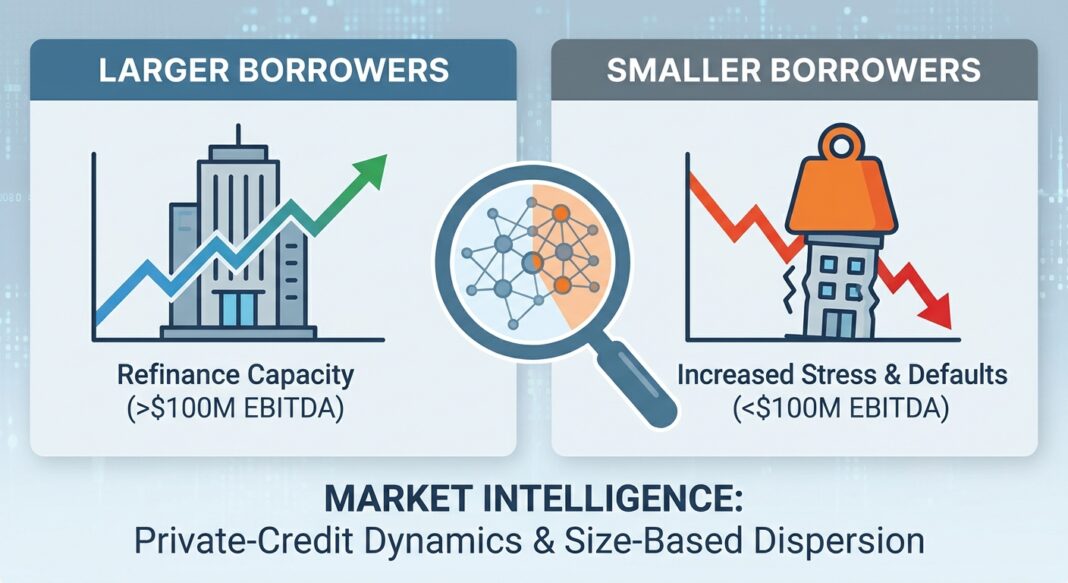
The most consequential credit signal is borrower dispersion, not a uniform retreat in lending. Houlihan Lokey’s November 19 release on Q3 data put private-credit defaults at 1.5% of outstanding principal, up from 0.8% in Q2. For borrowers with less than $100 million of EBITDA, the size-weighted rate was 3.9%, up from 3.0%; by count, defaults reached 5.0%. The data include technical as well as payment defaults, so they are not directly comparable with public-market payment-default measures. Still, the direction and the concentration by borrower size matter for refinancing capacity and portfolio surveillance. Houlihan Lokey, November 19, 2026.
Meanwhile, direct-lending pricing has moved wider while the syndicated market has regained larger transactions. PitchBook LCD’s October monitor says direct-lending spreads widened as syndicated spreads tightened, with the pricing gap growing since the start of 2026. Q3 direct-lending LBO spreads averaged 520 basis points over the base rate, versus 494 bps in Q2. That higher spread is paired with lower reported leverage for private-credit LBOs than for syndicated deals. The market is therefore offering lenders better entry pricing, but the cost is a tougher borrower pool as larger, better-rated companies can refinance in public markets. The October Federal Reserve SLOOS also reports unchanged C&I standards for large and middle-market firms, tighter standards for small firms, and tighter standards for loans to nondepository financial institutions. This is selective credit, not a generalized bank withdrawal. PitchBook LCD, October 2026 monitor; Federal Reserve, October 2026 SLOOS.
Quantitative Snapshot
Private-market figures below are latest Q3 observations reported in November; public-market spread data are daily through November 23. Spread conventions differ: private-credit spreads are quoted over the floating benchmark, while the high-yield figure is an option-adjusted spread over Treasuries.
| Metric | Latest and prior-period comparison |
|---|---|
| Direct-lending LBO spread | 520 bps in Q3, up from 494 bps in Q2 and 475 bps in Q1. PitchBook LCD data, reported November 19. |
| Middle-market direct-lending all-in yield | 9.61% in Q3, versus 9.25% in Q2. NEPC Q3 2026 report. |
| Direct-loan volume and deal count | $49.8bn across 208 Q3 deals, versus $37.6bn across 168 deals in Q2. Macquarie, November 2026, citing PitchBook LCD. |
| Leverage on Q3 LBOs | Private-credit first-lien and total debt: 4.0x pro forma EBITDA. BSL deals: 5.1x first-lien and 5.3x total debt. Covenant Review data, reported November 19. |
| Default measures | Private credit: 1.5% of principal in Q3, versus 0.8% in Q2, including technical defaults. Public leveraged-loan payment defaults: 0.55% in October, unchanged from September. Methods differ. Houlihan Lokey; PitchBook LCD, as reported by Goodwin. |
| U.S. high-yield OAS | 3.63% on November 23, up from 3.44% on October 30. FRED, ICE BofA U.S. High Yield Index OAS. |
The private-credit yield and leverage comparisons are not matched borrower cohorts, and the 9.61% yield includes first-lien and unitranche middle-market deals. A single market-wide FCCR threshold is not available in these latest releases. Underwriting discussions should therefore focus on borrower-specific cash-interest coverage, fixed charges, and the sensitivity of free cash flow to floating-rate debt, rather than treat spread or leverage averages as a substitute for coverage analysis.
Sector Analysis
Healthcare is a high-activity sector with a clear credit-quality fault line. NEPC reports healthcare represented 20% of new-issue direct-lending deals in 2026, up from 18% in 2025. Houlihan Lokey’s Q3 dataset, however, records healthcare defaults at 7.1% by count and 4.6% by outstanding principal, concentrated in provider platforms assembled through acquisitions. The activity share shows lenders are still financing the sector; the default data argue for underwriting reimbursement exposure, integration costs, and same-store cash generation separately from acquisition-adjusted EBITDA. NEPC, Q3 2026; Houlihan Lokey, November 19.
Consumer credit is also under pressure: Houlihan Lokey puts Q3 defaults at 4.6% by count and 2.5% by principal. Smaller borrowers amplify the issue. In the sub-$100 million EBITDA group, defaults reached 5.0% by count, and borrowers below $20 million EBITDA showed greater earnings volatility. For operators, working-capital headroom and downside liquidity matter more where demand is discretionary or customer concentration is high.
Software is being screened more carefully, but the available Q3 evidence does not support a blanket exclusion. NEPC says the sector’s share of PE-backed direct-lending deals fell to 12% year-to-date from 16% in 2025. Yet Houlihan Lokey reported software defaults at 1.0% on a size-weighted basis, with median revenue 24% above origination and median EBITDA 10% higher. The lending distinction is between durable recurring revenue and business models exposed to product substitution, not simply a software label. PitchBook LCD’s Q3 market survey likewise found software remained the least-favored credit sector for many respondents, while commercial and professional services and healthcare equipment and services ranked among preferred areas. PitchBook LCD, Q3 2026 survey.
Industrial and other non-software borrowers may benefit from lender competition. NEPC says non-software loan pricing often fell below SOFR plus 500 bps as capital competed for attractive deals. This creates a pricing advantage for stronger operators, but it can also compress lender returns without reducing company-specific risk. Asset-backed lending is one area investors are turning to where collateral and borrowing-base controls offer a different underwriting basis. NEPC, Q3 2026.
Implications
For borrowers: Financing access now depends more heavily on scale, cash conversion, and transaction fit. Larger or more broadly syndicated borrowers can test public markets for lower-cost refinancing, while smaller firms may depend on direct lenders and face higher spreads, lower leverage, and tighter terms. Before a refinancing or acquisition, operators should reconcile adjusted EBITDA to cash, build a monthly liquidity view, and stress-test interest expense and fixed charges against slower collections, lower volumes, and delayed synergies. Present FCCR calculations with explicit assumptions; do not rely on add-backs that have not converted into cash.
For lenders and investors: The spread premium is meaningful, but it is not a free risk premium. The gap partly reflects borrower scale, complexity, and reduced access to syndicated takeouts. Portfolio monitoring should separate technical defaults from payment misses, flag amendments and PIK interest, and track borrower performance by EBITDA band and sector. For healthcare platforms, test organic growth and integration independently. For software, review retention, pricing power, and product exposure at the borrower level. A strategy that depends on high leverage or a rapid refinancing exit is more vulnerable to the current market sorting process.
Next three to six months: The evidence points to continuing competition for large, higher-quality deals alongside tighter small-business bank standards and elevated stress among smaller private-credit borrowers. If syndicated spreads remain below direct-loan pricing, refinancing migration can continue and leave direct lenders with a more concentrated exposure to borrowers that cannot issue publicly. If M&A revives, new direct-lending volume may improve, but underwriting standards and lender economics will be tested by larger capital pools. Operators should preserve refinancing optionality early; investors should distinguish income from realized credit performance and liquidity at the fund level.
Key Market Insights
- Private-credit defaults increased in Q3, with the highest observed stress concentrated below $100 million of EBITDA.
- Direct-lending LBO spreads rose to 520 bps, while reported Q3 leverage was lower than in BSL-financed LBOs.
- Healthcare deal activity remains high, but provider roll-ups account for a concentrated share of sector stress.
- Software lending is selective rather than shut: reported operating results and default outcomes differ materially across business models.
- Borrowers should prepare cash-based coverage and liquidity evidence before refinancing; lenders should monitor amendments and non-cash interest alongside payment defaults.


