
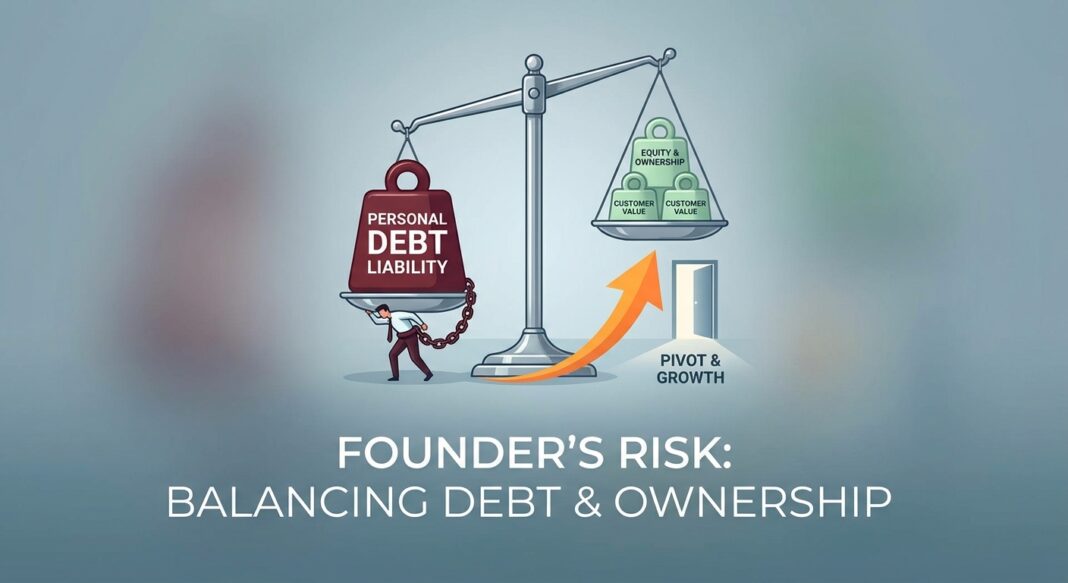
Key distinction: Tratta’s founder did not disclose a company-level leveraged buyout or a priced choice between a lender and a venture investor. Josh Allen’s story is about personal debt used to fund an early software effort, the risks that came with it, and the very different business he built after changing course.
The Story
Josh Allen came to software from merchant services. He hired contractors to build a payment portal for debt collection agencies and creditor-rights law firms. The problem was real, but the first product did not scale. Over about three years, it won five clients, while Allen accumulated well over $1 million in personal debt tied to the business.
The distinction between company borrowing and personal recourse matters here. The public account does not itemize the loans, interest rates, collateral, guarantees, or precise uses of proceeds. It does report that Allen was personally on the hook. That put household balance-sheet risk alongside the ordinary startup risks of weak product-market fit and unreliable software.
Allen had a choice: return to merchant services and repay the obligations over time, or start over. He had a young family and a product that was not working. The episode was not a clean story of cheap debt funding a proven growth plan. It was a founder financing an unvalidated build, then deciding whether to keep spending against evidence that the software needed a fundamental reset.
Tratta emerged from a back-office feature that one customer valued, rather than from the original portal concept. In an October 15, 2026 interview, Allen said the company had about $5 million in annual recurring revenue, just over 20 employees, and almost 100 clients. He had repaid the personal debt in late 2023 and had not taken outside funding, according to the Practical Founders interview.
The Decision
The documented decision was not “debt or VC.” Allen described two practical paths after recognizing that the software was not scalable: return to his prior line of work while repaying the debt, or start over. The public interview does not report a venture term sheet, an available corporate loan, or specific financing terms. It would be inaccurate to claim that he rejected a documented equity offer in favor of a cheaper debt facility.
Still, the case exposes the capital question founders often face earlier than they expect: who bears the downside if a product build fails? Equity capital can reduce personal exposure if raised on terms without founder guarantees, but it sells ownership and may introduce board rights, preferences, and investor expectations. Debt can preserve ownership, but repayment is fixed, and personal recourse can move the risk from the company to the founder.
For scale, consider a hypothetical $1 million equity raise at a $4 million pre-money valuation. The new investor would own 20% after the investment, before any later dilution. That is an illustration only. No such offer or valuation was reported for Allen. Nor is there public evidence that his personal borrowing carried standard commercial loan terms. The known structure is simpler and more consequential: more than $1 million of personal exposure, an early product with five clients, and no reported outside equity.
The important choice was therefore not leverage versus dilution in the abstract. It was whether more capital, from any source, could fix the product and customer-validation problem. The pivot began with a customer-valued feature, not a larger financing package.
The Outcome
Allen chose to begin again around the back-office function customers had shown they wanted. The later company sells software to collection agencies and creditor-rights law firms, with pricing linked to approved payments, according to the interview. The reported scale was about $5 million ARR, almost 100 clients, and a team of just over 20. The interview also said revenue and headcount had each doubled over the preceding year. Those figures describe the company as reported in October 2026, not audited financial statements.
Allen repaid the earlier personal debt in late 2023. Tratta had no outside funding at the time of the interview. This preserved founder ownership in the straightforward sense that no external equity investor had been reported, but it does not establish that borrowing caused the later growth. The company’s product reset, customer focus, and subsequent execution were distinct from the original financing decision.
There is no public counterfactual showing what would have happened with venture capital, a business loan without personal recourse, or an earlier shutdown. The equity illustration above shows the ownership arithmetic, not a forecast of Allen’s actual proceeds. A hypothetical investor’s 20% stake in a successful company might ultimately be worth more than the founder’s retained 80% in a failed one. Conversely, a founder who keeps all the equity but personally guarantees obligations can lose substantial personal wealth before there is any exit value to divide.
That is the case’s central outcome: the first financing-backed effort failed to scale, but the founder repaid the resulting personal debt and built a separate, customer-led software business without reported outside capital. The result supports neither “debt always wins” nor “equity is always safer.” It shows that ownership retention and founder risk are separate variables.
The Lessons
First, identify the borrower and the recourse. A company loan secured only by business assets has a different risk allocation from a loan personally guaranteed by its founder. Before comparing dilution with borrowing, map the legal obligor, guarantees, collateral, covenants, maturity, and repayment source. Allen’s interview reports personal exposure but not enough contract detail to reconstruct those terms.
Second, finance evidence, not hope. Five clients over roughly three years and software that did not scale were signals to revisit product scope. More capital can extend runway, but it cannot by itself establish customer demand or repair weak technical execution. Tratta’s later product grew from a feature a client already valued, a sharper validation point than the original broad portal concept.
Third, separate equity cost from debt capacity. A founder can compare the ownership sold in an equity raise with debt service under a downside case, but should not treat the two as interchangeable. Equity absorbs uncertainty and dilutes future proceeds. Debt preserves ownership only if the business can meet payments, and personal recourse can make a failed company a household liability.
A useful framework is to ask, in order: What customer evidence supports the use of funds? What milestone will the capital buy, and by when? Can expected cash flow repay debt under a slower-growth case? Who is liable if it cannot? What ownership and governance rights accompany equity? If those questions cannot be answered with reliable numbers, Allen’s experience argues for narrowing the experiment before increasing the exposure.
This is a founder interview, not a financing term sheet or audited case study. Its value is the boundary it makes visible: leverage can preserve equity, but personal recourse can put the founder’s own balance sheet behind an unproven product. In Tratta’s reported path, the eventual growth followed a product reset and customer validation, while the earlier debt remained a liability Allen had to repay.
Key Insights
- Allen reported more than $1 million in personal debt from an early software effort that won five clients over about three years.
- The public account documents personal exposure, not a company-level debt facility or a rejected VC offer.
- Tratta grew from a client-valued back-office feature; the interview reported about $5 million ARR and almost 100 clients in October 2026.
- Allen said he repaid the debt in late 2023 and had taken no outside funding for Tratta.
- Ownership preservation does not equal risk reduction: personal recourse can shift business failure onto the founder’s household balance sheet.


