
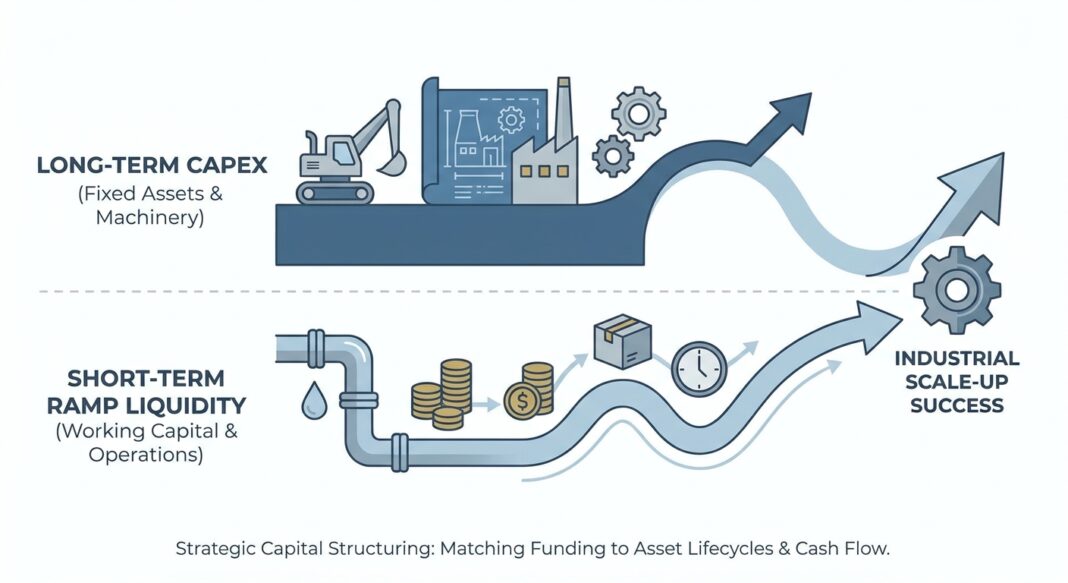
Industrial Scale-Up Capital: Separate Capex From Ramp Liquidity
A growth-stage manufacturer can have a bankable production line and still face a cash shortfall before that line produces saleable output. Construction, equipment installation, qualification, initial inventory, payroll, and customer payment timing create different funding needs. Financing them with one undifferentiated loan can mismatch repayment with cash generation, or tie operating liquidity to long-lived fixed assets.
The structuring question is not simply how much capital to raise. It is which source should fund each cost, when funds become available, and what repayment source supports each layer. For an industrial scale-up, a workable stack may combine customer prepayments or long-term commitments, grants or tax incentives, fixed-asset debt, a working-capital revolver, and equity for residual execution risk. Each component has separate conditions and timing. A conditional commitment is not cash available at closing.
This approach also fits the wider company lifecycle. Seed capital typically funds product and technical validation, often with equity. Early-stage capital supports commercialization and first customers. Growth capital funds repeatable capacity, inventory, and distribution. Mature businesses can use bank or public and private credit against established cash flow. Succession may add seller financing, acquisition debt, or equity from new owners. The appropriate layer depends on repayment capacity and the use, not the company label.
Start with the cost spectrum, then assign each use
Commercial banks are generally the first debt comparison for borrowers with reliable cash flow, collateral, and documentation. Asset-based revolvers can support eligible receivables and inventory; equipment or real-estate facilities can align borrowing with specific assets. SBA’s current lender materials describe its 504 program as long-term, fixed-asset financing used with private-sector lenders and certified development companies. Eligibility, collateral, advance rates, covenants, and timing still depend on the program and transaction.
Private credit may offer a more tailored facility, delayed draws, or greater flexibility when a project has unusual execution or timing demands, but the borrower must compare its full economics and control terms with bank debt. Public credit markets can suit larger, established issuers able to meet disclosure and execution requirements. Mezzanine debt sits below senior debt and can fill a borrowing-capacity gap, usually at a higher cost and with subordination terms. Preferred equity and common equity absorb risk without scheduled debt service, but bring governance, return, and ownership consequences. Public equity is available only to companies able to access that market.
Keep fixed-asset funding separate from ramp liquidity. Long-lived machinery or buildings can support term debt whose amortization follows the asset’s useful life and commissioning schedule. Receivables, inventory, and the lag between supplier payments and customer collections call for a revolving or borrowing-base structure, when the collateral and lender criteria fit. Equity or subordinated capital can cover costs that lack collateral or near-term repayment, such as qualification delays, cost overruns, or an unproven production ramp.
How a layered industrial stack works
Build a sources-and-uses schedule by milestone. Identify eligible project costs, the date each invoice falls due, and the expected source of repayment. Then separate committed sources from conditional ones. A government commitment, grant award, or tax credit that still requires approvals, appropriations, reimbursement, or milestone completion should not be treated as funded liquidity. Add a contingency reserve and show which source covers it.
GlobalFoundries’ November 4, 2026 Form 6-K describes a capital mix that includes operating cash flow, customer prepayments under long-term agreements, debt, government grants, and advanced manufacturing investment tax credits. It also identifies timing of customer payments and grant reimbursements among factors affecting future capital requirements. The example illustrates why a project’s sources should be sequenced against actual cash dates, not just its headline financing total. Read the company filing.
A different recent example is 6K Inc.’s November 5 announcement of a conditional loan commitment of up to $250 million for a cathode-materials facility. The company said disbursement depends on government authorization, available appropriations, due diligence, and satisfaction of financial, legal, technical, and regulatory conditions. It is evidence of a potential project-finance source, not evidence that the full amount was already funded. Read 6K’s announcement.
Gap capital playbook for a production ramp
- Quantify the gap. Build a monthly cash forecast from purchase orders through commissioning, qualification, shipment, invoicing, and collection. Calculate peak cumulative cash need, then subtract cash on hand and sources that are executed, drawable, and available on the required dates. Stress-test a delayed start, slower yield improvement, cost overrun, and slower collections.
- Prepare lender-ready evidence. Provide a detailed sources-and-uses schedule, equipment quotes, construction milestones, customer contracts, deposit and cancellation terms, inventory plan, receivables aging, historical financials, and downside forecast. Reconcile grant and incentive assumptions to documented eligibility, approval status, and reimbursement timing.
- Run parallel but distinct processes. Approach banks for asset-backed and working-capital capacity, specialist lenders for project-specific needs, and equity or subordinated investors for the portion that cannot support scheduled amortization. Compare proposals on committed availability, conditions precedent, draw mechanics, fees, collateral, covenants, and timing, not coupon alone.
Market access is not uniform. The Federal Reserve’s October 2026 Senior Loan Officer Opinion Survey, released November 2, reported that standards for commercial and industrial loans to large and middle-market firms were basically unchanged in the third quarter, while standards tightened for small firms. That survey is context, not a promise of approval for a particular borrower. See the Federal Reserve survey. The SBA separately reported $39.5 billion in 7(a) and 504 loan guarantees for fiscal 2026, as of its November 2 release, while also reporting that a shutdown had interrupted lending for nearly two months of the fiscal year. Access and timing both matter. See the SBA’s FY2026 release.
Negotiation priorities
For operators, negotiate draw conditions that track project milestones and avoid a gap between equipment delivery and lender funding. Seek a realistic availability period, cure rights for reporting or covenant breaches, and a clear path for additional debt or grants. Define permitted liens and intercreditor rights before signing multiple facilities. Confirm whether customer prepayments are refundable, restricted, or treated as debt-like obligations.
For investors and lenders, underwrite the completion path and the cash conversion cycle, not only steady-state earnings. Check that the borrower can service debt under a slower ramp, that the revolver borrowing base reflects eligible collateral, and that contingent public support is not double-counted as committed funding. The core structuring discipline is simple: match tenor to asset life, revolving availability to working-capital turnover, and risk-bearing capital to execution uncertainty.
Key takeaways
- Separate fixed-asset costs from inventory and receivables needs.
- Count conditional commitments only when their funding conditions and timing are understood.
- Use debt where repayment is supported by identifiable cash flow or collateral; reserve equity for risk the debt stack cannot safely carry.
- Model the cash gap monthly through commissioning, customer acceptance, invoicing, and collection.
- Negotiate availability, draw conditions, and intercreditor terms alongside pricing.


