
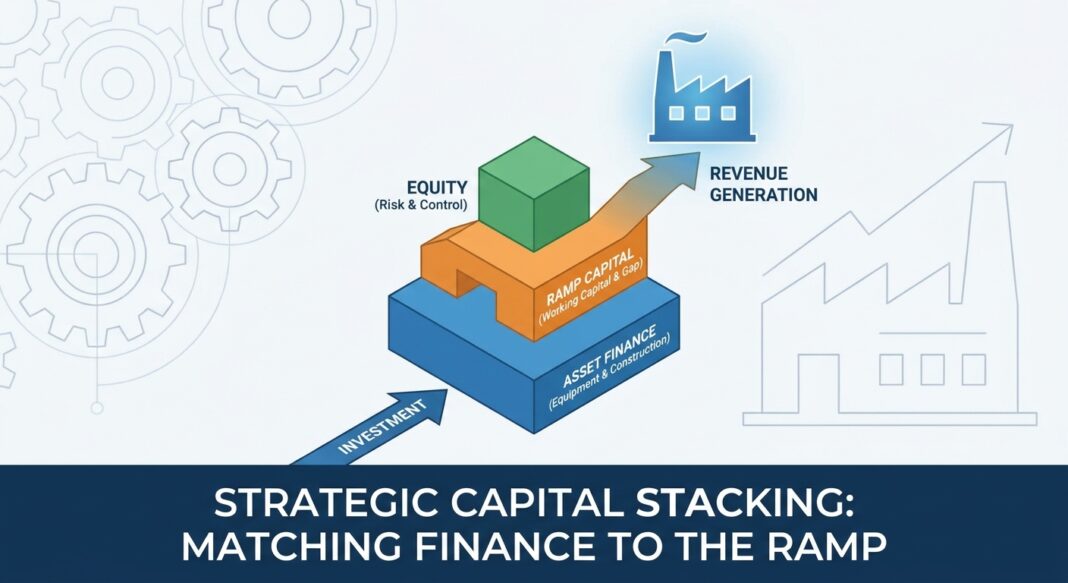
A growth-stage manufacturer wins demand for a new production line, but the cash leaves well before the line generates revenue. Equipment deposits, installation, facility work, hiring, and opening inventory each have different useful lives and collateral value. Funding all of them with one short-amortization loan can strain cash before the new capacity reaches steady output. Funding the whole project with equity can transfer more ownership than the ramp risk requires.
The structuring question is how to separate durable assets from the temporary cash conversion gap, then match each to capital with a repayment profile the business can support. The right answer depends on the company’s stage, cash flow, collateral, ramp schedule, and tolerance for control dilution. The aim is not to find one universal cheapest source. It is to build a stack in which each layer finances the risk it can actually underwrite.
Structure breakdown: fund the asset and the ramp separately
Start with a uses schedule that splits equipment and construction, installation, pre-opening costs, working capital, and contingency. Equipment with identifiable resale value may support equipment finance or a capital lease. Receivables and eligible inventory can support an asset-based revolver sized to a borrowing base. A bank cash-flow term loan or private-credit facility may fund uses that depend on enterprise cash generation rather than a specific asset. These facilities differ in collateral, repayment, covenants, and availability; they are not interchangeable.
For a real expansion example, 6K announced on November 5, 2026, a conditional loan commitment of up to $250 million from the U.S. Department of War to support construction and development of a cathode-materials production facility in Tennessee. The announcement describes intended use and conditional status, but does not disclose pricing or a final loan agreement. It is therefore a project-specific example of long-horizon expansion capital, not a market pricing quote or a template for another borrower. See 6K’s announcement.
A term-sheet review for a comparable project should establish the committed amount and eligible uses, conditions for each draw, draw period, maturity, amortization, interest and fees, collateral and guarantees, financial covenants, reporting, prepayment rights, and remedies. If the project’s output will take time to monetize, test whether interest-only or capitalized interest is available and how the balance grows. Do not treat a conditional commitment as cash available at closing. Confirm all conditions, approvals, and funding milestones.
How it compares: map stage and use of proceeds
- Seed: uncertain product-market fit usually points to founder capital, grants, or equity, since operating cash flow and collateral are limited.
- Early revenue: working capital may fit a small bank line or receivables facility when collections are demonstrable; equity can fund product development and losses without scheduled debt service.
- Growth: recurring earnings and assets can support a mix of bank debt, equipment finance, ABL, or private credit, with preferred or common equity for risk the debt capacity cannot carry.
- Mature: banks and public or private credit can fund refinancing, ordinary capex, and some acquisitions when cash flows are stable; equity remains relevant for large or highly uncertain investments.
- Succession: cash-flow debt, seller financing, preferred capital, or buyer equity may fund a transition, with control and repayment obligations negotiated together.
Across the cost spectrum, bank debt is often the first comparison for borrowers with predictable cash flow and acceptable collateral, but borrowing limits and covenants constrain access. Equipment lenders and ABL providers focus more on asset value or borrowing-base eligibility. Private or public credit may offer greater size or execution flexibility, with pricing and documentation dependent on credit quality and market access. Mezzanine sits below senior debt and can fill a gap, often at higher cost and sometimes with PIK interest or an equity feature. Preferred and common equity absorb more business risk, in exchange for economic rights and, depending on terms, governance or ownership dilution.
For plant expansion, avoid using long-term asset debt to cover an indefinite operating shortfall. Pair asset financing with a revolver for eligible working capital, and use subordinated debt or equity only for the portion that projected debt service cannot safely absorb. A borrower with strong collateral but uneven earnings may prefer an asset-based structure; a business with reliable cash generation and fewer lendable assets may be better assessed on cash flow. A long construction period can require patient, delayed-draw capital rather than a fully funded loan accruing interest before the project needs the money.
Current market terms and signals
The latest Federal Reserve Senior Loan Officer Opinion Survey, released in October 2026 and covering the third quarter, reported that bank C&I standards were basically unchanged for large and middle-market firms but tightened for small firms. Banks reported tightening premiums for riskier borrowers across company sizes, and collateral requirements and interest-rate floors for small firms. Net demand for C&I loans weakened across firm sizes. These are reported changes in bank practices, not a quote for any individual borrower. Federal Reserve, October 2026 SLOOS.
PitchBook’s November 6, 2026, U.S. Private Credit Monitor reported direct-lending spreads widening while syndicated-loan spreads tightened, with the pricing gap between the markets growing since the start of the year. Its public summary does not provide a single representative spread for plant-expansion borrowers. The practical takeaway is to compare executable proposals on total cost and documentation, rather than assume private credit is cheaper or that bank availability is unchanged. PitchBook, October 2026 U.S. Private Credit Monitor.
The 6K commitment announced November 5 is a further current example of conditional, use-specific expansion financing, with a disclosed maximum amount but no public pricing in the announcement. Together, these sources point to selective access: bank terms vary by borrower size and risk, while private-credit pricing has moved differently from syndicated markets. Do not infer a standard coupon, leverage multiple, or covenant package from these disclosures.
Gap capital playbook and negotiation
- Quantify the gap: build a monthly sources-and-uses schedule from deposits through commissioning and the cash-conversion cycle. Model delayed delivery, slower utilization, customer payment terms, and lower initial yield. Separate committed funding from conditional or unapproved sources.
- Prepare lender evidence: provide vendor quotes, construction milestones, equipment specifications and lien status, customer demand evidence, historical financials, a forecast with downside cases, and a reconciliation of forecast to debt-service capacity. Identify which assets and cash flows support each requested facility.
- Run a matched process: seek proposals from relevant banks, equipment lenders, and asset-based or cash-flow lenders using the same uses schedule. Compare availability, timing, draw conditions, total fees, cash-pay burden, amortization, covenant headroom, collateral overlap, and prepayment flexibility.
- Negotiate the gap layer: if debt leaves a funding shortfall, compare subordinated debt, preferred capital, and equity on cash cost, PIK accrual, warrants or conversion rights, intercreditor restrictions, control rights, and exit or redemption mechanics. For every lender, negotiate a clear collateral perimeter, cure rights, permitted liens, and treatment of future borrowing.
Operators should prioritize committed availability aligned with the project calendar and protect liquidity during the ramp. Investors should test whether draw conditions, reporting, collateral value, and covenant triggers give early visibility into cost overruns or delayed production. In every layer, negotiate the downside case as carefully as the headline price. Capital is useful only if its draw, repayment, and control terms fit the business plan.
Key takeaways
- Separate equipment, construction, and working-capital needs before choosing a facility.
- Match repayment tenor to asset life and the production ramp, not simply the closing date.
- Compare bank, asset-based, equipment, private-credit, mezzanine, and equity options by access, control, and total cost.
- Use current market reports as directional evidence, not as a substitute for borrower-specific proposals.
- Model draw conditions, collateral overlap, covenants, and downside liquidity before signing.


