
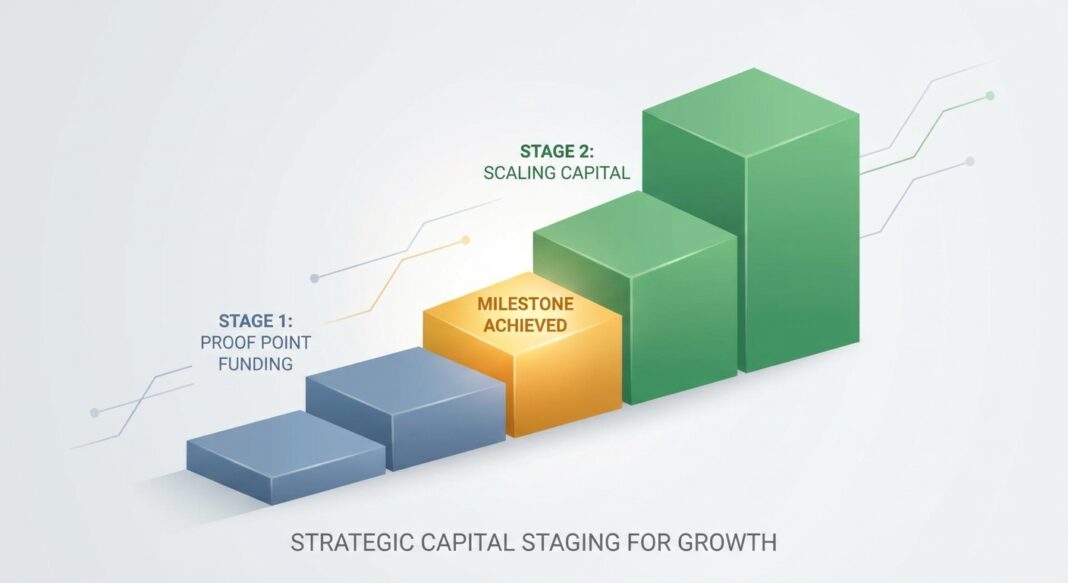
Growth-Stage Capital Strategy: Fund the Proof Point Before Scale
A growth-stage company moving from a validated product or service into repeatable sales often faces a mismatch: the next operating milestone requires cash now, while the revenue that supports conventional debt arrives later. The wrong response is to raise one large pool against an entire plan. That can burden the business with fixed payments before cash conversion is proven, or sell more equity than the near-term requirement warrants.
The capital decision starts with the use of proceeds and the event that repays each dollar. Hiring, product development, market entry, equipment, inventory, and receivables do not have the same risk or timing. A term loan sized to a recurring cash stream is different from an advance against eligible invoices. Equity is often a better fit for uncertain product or market risk, even when it has a higher long-term ownership cost.
Build the stack around the next proof point: the operating result that changes the company’s risk profile, such as repeat orders, positive contribution margin, or a stable collection cycle. Keep the capital committed for that milestone distinct from funding that is needed only if it is achieved.
Place each stage and use of proceeds in the stack
At seed, capital usually funds discovery and product risk. Founder capital, grants, and equity are common fits because there may be no dependable repayment source or collateral. In early commercialization, equity and milestone-based strategic capital can fund validation, while customer deposits or contract-linked advances may match specific work when payment obligations are clear.
At growth, combine sources rather than forcing every need into one facility. A bank revolver or asset-based lending line can fund eligible receivables and inventory. Equipment finance can match a machine’s useful life. A cash-flow term loan fits more predictable earnings and a defined repayment schedule. Private credit may offer greater size, speed, or structural flexibility, usually at a higher cost or with tighter controls. Mezzanine debt and preferred equity can bridge a funding gap when senior debt capacity is insufficient, but their PIK interest, redemption terms, or equity participation raise the total cost.
Mature companies can add syndicated or public debt when scale, reporting, and market access support it. At succession, a bank loan, seller note, rollover equity, or preferred capital can allocate purchase price and transition risk between buyer, seller, and new investors. Across stages, common equity sits at the highest point of the cost spectrum in ownership dilution, while secured bank debt is often cheaper but depends on collateral, cash flow, covenants, and lender appetite. These are tendencies, not universal pricing rules.
Structure the gap around the milestone
First separate the funding need into three buckets: committed operating costs through the next proof point, working-capital volatility, and optional expansion that should proceed only if the proof point is met. For each bucket, identify an asset, contract, recurring cash flow, or equity value that can support repayment. Do not use a short-term revolver to finance a permanent loss-making plan, or assume a discretionary delayed draw is committed cash.
Akebia Therapeutics’ November 2026 financing illustrates staged availability, not a general market quote. Its November 16 release described a $140 million senior secured term facility: $60 million funded at closing, used to repay a $55 million prior loan, plus up to $80 million available at the lender’s discretion. The disclosed loan has a 60-month maturity and interest-only period, with a variable rate equal to the greater of WSJ Prime plus 4.5% or 11.5%. The distinction between funded and discretionary capital matters: a borrower should not build its base-case liquidity plan around an uncommitted option. The example also shows how a refinancing can address an existing obligation while retaining conditional capacity for later needs. Akebia’s November 16, 2026 filing and release.
What recent market evidence says
The Federal Reserve’s October 2026 Senior Loan Officer Opinion Survey, released November 2, found C&I standards basically unchanged for large and middle-market firms during the third quarter, while standards tightened for small firms. Banks reported weaker demand, on net, from firms of all sizes. The Fed also reported tighter premiums for riskier loans across sizes and tighter collateralization requirements and interest-rate floors for small firms. This is a bank-lending survey, not a measure of private-credit pricing. Federal Reserve, October 2026 SLOOS.
A second current example shows how a mature borrower can use multiple layers for distinct purposes. On November 2, SS&C announced $240 million of incremental Term A loans, a $400 million revolver increase, and the launch of $500 million of incremental Term B loans. The company said the proceeds, alongside planned additional debt, were intended in part to refinance $2 billion of 5.500% notes due in 2027; the facility extensions were expected to move the A-loan and revolver maturities to November 2031. These were announced, conditional transactions, not completed market comparables or a benchmark for a smaller growth company. SS&C announcement, November 2, 2026.
Those releases provide specific structures, not universal current terms. They do not establish a standard spread, leverage multiple, or covenant package for all borrowers. The practical market signal is more limited: bank access varies by borrower size and risk, and publicly disclosed transactions distinguish liquidity, term debt, and refinancing needs rather than treating all proceeds as interchangeable.
The gap-capital process
Quantify: Build a monthly cash forecast through the milestone and a downside case with slower collections, delayed launch, or lower utilization. Calculate the minimum cash trough, existing debt service, fees, required reserves, and financing already committed. The gap is the shortfall after available cash and dependable facilities, not the total aspirational budget.
Prepare: Give lenders and investors a reconciled sources-and-uses schedule, monthly forecast, debt and covenant schedule, customer or contract evidence, borrowing-base detail where relevant, and a clear milestone definition. Separate contracted revenue from pipeline and label assumptions. Show what happens if the milestone is late.
Run the process: Approach capital providers whose repayment model matches the proceeds. Compare a bank revolver, asset-based facility, cash-flow debt, private credit, mezzanine or preferred capital, and equity on usable availability, timing, collateral, amortization, covenants, fees, and dilution. Compare total cash cost and control rights, not headline coupon alone. Maintain a base plan that works without discretionary capital unless that capital is documented as committed.
Negotiation points
Operators should negotiate for availability that tracks actual need: borrowing-base definitions for working capital, objective conditions for delayed draws, a maturity beyond the period required to reach stable cash generation, and cure rights and reporting obligations the team can realistically meet. Test prepayment premiums, minimum liquidity, lien scope, baskets for future debt, and restrictions on acquisitions or distributions against the operating plan.
Investors should examine whether the milestone is measurable, whether cash proceeds have a controlled use, and whether repayment depends on a credible conversion event rather than optimistic growth assumptions. In a layered deal, document lien priority, intercreditor rights, and the treatment of PIK or preferred returns. The objective is a stack in which each instrument funds a risk it can bear and has a repayment path that does not require the next financing round to arrive on schedule.
Key takeaways
- Start with the use of proceeds and repayment source, not the lender’s product menu.
- Separate committed liquidity from discretionary future capacity.
- Match receivables, equipment, and recurring cash flow to instruments designed for those repayment sources.
- Use equity or structured capital for material uncertainty that debt cash flows cannot support.
- Measure the gap against a downside cash forecast and negotiate availability, tenor, covenants, and control rights together.


