
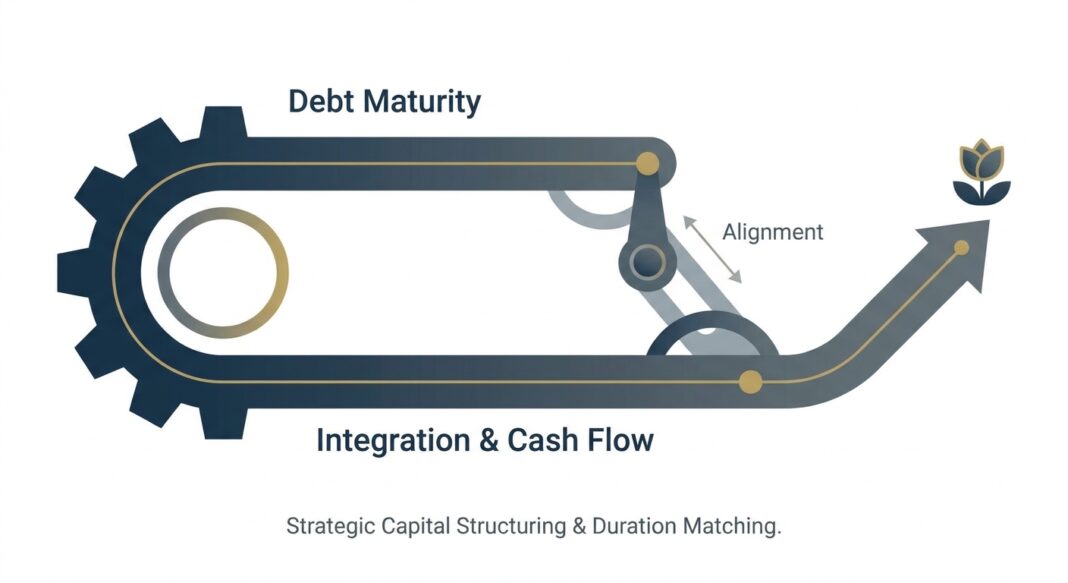
A growth-stage company buying a smaller business often has two different cash needs inside one transaction: purchase consideration due at closing, and integration spending that may take quarters to produce savings. Financing the full amount with short-maturity working-capital debt can put a refinancing deadline ahead of the operating plan. Funding every need with permanent equity can surrender more ownership than the risk profile requires. The capital-structure question is therefore not simply how much debt the buyer can raise. It is which funding layer should carry each use, and whether repayment timing matches the cash flow that use can generate.
That question changes as a company matures. Seed businesses usually fund uncertain product development with equity. Later-stage businesses can add debt as revenue, receivables, inventory, or contracted cash flows become underwritable. Mature businesses have more financing channels, while succession transactions must account for both purchase price and the continuity of the operating company. Across those stages, a useful discipline is to match capital duration to the time needed for proceeds to become cash.
Map the stack to stage and use
At seed, common or preferred equity usually bears the risk of product development and customer discovery. There may be little dependable collateral or operating cash flow to support scheduled debt service. In the early-revenue stage, equity can still fund losses and market entry; a bank line may become relevant when receivables or inventory support a borrowing base. Venture debt is a separate option for companies with institutional backing and a credible repayment path, not a substitute for equity where the business has no debt-service capacity.
At growth, split the use of proceeds. A revolver or asset-based facility can fund eligible receivables and inventory. Equipment or term debt can fund assets with useful lives that extend beyond the loan’s amortization. Acquisitions may use bank term debt, broadly syndicated loans for larger or more standardized borrowers, or private credit where certainty and customization matter. Mezzanine debt or preferred equity can fill a financing gap, but typically raises the all-in cost or introduces return participation. For a mature issuer, bank debt, private credit, public bonds, or a public equity raise can all be considered against scale, ratings, disclosure capacity, and market access. In succession, senior debt may fund part of a buyout; seller notes, rollover equity, or preferred capital can bridge valuation and cash-at-close differences.
The hierarchy is not an automatic ladder from “cheapest” to “most expensive.” Banks often price senior secured debt attractively but may cap leverage or require maintenance covenants. Private and public credit widen access for some borrowers, with terms shaped by scale, risk, and market conditions. Mezzanine and preferred capital can provide flexibility beneath senior claims, at a higher economic cost. Common equity has no scheduled debt service, but dilutes ownership and shares future upside.
Build the gap around cash conversion
Consider an illustrative $100 million enterprise-value software company acquiring a target. It needs $50 million of financing for purchase consideration and integration, and proposes a $50 million unitranche. This is a teaching example, not a reported transaction or a claim that the lender will advance that amount. A unitranche combines senior and junior debt economics in one borrower-facing facility. Lenders may allocate risk through first-out and last-out positions under an agreement between themselves, while the borrower typically deals with one lender group.
A term sheet would distinguish funded amount, permitted uses, delayed-draw availability if applicable, cash interest, amortization, maturity, call protection, leverage tests, covenant headroom, and collateral. As a current market reference, Pathway Capital Management’s November 2026 report describes 3Q 2026 sponsored middle-market spreads of 450–550 basis points over SOFR, original issue discount of 98–99, unitranche leverage up to 6.0x, and average equity contribution of 40%–55%. It also reports a three-year-call yield range of 9.5%–10.5%. These are market observations, not a promised quote or a universal standard; the report cautions that deal terms vary. The example should therefore be tested against the company’s actual EBITDA, debt capacity, and downside case, not against enterprise value alone.
Cash-pay interest is the base case to model. A PIK toggle can defer some cash interest, but it increases principal and the eventual repayment burden; it should not be treated as durable operating liquidity. Warrants or another equity kicker are not assumed in this example. If proposed, their dilution and exercise economics belong in the total cost comparison. The key structural test is whether the integration period, expected savings, and required amortization fit the same cash-flow forecast.
Run the gap-capital playbook
- Quantify the uses. Separate purchase price, fees, integration, capex, working capital, and minimum liquidity. Build monthly sources and uses, then show when each expenditure converts into revenue, savings, or collateral.
- Set debt capacity from cash flow. Reconcile reported EBITDA to supportable earnings, then model interest, amortization, capex, taxes, and working-capital swings under a downside case. The residual is not automatically mezzanine: compare it with reduced purchase consideration, seller financing, equity, or phased spending.
- Prepare lender materials. Provide historical financials, monthly forecasts, customer and contract data, receivables and inventory detail where relevant, acquisition diligence, integration milestones, and a clear schedule of debt maturities. Keep one controlled model so lender cases can be compared on consistent assumptions.
- Run comparable processes. For a suitable borrower, solicit bank, syndicated, and private-credit alternatives in parallel. PitchBook’s October 2026 U.S. Private Credit Monitor reports that direct-lending spreads widened while syndicated spreads tightened, and that the syndicated market refinanced substantially more direct-lending debt than vice versa. That evidence supports checking both channels when eligibility and execution timing permit, rather than assuming one market is always cheaper.
Negotiate for flexibility that has value
Compare total economics, not headline spread alone: include original issue discount, fees, call protection, unused-line fees, amortization, and any PIK or equity participation. Negotiate delayed-draw conditions, acquisition baskets, add-on debt capacity, permitted liens, restricted-payment limits, covenant definitions, cure rights, and reporting timelines against the operating plan. Ask how integration delays affect covenant headroom and whether excess cash sweep or mandatory prepayment terms trap liquidity needed for the business.
For investors, focus on the durability of cash conversion, collateral coverage, downside leverage, and the repayment source at maturity. For operators, the structure should leave room for ordinary working-capital volatility without relying on optimistic add-backs or repeated refinancing. The Federal Reserve’s October 2026 Senior Loan Officer Opinion Survey found C&I standards basically unchanged for large and middle-market firms in 3Q 2026, while standards tightened for small firms; it also reported tighter pricing for riskier loans and weaker net demand across firm sizes. Access is therefore borrower-specific. The financing process should test the stack against the business’s actual stage and cash cycle, not a generic market label.
Key takeaways
- Match debt maturity and amortization to the time proceeds need to generate cash.
- Use revolvers for working-capital cycles, term debt for durable assets, and equity for uncertain or long-payback risks.
- Measure gap capital only after separating transaction costs, integration, liquidity, and operating needs.
- Compare banks, syndicated loans, and private credit where the borrower can access each market.
- Price PIK, warrants, covenant flexibility, and call protection as part of the total capital cost.


