
Cohort Retention Underwriting: Price Renewal Risk into Debt Capacity
The underwriting question
If a borrower reports stable recurring revenue, how much of that revenue will renew without price concessions, cross-selling, or replacement customers? For a lender, a headline renewal rate can obscure shrinking contract value, concentrated renewal dates, customer downgrades, and revenue that depends on discretionary projects. Those weaknesses matter because the debt is serviced by cash collections, not by the label “recurring.”
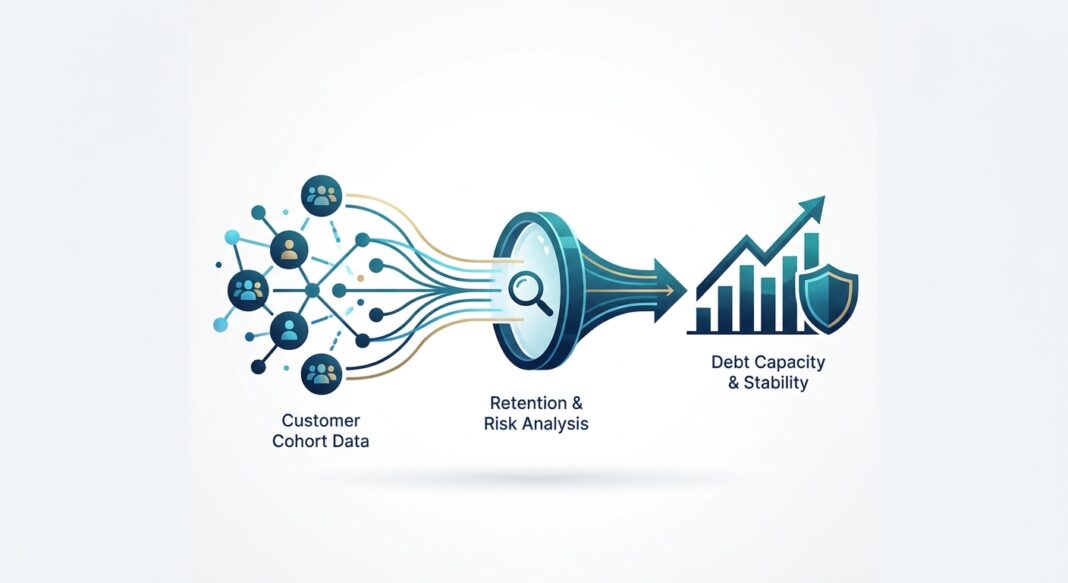
Cohort retention analysis tests the durability of revenue at the customer and contract level. It separates existing-customer performance from new bookings, then translates lost or delayed renewals into EBITDA, leverage, interest coverage, liquidity, and covenant headroom. The approach is useful for software, outsourced services, maintenance, distribution, and other businesses with repeat customers or renewal-based revenue. It is not a substitute for a full cash-flow model. It gives that model a more defensible starting point by testing what customers actually renewed, reduced, delayed, or left.
The framework
Build a customer-by-customer schedule using at least three completed annual renewal periods, or enough periods to capture the business cycle and contract terms. Fix each cohort at its original customer population and opening-period revenue. Track each customer’s renewal date, contract value, price changes, volume, usage, downgrade, cancellation, payment status, and any replacement sale. Reconcile cohort revenue to the general ledger, billings, accounts receivable, and management’s recurring-revenue reporting.
Calculate gross revenue retention (GRR) as opening cohort revenue less churn and contraction, divided by opening cohort revenue. Calculate net revenue retention (NRR) by adding expansion revenue to the retained opening cohort revenue before dividing by opening cohort revenue. Report logo retention separately: customer counts can remain high while large contracts contract, and revenue retention can look strong when a few accounts expand despite broad customer attrition. Definitions differ across issuers, so document whether price increases, acquisitions, foreign exchange, usage overages, and acquired customers are included.
Next, sort renewals by customer size, sector, product, contract length, sales channel, and renewal month. Identify the largest renewal cliffs and compare contract renewal rates with cash collection, gross margin, and customer acquisition cost. Apply a contribution margin to lost revenue, not a company-wide EBITDA margin by default. Then test whether cost reductions are executable and timely. A renewal loss can reduce cash immediately while payroll, facilities, implementation costs, or vendor commitments remain fixed.
Illustration: a recurring-services borrower has $10 million of EBITDA and a $25 million opening customer cohort. If cohort revenue falls to $23.75 million before expansion, GRR is 95%. If expansion adds $1.5 million, NRR is 101%. Both metrics matter. For debt sizing, the 101% figure should not erase the 5% underlying contraction unless the expansion is evidenced, repeatable, and collectible.
The analysis: convert churn into repayment capacity
Assume the $10 million EBITDA borrower has $40 million of debt, or 4.0x gross leverage, and $4 million of annual cash interest. Base interest coverage is 2.50x, calculated as EBITDA divided by cash interest. These are illustrative inputs, not reported market terms.
Now stress cohort GRR from 95% to 90% on the same $25 million base. The additional $1.25 million of revenue loss, multiplied by an assumed 35% contribution margin, reduces EBITDA by $437,500. Stressed EBITDA is $9.5625 million, leverage rises to 4.18x, and interest coverage falls to 2.39x if cash interest is unchanged. This isolates the incremental loss relative to the 95% case. A separate full downside case should also model actual churn from the borrower’s current revenue base, not just this cohort illustration.
Run a timing case as well as a permanent-loss case. Shift a major renewal or customer payment by one quarter and model cash receipts, payroll, taxes, maintenance capex, revolver availability, and minimum liquidity by month. Test whether covenant headroom survives before the renewal decision is resolved. Where the agreement permits add-backs, acquisitions, or incremental debt, calculate ratios using the defined covenant EBITDA and separately using lender-underwritten EBITDA. A gap between the two is a monitoring issue, not free borrowing capacity.
Industry standards and credit performance
The Federal Reserve, OCC, and FDIC leveraged-lending guidance calls for supportable base projections, realistic downside cases, repayment and deleveraging analysis, financial covenants, and ongoing variance monitoring. It also calls for timely reporting on covenant noncompliance, restructurings, delinquencies, and risk-rating migration. Applied to cohort analysis, that means testing customer renewal assumptions against actual results and refreshing the forecast when material accounts renew, downgrade, or pay late. See the Interagency Guidance on Leveraged Lending.
Recent default data also argues against treating a quiet payment history as proof that risk is absent. Moody’s Ratings reported six global speculative-grade corporate defaults in October 2026, with five involving distressed exchanges; the trailing 12-month issuer-weighted default rate was 4.3% as of October 31, 2026. Moody’s counted 98 defaults through October 2026, compared with 107 in the same period of 2025. These statistics cover Moody’s rated global speculative-grade issuers, not a direct-lending-only universe, and default definitions differ across datasets. Moody’s October 2026 Default Report provides the underlying context. S&P Global Ratings reported that repeat defaulters were 31% of year-to-date defaults through September 30, 2026, a reminder that a prior amendment or restructuring does not reset operating risk. See its October 2026 credit review.
Common underwriting errors include counting new-customer wins as retention, using NRR without GRR, accepting management’s contract status without executed documents, and assuming lost revenue converts dollar-for-dollar into saved costs. Other red flags are clustered renewal dates, discounts required to retain accounts, rising receivables days, renewal extensions without signed terms, and frequent amendments that capitalize interest or defer cash obligations. Define reporting covenants around customer metrics only when the borrower can produce them consistently and the definitions are fixed in the agreement.
Underwriting checklist
- Obtain monthly customer-level revenue, invoice, cash-receipt, churn, downgrade, and renewal records for the historical period. Reconcile totals to audited statements, the trial balance, and billing systems.
- Collect executed contracts, amendments, renewal notices, pricing schedules, termination rights, service-level commitments, and material customer correspondence. Confirm assignments, change-of-control provisions, and customer consent requirements.
- Recalculate GRR, NRR, logo retention, renewal rates, concentration, and cohort revenue by year. State definitions, exclusions, and denominator choices. Test source data to invoices and bank receipts.
- Interview sales, finance, and operations separately about churn reasons, discounting, pipeline conversion, implementation capacity, and cost actions. Compare explanations with customer records.
- Model base, downside, and timing cases through EBITDA, cash conversion, leverage, interest coverage, monthly liquidity, and covenant headroom. Document assumptions, sensitivities, covenant definitions, and escalation triggers.
- After closing, update renewal and collection results at each reporting cycle. Escalate material deterioration, missed reporting, covenant pressure, or repeat amendments under a documented watchlist and action plan.
Key takeaways
- Underwrite cohort-level GRR before giving credit to NRR expansion.
- Translate lost renewals through contribution margin and delayed cost actions.
- Measure contract timing, cash collections, and monthly liquidity, not only annual revenue.
- Reconcile customer metrics to contracts, billing records, accounting data, and cash.
- Monitor renewals and covenant headroom after close, with defined escalation triggers.


