
MARKET HEADLINE
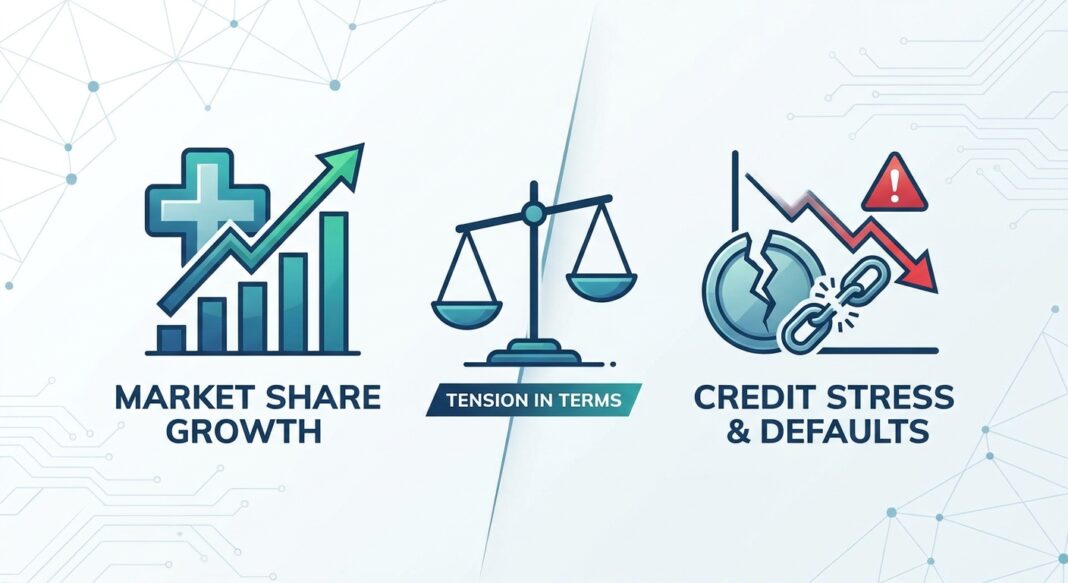
Healthcare is taking a larger share of new direct-lending deals, but it is also the most stressed major sector in the latest loan-level data. That tension captures the market better than a broad claim of either credit contraction or renewed risk appetite: lenders are still financing transactions, while repricing exposure according to borrower quality, cash generation and industry risk.
In Q3 2026, healthcare represented 20% of U.S. private-equity-backed direct-lending deals year to date, up from 18% in 2025, according to NEPC’s November 5 quarterly report. Houlihan Lokey’s November 19 Private Credit DataBank release, however, put healthcare defaults at 7.1% by borrower count and 4.6% by loan principal in Q3, the highest sector readings in its dataset. Origination share is not a clean signal of lender confidence: healthcare activity includes varied business models, and provider platforms assembled through acquisitions drove much of the stress.
The broader price signal is also mixed. Average direct-lending LBO spreads widened to 520 basis points in Q3, while broadly syndicated loan spreads narrowed to 307 basis points, according to PitchBook LCD. Meanwhile, the Federal Reserve’s October SLOOS showed that most banks left C&I standards unchanged in Q3. This is a market-share contest, not evidence of a uniform bank retreat.
QUANTITATIVE SNAPSHOT
| Metric | Current | Prior comparison | Source |
|---|---|---|---|
| Direct-lending LBO spread | 520 bps, Q3 2026 | 494 bps, Q2 2026 | PitchBook LCD, Nov. 20 |
| BSL LBO spread | 307 bps, Q3 2026 | 332 bps, Q2 2026 | PitchBook LCD, Nov. 20 |
| Middle-market direct-lending all-in yield | 9.61%, Q3 2026 | 9.25%, Q2 2026 | NEPC, Nov. 5 |
| Direct-lending volume and deal count | $49.8bn across 208 deals, Q3 2026 | $37.6bn across 168 deals, Q2 2026 | Macquarie, November 2026 |
| Private-credit defaults, share of loan principal | 1.5%, Q3 2026 | 0.8%, Q2 2026 | Houlihan Lokey, Nov. 19 |
| U.S. high-yield OAS | 3.63%, Nov. 23, 2026 | 3.34%, Nov. 9, 2026 | FRED, ICE BofA index |
These measures are not interchangeable. Private-loan spreads are transaction pricing over SOFR, while high-yield OAS is a public-market index spread over Treasuries. Still, the comparison shows the premium paid for private execution and illiquidity: Q3 direct LBO spreads exceeded BSL LBO spreads by 213 bps. Public pricing has since repriced: high-yield OAS rose to 3.63% on November 23 from 3.34% on November 9. The all-in direct-lending yield also reflects base rates and transaction economics, not spread alone.
Deal flow remains selective despite the Q/Q rise in overall direct-lending volume. PitchBook LCD reported that direct lenders funded $9.34bn in new LBO debt in the three months ended October 31, against $24.25bn for BSL lenders, the lowest three-month direct LBO volume since 2020. NEPC reported $300bn of private-credit fundraising through Q3 2026. Capital formation has not translated into a matching pace of buyout deployment.
SECTOR ANALYSIS
Healthcare: It leads the tracked sector mix, but the default data demand a split by subsector and sponsor strategy. Houlihan Lokey said provider platforms built through acquisition accounted for much of the healthcare stress. Its Q3 figures were 7.1% defaults by count and 4.6% by principal. A lender evaluating a provider roll-up therefore needs to test same-store performance, labor costs, reimbursement exposure and integration costs separately from headline revenue growth. Sector growth alone does not establish debt capacity.
Software: Deal share is falling as lenders reassess legacy product exposure to AI competition. NEPC measured software at 12% of 2026 year-to-date PE-backed direct-lending deals by count, down from 16% in 2025. Houlihan Lokey nevertheless recorded a 1.0% Q3 size-weighted software default rate, among the lowest sectors in its dataset, and reported median software revenue 24% above origination levels. The contrast is important: current borrower performance can remain sound while valuation multiples and refinancing options weaken. Lenders are more cautious on older products than on software as a single sector category.
Consumer: Defaults were 4.6% by count and 2.5% by principal in Q3, second only to healthcare by count in Houlihan Lokey’s figures. Consumer borrowers with narrow margins or discretionary demand exposure face less room for wage, input-cost or volume shocks. The data support tighter borrower-level stress tests, not a blanket exclusion of the sector.
AI infrastructure: Capital is moving toward data-center and compute financing even as lenders scrutinize legacy software. Pathway Capital’s Q3 market report describes AI infrastructure as a growing private-credit deployment theme. Underwriting here turns on contracted capacity, power availability, equipment life and counterparty strength. Those risks differ materially from recurring-revenue software credit and should not be blended into one technology exposure limit.
Across smaller borrowers, leverage discipline is tightening in practice. Houlihan Lokey put median leverage for lower-middle-market 2026 vintages at 3.8x, below 4.3x for 2025 vintages. Median interest coverage slipped to 1.68x in September from 1.73x in June, and the share below 1.0x rose to 15.1% from 13.9%. Interest coverage is not FCCR, but it is a timely signal that EBITDA resilience and cash interest have become more binding than headline spread.
IMPLICATIONS
For borrowers: Prepare for financing discussions to hinge on cash conversion, not only reported EBITDA or sector classification. Healthcare operators should separate organic growth from acquired revenue and show integration milestones, clinician retention and reimbursement sensitivities. Software companies should document renewal rates, churn, product-level AI exposure and customer concentration. Lower-middle-market borrowers should expect lenders to scrutinize add-backs, maintenance capex and liquidity headroom. A 3.8x observed median for recent small-borrower vintages is a market reference, not a universal leverage ceiling.
For lenders and institutional investors: The pricing gap over BSL loans compensates for bespoke execution and illiquidity, but it does not by itself cover weaker underwriting or delayed loss recognition. Compare default series carefully: Houlihan Lokey includes technical as well as payment defaults, so its private-credit rate should not be directly equated with public loan payment-default measures. Portfolio review should distinguish sector exposure from risk drivers such as acquisition dependence, sub-1.0x interest coverage, second-lien position and refinancing needs. Reported deal counts can conceal meaningful quality dispersion.
Liquidity outlook, next three to six months: The October Federal Reserve SLOOS found 89.7% of respondent banks kept standards for C&I loans to large and middle-market firms basically unchanged over Q3; 8.6% tightened and 1.7% eased. That is not evidence of a broad banking pullback. Yet in the buyout market, syndicated lenders’ lower Q3 pricing and larger recent LBO volume give sponsors a credible alternative for marketable credits. Private lenders are likely to retain an edge where certainty, speed, confidentiality or complex structures matter, while spreads and covenants remain more borrower-specific. If public spreads stay volatile and default readings rise, liquidity may continue to favor larger, well-documented credits over marginal borrowers.
KEY MARKET INSIGHTS
- Healthcare deal share and healthcare defaults are rising together, so sector allocation should be tested at the subsector and borrower level.
- Q3 private LBO spreads widened while BSL spreads tightened; compare execution value with the 213-bp pricing gap.
- Fundraising remains substantial, but private lenders ceded recent LBO volume to syndicated markets.
- Sub-1.0x interest coverage increased to 15.1% in Q3. EBITDA downside is now a direct refinancing and covenant risk.
- For operators, lender readiness depends on verifiable cash conversion, liquidity runway and credible downside cases, not headline leverage alone.


