
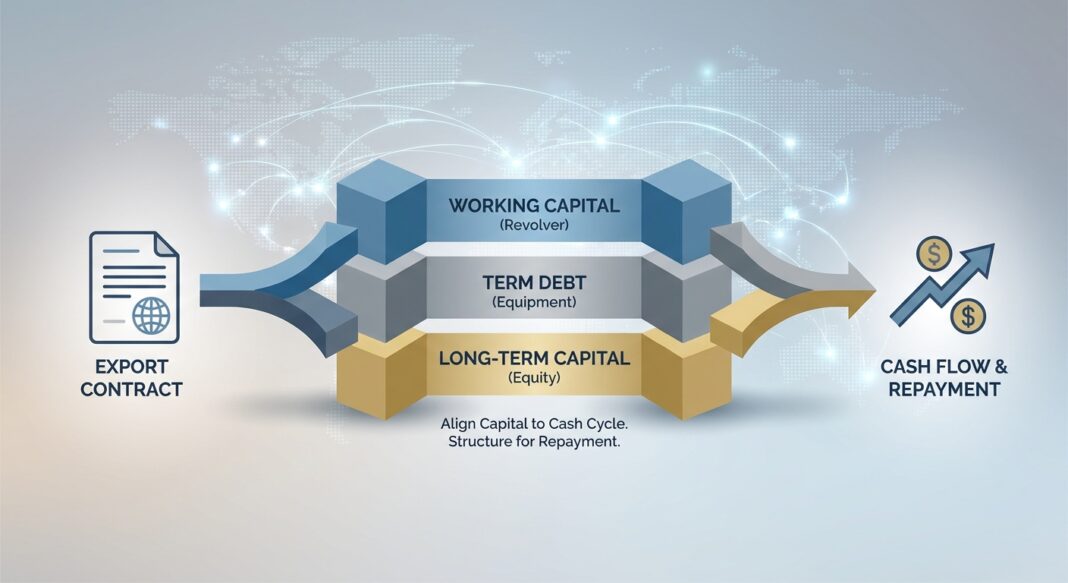
The growth-stage cash challenge
A growth-stage U.S. manufacturer wins a large overseas order. The customer payment is due after shipment, but the business must buy materials, pay labor, cover freight, and possibly post a performance bond before it can collect. The financing question is not simply how much capital the company can raise. It is which layer should carry each cash need, and what cash flow will repay it.
When a company funds a short production cycle with long-term debt, it can pay for unused capacity after the order is complete. When it funds equipment or a new market with a revolving line, it can face a maturity before the investment produces cash. A disciplined stack assigns working capital to receivables, inventory, and order costs; fixed assets to term debt; and riskier expansion to capital that can absorb a longer payback period.
The same logic changes across the business lifecycle. Seed companies usually rely on founder and investor equity because they lack collateral and predictable repayment. Early-stage firms may add customer deposits, grants, or limited venture debt alongside equity. At growth, banks and asset-based lenders can fund eligible working capital. Mature businesses can access syndicated loans or public debt if scale and reporting support them. Succession may combine senior cash-flow debt with seller financing, rollover equity, or preferred capital. The use of proceeds, rather than the company label, should drive the choice.
Build the order-finance structure around repayment
Illustrative case: a manufacturer with a signed export contract needs to pay suppliers and workers before receiving the foreign buyer’s payment. The core facility is a revolving working-capital line secured by eligible export receivables and inventory. Draws rise as approved production costs accumulate; repayment comes from the buyer’s collections. A borrowing base, reporting cadence, customer concentration limits, and controls over collections determine how much is available. If the buyer requires a bid or performance bond, the company should model the letter-of-credit capacity separately from cash advances because both consume bank availability.
For a lender concerned about export collateral, the exporter can ask its bank whether an export-credit guarantee is available. EXIM’s FY2026 annual report describes its Working Capital Guarantee Program as support for secured short-term loans, either a single loan or revolving line, with a repayment term of one year or less. The bank makes the loan; the guarantee supports the lender’s exposure. Eligibility and approval remain transaction-specific. EXIM FY2026 Annual Management Report.
Keep equipment separate. A production line or tooling purchase with a multi-year useful life is better matched to an equipment term loan, lease, or other amortizing facility than to an order-driven revolver. If the contract requires a new plant or a sustained capacity build, equity or longer-tenor private credit may cover the portion that cannot be repaid from one shipment cycle. Do not treat an uncommitted accordion as cash, and do not count the same inventory or receivable as collateral for two lenders.
A recent public-company example shows how proceeds can be ring-fenced: Ameresco disclosed a five-year, limited-recourse financing facility for European project and working-capital needs, separate from its senior secured corporate leverage ratios, with additional capacity subject to the facility structure. It is not a template for a smaller exporter, but it illustrates a key design choice: isolate financing against a defined business or cash-flow pool where documentation and lender consent permit it. Ameresco’s November 12, 2026 SEC-filed announcement.
Choose the layer by use, access, and economic cost
At the low-cost end, a bank revolver or asset-based line often fits a short cash-conversion cycle when receivables and inventory are eligible and the borrower accepts collateral monitoring, reserves, and borrowing-base limits. Export insurance or a government guarantee can improve lender access, but it does not erase repayment obligations or make weak order economics financeable. EXIM’s FY2026 report also says its charter authority to approve new credits ends after December 31, 2026 unless Congress extends it. As of November 28, 2026, borrowers should confirm program authority and timing before making it a critical path to closing.
Private credit can offer a negotiated structure where bank capacity is insufficient or execution flexibility matters, usually at a higher spread and with more lender-specific documentation. Larger, stronger issuers may compare syndicated loans or public bonds, which can reduce pricing but require scale, disclosure, and a marketable credit story. Mezzanine sits below senior debt and may use PIK interest or equity participation to defer cash cost, but increases total claims and exit dilution. Preferred equity has no scheduled principal payment like debt, but carries senior economic rights. Common private or public equity has no contractual debt service, yet gives up ownership and control. For a single export order, these junior layers are usually a poor substitute for a properly sized working-capital line unless the proceeds also fund strategic expansion that cannot be repaid from the order.
Current market terms and reference points
Current leveraged-buyout data are context, not a quote for export working capital. PitchBook LCD reported that in Q3 2026, average spreads on new-issue LBOs were 520 basis points over the base rate for direct lending and 307 basis points for broadly syndicated loans, as reported November 20, 2026. For Q3 2026, the same report recorded $24.25 billion of syndicated new-issue LBO debt versus $9.34 billion from direct lenders in the three months ended October 31, 2026. The report also said more than two-thirds of Q3 private-credit LBOs priced at 500 basis points or wider. These measures describe LBO debt, not trade facilities, and should not be applied as a borrower’s expected coupon. PitchBook LCD, November 20, 2026.
For exporters, the relevant structural standard is tenor and collateral fit. EXIM’s FY2026 report describes working-capital guarantees as short-term, one year or less, and available for a single loan or revolving line. SBA’s current export-finance materials describe both transaction-based pre-shipment working capital and asset-based lines against inventory and receivables; the program path depends on eligibility and lender underwriting. SBA lender program materials. Recent market pricing also shows why a company should compare bank and private-credit access rather than assume one channel dominates: public syndicated pricing was materially tighter than direct-lending LBO pricing in Q3, while private lenders still lead some borrowers in flexibility and certainty.
The gap-capital playbook and negotiation
First, quantify the peak funding need by week: supplier deposits, payroll, freight, duties, bond collateral, customer deposits, and expected collection dates. Reconcile the model to the contract’s payment milestones and downside cases for delayed acceptance, cost overruns, disputed invoices, and foreign-exchange movement. The peak need is not the same as the total contract value.
Second, prepare a lender file that connects the order to cash: executed contract and amendments, buyer credit information, production and shipment schedule, gross-margin build, historical borrowing-base certificates, receivables aging, inventory reports, and a 13-week cash forecast. Then approach relationship banks and qualified export-finance lenders with one consistent data room. For larger or more complex structures, compare direct lenders only after separating order liquidity from longer-term capex or acquisition needs.
Negotiate availability, not just headline commitment. Clarify eligible receivables and inventory, foreign-buyer and country exclusions, advance-rate mechanics, dilution and concentration reserves, dominion over collections, letter-of-credit sublimits, clean-down tests, unused fees, covenant triggers, and release mechanics when the order is paid. Match amortization to actual cash receipts. Investors should test collateral liquidation value, contract cancellation rights, buyer concentration, and whether the facility can be repaid if shipment or acceptance slips. A well-sized gap facility bridges a defined timing mismatch; it should not conceal recurring negative margins or permanently underfunded operations.
Key takeaways
- Match working-capital borrowing to the order’s cash-conversion cycle, not total contract value.
- Finance equipment and durable expansion with longer-lived capital, not a short-cycle revolver.
- Bank, private-credit, mezzanine, preferred, and equity capital trade cost against collateral, repayment pressure, flexibility, and dilution.
- Measure the peak weekly cash gap and test delayed shipment, acceptance, or collection before sizing availability.
- Confirm export-program eligibility and authority early, especially where a guarantee is central to closing.


