
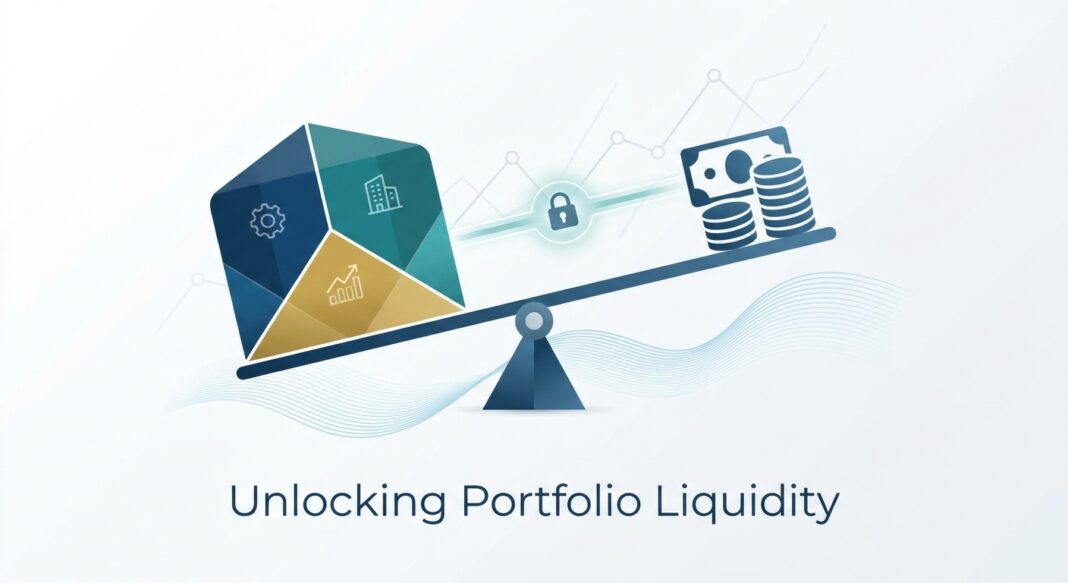
A NAV loan lets a private fund borrow against the value of investments it already owns. Unlike a subscription line, which is underwritten primarily against investors’ uncalled commitments, a net asset value facility is supported by the fund’s portfolio value and the cash it may generate. The distinction matters late in a fund’s life, when most commitments have been called but assets remain unsold.
For fund managers, NAV financing can provide liquidity without selling an investment immediately. For lenders and institutional investors, it adds a new debt claim between portfolio assets and the fund’s limited partners. The core underwriting question is not simply whether the portfolio has a high stated NAV. It is whether realizable portfolio proceeds, after existing debt and a stress haircut, can repay the facility on time.
This is fund-level leverage, not ordinary operating-company debt. A company can have modest leverage while the fund that owns it borrows materially against its equity value. Understanding both layers helps investors assess who gets paid first and helps operators compare financing with an asset sale or a capital call.
The Concept: A Loan Secured by Fund Investments
Net asset value (NAV) is the estimated value of a fund’s assets minus its liabilities. A NAV lender generally lends to a fund or holding vehicle and takes security over specified assets, such as the fund’s equity interests in portfolio companies, its interests in underlying funds, or related distributions and proceeds. The precise collateral package depends on the legal structure and existing financing.
The lender sets an advance rate, the portion of eligible collateral value it will lend against. It may also apply asset-specific haircuts, exclude assets that are difficult to value or sell, and cap exposure to any one company or sector. These adjustments produce a borrowing base, which is the amount of debt permitted by the eligible collateral under the facility’s rules.
That is different from relying on reported NAV at face value. Private assets are not continuously traded, so marks can lag changes in operating performance or market pricing. A lender therefore needs to test valuation assumptions, concentration, currency exposure, existing portfolio-company debt, and the time required to sell assets. A NAV facility may be recourse only to the borrowing vehicle and pledged interests, but that does not make losses disappear: fund distributions can be diverted, and limited partners’ residual value can fall.
How It Works: A Hypothetical Borrowing Base
Assume a closed-end fund owns equity interests in eight companies with a reported aggregate NAV of $500 million. It has little uncalled investor capital remaining, and it wants $80 million to meet follow-on investment needs and fund expenses while preparing portfolio exits. A lender agrees to a facility secured by the fund’s interests and proceeds, subject to a 20% advance rate on eligible NAV. For simplicity, assume every asset is eligible and there are no other deductions. The initial borrowing base is $100 million, calculated as $500 million multiplied by 20%. An $80 million draw therefore uses 80% of that base.
Now stress the valuation. One company represents 20% of portfolio NAV, or $100 million, and its estimated value falls by 30%, a $30 million reduction. Aggregate NAV declines to $470 million. At the same assumed advance rate, the simplified borrowing base falls to $94 million. The $80 million loan still fits, but remaining capacity falls from $20 million to $14 million. If the facility also applies a concentration haircut or excludes that company, capacity could be lower. This is why the loan agreement’s valuation rules can matter as much as the headline advance rate.
Suppose later asset sales generate $90 million after company-level debt and transaction costs. If the facility requires repayment of its $80 million principal plus accrued interest and fees from those proceeds, the lender is paid before the fund distributes the remaining cash, subject to the documents and other claims. The fund has avoided an immediate sale to raise cash, but it has encumbered future proceeds. If exits are delayed or sale prices disappoint, interest accrues and the fund may need to sell assets, contribute capital, or negotiate an amendment. The example is illustrative, not a market-standard term sheet.
Current Market Relevance
Recent data show why fund-level financing deserves careful analysis, but they do not establish a market-wide NAV loan volume. The Federal Reserve’s October 2026 Senior Loan Officer Opinion Survey, released November 2 and covering the third quarter, found that banks tightened standards on net for all surveyed loans to nondepository financial institutions, including private equity funds. At the same time, standards for commercial and industrial loans to large and middle-market companies were basically unchanged, while banks tightened for small firms. The survey describes bank credit conditions, not NAV-loan pricing or availability.
Preqin’s Q3 2026 update, published November 8, reported that private credit fundraising reached $185 billion through September 30, 2026, equal to 95% of full-year 2025 fundraising. Europe-focused funds accounted for 72% of Q3 fundraising, while 79% of surveyed investors planned to commit to only one private credit fund over the next 12 months. These figures point to substantial capital raising alongside selective allocation, not automatic demand for NAV borrowing.
Manager disclosures add scale, but should be read in context. Apollo reported $82 billion of dry powder at September 30, 2026, including $45 billion in credit. Dry powder is available investment capital across strategies, not a measure of NAV lending. PitchBook’s October 2026 U.S. Private Credit Monitor, published November 6, said direct-lending activity had edged higher over the prior three months on fewer, larger deals, while syndicated markets captured more large financings and direct-lending spreads widened relative to syndicated spreads.
Separately, a November 24 fund-finance market update from Haynes Boone described NAV financing as an active area and noted use across an expanding range of asset types. That is market commentary, not a quantified issuance series. The practical takeaway is to distinguish evidence of broader fund-finance activity from verified information about a particular lender’s NAV terms, collateral rules, and capacity.
Decision Framework for Investors and Operators
Investors evaluating a NAV lender or fund borrower can start with the denominator: which assets count toward eligible NAV, who sets marks, and what happens after a valuation decline? Then examine advance rates, asset concentration limits, permitted additional debt, maturity, interest-payment capacity, and mandatory repayment from sale proceeds. Review whether portfolio companies already have debt that ranks ahead of the fund’s equity interests. Finally, test an exit delay and a material valuation haircut together, rather than relying on a single downside case.
Operators considering a NAV facility can compare its all-in cost and restrictions with selling an asset, calling remaining commitments, or reducing planned distributions. The facility is more defensible when the use of proceeds is defined, the fund has a credible repayment path, and borrowing does not depend on a rapid sale at an optimistic valuation. Model interest and fees through a delayed-exit scenario. Confirm that fund documents, investor agreements, and existing portfolio-company financing permit the pledge and cash-control terms.
Both sides should separate liquidity from solvency. A loan can bridge timing, but it does not improve the underlying value of a portfolio or make an uneconomic investment viable. If repayment depends on asset sales, underwriting should focus on net proceeds after senior company debt, sale costs, taxes, and the NAV lender’s claim.
Key Takeaways
- A NAV loan is secured by fund investments or related proceeds, rather than primarily by uncalled LP commitments.
- Reported NAV is not the same as realizable collateral value. Eligibility rules, haircuts, and concentration limits determine borrowing capacity.
- Fund-level borrowing adds a claim against future proceeds and can reduce distributions to limited partners.
- Evaluate repayment under lower valuations and delayed exits, including existing company-level debt ahead of fund equity.
- Use current market data as context, not as a substitute for the specific facility agreement, collateral schedule, and repayment analysis.


