
The Story
In October 2026, SpaceX agreed to a financing structure aimed at a problem that conventional corporate borrowing does not solve neatly: how to bring a vast quantity of expensive, fast-aging computing equipment online without paying for all of it upfront or issuing more shares. The company’s agreement was a binding commitment to enter an approximately $40 billion master finance lease with an Apollo-managed lessor. The lessor would acquire GPU pods and related equipment, then lease them to SpaceX for use at data centers it selects. SpaceX’s October 26 announcement said the equipment would support its terrestrial compute buildout.
The scale is easier to understand against the company’s recent investment pace. For the nine months ended September 30, 2026, SpaceX reported $48.1 billion of capital expenditures. At that quarter-end, it held $51.3 billion of cash and $38.6 billion of marketable securities, alongside $38.0 billion of debt principal. In the third quarter, revenue reached $14.6 billion and adjusted EBITDA was $8.8 billion. Those figures show substantial funding resources, but also a business committing capital across launch systems, satellite connectivity, and computing infrastructure at once. The September 30 SEC filing details that capital intensity.
The story is not simply about a founder avoiding dilution. SpaceX is now publicly traded, and its capital decision was whether to add equipment through a lease-backed structure rather than finance the full purchase with cash or a conventional corporate equity issuance. The company’s CFO said the lease diversifies funding sources; SpaceX also described sub-one-year payback periods on its SI infrastructure investments. That payback claim is management’s assertion, not an independently established result. The key question for investors is whether utilization and customer demand will support the contractual payments before the equipment loses economic value.
The Decision
SpaceX had several broad paths. It could pay for GPUs from cash, issue more equity, borrow directly at the corporate level, or use a lessor and equipment-backed financing. Cash would avoid financing costs, but draw down liquidity needed for other large projects. Equity would avoid fixed lease payments and preserve borrowing capacity, but would dilute existing shareholders. Corporate debt would preserve ownership percentages, but place another repayment claim directly on the operating company’s balance sheet.
The selected route separates equipment acquisition from the operating company’s upfront cash requirement. Under the October commitment, an Apollo-managed entity would acquire GPU pods and related equipment, then lease them to SpaceX. The company expected aggregate principal payments under the lease schedules to total about $40 billion. Lease schedules were expected to begin on delivery in the first half of 2027, subject to closing conditions. SpaceX’s SEC-filed commitment disclosure sets out those terms.
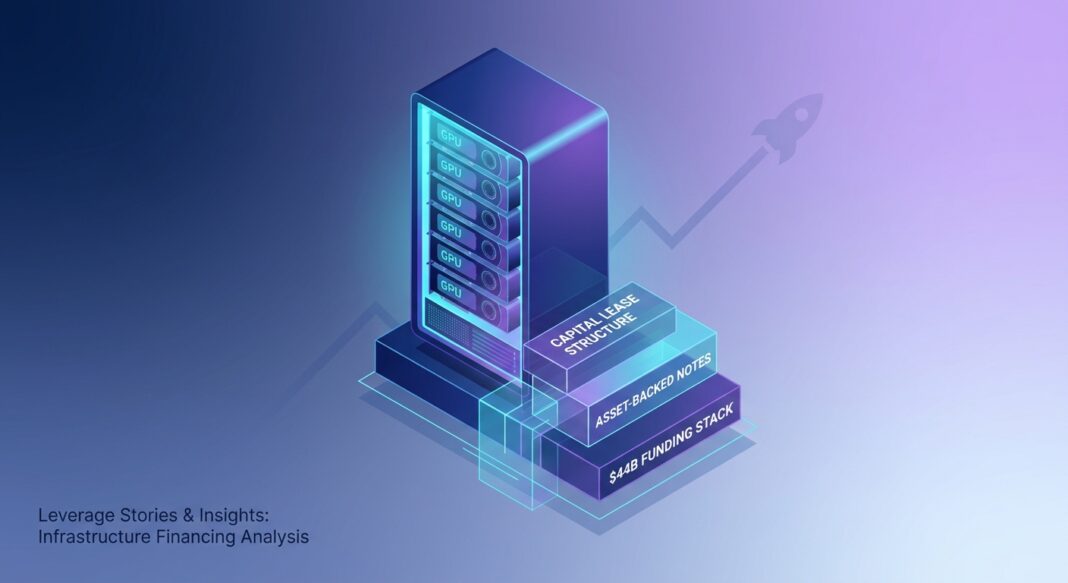
On November 20, Apollo and Goldman Sachs announced pricing of approximately $44 billion in senior and subordinated notes to fund the equipment purchase. They said the financing was oversubscribed and upsized, with BlackRock-managed funds, Goldman Sachs Asset Management, and KKR-advised capital accounts among the anchor commitments. The two figures describe different parts of the package: SpaceX disclosed expected lease principal payments of roughly $40 billion, while the arrangers announced approximately $44 billion of notes priced. They should not be treated as interchangeable amounts of corporate debt. Apollo and Goldman’s November 20 release describes the notes.
Reported deal coverage describes a special-purpose vehicle that buys the equipment and issues bonds supported by lease payments and collateral. The structure can reach investors who buy asset-backed securities, while keeping the financing tied to a defined equipment pool. The lease still creates fixed payment obligations for SpaceX. A finance lease is not free capital and does not transfer the demand risk away from the company using the GPUs.
The Outcome
As of November 26, 2026, the financing had been priced, but public disclosures still described the lease as subject to closing conditions, with equipment deliveries and lease schedules expected in 2027. There is no operating track record yet for this particular package, so it would be premature to call it a success or failure. What is observable is the structure and the capital allocation choice: SpaceX secured a large equipment funding channel without announcing a share issuance connected to this transaction.
The counterfactual cannot be given as a precise dilution percentage. SpaceX did not disclose a hypothetical equity valuation or price for an alternative issuance. A numerical comparison would therefore be invented. The relevant contrast is economic: equity has no scheduled principal repayment and absorbs business volatility, but gives new investors ownership and potentially governance rights. The lease preserves ownership percentages at issuance, but gives the company a contractual schedule to meet even if GPU demand, pricing, or utilization weakens.
For the lenders and noteholders, the equipment and lease cash flows provide a defined financing basis, though the assets’ resale value and technical life matter. For SpaceX, the arrangement converts a capital purchase into continuing payments while allowing cash to remain available for other uses. The difference between a productive lease and a drag on equity value depends on whether the infrastructure generates cash in time. SpaceX’s reported third-quarter SI segment revenue was $7.6 billion, but quarterly results do not establish that this GPU package will itself earn enough to cover its obligations. The SEC filing shows that the segment’s operating income was $431 million in that quarter, a more modest indicator than revenue alone.
The reported structure also contains a risk that headline proceeds obscure: complexity. The Los Angeles Times reported that the bond financing used a special-purpose vehicle and included asset-backed features, while some lease terms leave SpaceX responsible for payments even if equipment is not being used. Investors must understand where collateral sits, who controls remedies, and which party owes each payment. The November 23 report describes those structural considerations.
The Lessons
SpaceX’s transaction illustrates a specific form of equity preservation: fund identifiable equipment through a lease and financing vehicle rather than issue shares for the full purchase. It does not establish that debt is superior to equity. Debt works best when the asset produces reliable cash flow over a period that matches the payment schedule. It becomes fragile when expected utilization is uncertain, equipment obsolescence is rapid, or the borrower’s other investment programs compete for cash.
Operators considering a similar structure can use a four-part test. First, identify the repayment source. Model contract revenue and internal use separately, and do not treat forecast demand as contracted cash. Second, match the financing tenor to the asset’s useful economic life, including a downside case for faster obsolescence. Third, measure fixed charges against cash flow after maintenance spending and working-capital needs, not only EBITDA. Fourth, map control and recovery rights: who owns the equipment, who can repossess it, and what happens if a service interruption or covenant breach occurs?
Compare those results with equity on a like-for-like basis. Estimate dilution using a defensible valuation, then compare it with total lease payments, fees, asset residual value, and the value of keeping liquidity available. Consider governance too. Equity investors may bring oversight and shared downside, while lenders usually rely on contractual protections and repayment priority. A financing vehicle can preserve the cap table while still shifting substantial operating risk onto the company.
The discipline is to underwrite the downside before celebrating the absence of dilution. SpaceX reports enough cash, assets, and operating scale to pursue an aggressive buildout, but its published results also show investment spending at a very high level. The central test for this deal will arrive after delivery: can deployed compute earn returns that justify fixed payments throughout the equipment’s useful life? Until that is demonstrated, the $44 billion pricing is evidence of capital access, not proof of investment performance.
Key Insights
- A finance lease can fund equipment without issuing shares, but it leaves contractual payment risk with the operating company.
- SpaceX disclosed roughly $40 billion in expected lease principal payments; Apollo and Goldman announced approximately $44 billion of priced notes. These are related but distinct figures.
- Revenue growth does not by itself prove debt capacity. Utilization, cash conversion, and capital expenditure all matter.
- Asset-backed structures require close review of collateral ownership, enforcement rights, lease terms, and equipment resale value.
- Compare debt with equity using realistic valuation and downside cash flows, not an assumed dilution percentage.


