
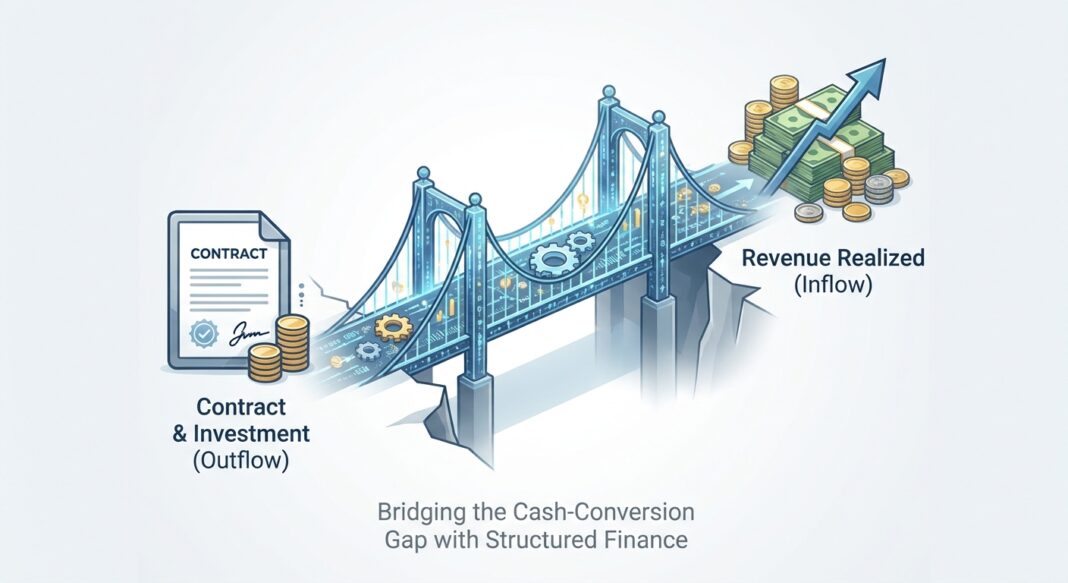
Growth-Stage Contract Finance: Bridging the Receivables Gap
A growth-stage company wins a large customer contract, but the cash arrives only after it buys materials, pays suppliers, and completes delivery. The challenge is timing, not necessarily a lack of demand. Funding the resulting cash-conversion gap with permanent equity can dilute owners for a need that may unwind when invoices are collected. Funding it with a long-term term loan can leave the company paying for working capital long after the receivable has turned into cash.
The right capital depends on the business stage, the asset being financed, and the certainty and timing of repayment. Seed companies often need risk capital because they have neither recurring cash flow nor lendable assets. Early-revenue firms can combine customer deposits, equity, and carefully sized working-capital facilities. Growth-stage companies with documented receivables and inventory can consider a borrowing-base revolver. Mature businesses may add cash-flow debt or public credit for durable uses, while mezzanine, preferred equity, or common equity can fill a gap that senior lenders will not carry. Succession transactions add seller notes and buyer equity to the mix.
For a contract-led growth business, the core question is whether the shortfall is a temporary asset-conversion need or a longer-term investment. That distinction sets the appropriate layer of the capital stack.
Match the proceeds to the repayment source
Start with the proceeds, not the lender product. A revolver or asset-based line is designed around eligible receivables and inventory, with availability set by a borrowing base and adjusted for exclusions, customer concentration, dilution, and reserves. A cash-flow term loan instead relies primarily on recurring operating cash flow. Equipment financing ties repayment to equipment use and useful life. Customer prepayments can reduce the amount borrowed, while factoring may accelerate collection of specific invoices at a cost that depends on the receivables and transaction.
A gap calculation should show the peak cumulative cash deficit across the contract cycle, then subtract unrestricted cash and committed, undrawn facilities. The forecast should identify when each supplier payment, payroll cost, shipment, invoice, and customer receipt occurs. Add a separately stated liquidity buffer. Do not blend that buffer with contract costs: lenders will test how much of the request is supported by eligible assets and how much depends on projected earnings or sponsor support.
A facility proposal can specify a revolving limit, collateral scope, borrowing-base formula, advance rates to be agreed after diligence, ineligible receivables, inventory appraisal rules, reserves, reporting frequency, maturity, and any clean-down requirement. If the contract also requires equipment or capacity that will remain in use after the receivables are collected, separate that longer-lived investment from the revolver request. SBA describes its 7(a) Working Capital Pilot as a monitored line for eligible small businesses, including contract fulfillment and borrowing against receivables or inventory; its program page outlines the framework.
Where the financing sits in the full stack
Bank debt is generally the first place to test for a documented, self-liquidating working-capital need, subject to collateral, cash flow, and lender appetite. Public credit markets are usually relevant to larger, established issuers with scale and reporting capacity. Direct lending can offer negotiated terms and execution flexibility, but price, covenants, fees, and call protection vary by borrower and transaction. Mezzanine debt adds subordination and often higher cost, sometimes with PIK interest or an equity feature. Preferred equity can supply capital without scheduled principal repayment, but carries negotiated distribution and control rights. Common equity has no contractual debt service, but transfers ownership and upside.
These layers are not interchangeable. A borrowing-base line can be efficient for eligible short-term assets, but it may not fund losses, unproven expansion, or long-payback investments. Cash-flow debt may fund broader corporate purposes if repayment capacity supports it, but increases fixed obligations. Mezzanine or preferred capital can address a senior-debt ceiling when the business has a credible repayment or value-realization path. Equity is often more aligned with uncertain returns, though it is the most dilutive form of capital.
The same use-of-proceeds logic shifts by stage. Seed funding typically absorbs product and market risk. Early-stage financing supports commercialization and runway. Growth capital funds working capital, hiring, or capacity only when the underlying economics and payback period are clear. Mature-company financing can support acquisitions, refinancing, or recapitalization. Succession capital must account for purchase consideration, seller rollover or notes, and the acquired company’s ability to service debt after ownership changes.
What current lending evidence says
The Federal Reserve’s October 2026 Senior Loan Officer Opinion Survey reported that, during the third quarter of 2026, C&I standards were basically unchanged for large and middle-market firms but tightened for small firms. Banks reported weaker net demand from firms of all sizes. These are broad bank-survey observations, not a quote for any particular borrower. See the Federal Reserve release.
PitchBook’s October 2026 U.S. Private Credit Monitor said direct-lending volume edged higher over the prior three months, while its year-to-date pace still trailed the previous year. The report also said sponsor-backed buyout financing was at its lowest level since 2020 and that direct-lending spreads widened as syndicated spreads tightened. It does not publish a single price that can be applied to every growth company. The October monitor is the relevant market snapshot.
Structure matters alongside stated price. In an October 22, 2026 market review, Goodwin reported PitchBook LCD data showing 376 conversions from cash interest to PIK in the second quarter, compared with 64 new PIK loans at origination among the covered group. This is a reported subset, not an estimate of the entire private-credit market. The distinction is useful: PIK at origination can be negotiated financing flexibility, while a later switch from cash pay may indicate that debt service has become difficult. See Goodwin’s October debt-market review.
The gap-capital process and negotiation
First, quantify the need by week or month, with base and downside cases for shipment timing, customer acceptance, invoice disputes, and payment delays. Separate the temporary contract build from operating losses, capex, acquisition consideration, and minimum liquidity. Second, prepare lender-ready materials: current financial statements, receivables and payables aging, inventory detail, customer and contract terms, borrowing-base support, cash forecast, and a bridge from forecast EBITDA to cash available for debt service. Reconcile assumptions to historical performance.
Third, approach relevant lenders with one consistent uses-and-sources schedule and ask each to state availability mechanics, fees, collateral, covenant tests, reporting, and funding conditions. Compare dependable proceeds at the projected peak need, not just the headline facility size. Before signing, negotiate the definitions that control availability: eligible receivables, customer concentration caps, dilution, inventory valuation, reserves, and treatment of disputed or unbilled work. Also test covenant headroom under delayed collections, the ability to add equipment or term financing later, and the release of collateral when the facility is repaid.
For investors, diligence the cash-conversion assumptions, customer concentration, contract cancellation rights, and downside liquidation value of collateral. The central structuring test is simple: temporary assets should support temporary debt; long-duration growth and uncertain outcomes need capital with a matching repayment profile.
Key takeaways
- Calculate the peak cash deficit from contract timing, not annual revenue alone.
- Use receivables or inventory facilities only to the extent assets meet the borrowing-base rules.
- Separate self-liquidating working capital from permanent capex, losses, and long-payback growth.
- Compare committed availability and covenants, not just the stated rate or facility size.
- Move down the stack toward mezzanine, preferred, or common equity when repayment is uncertain or senior debt capacity is exhausted.


