
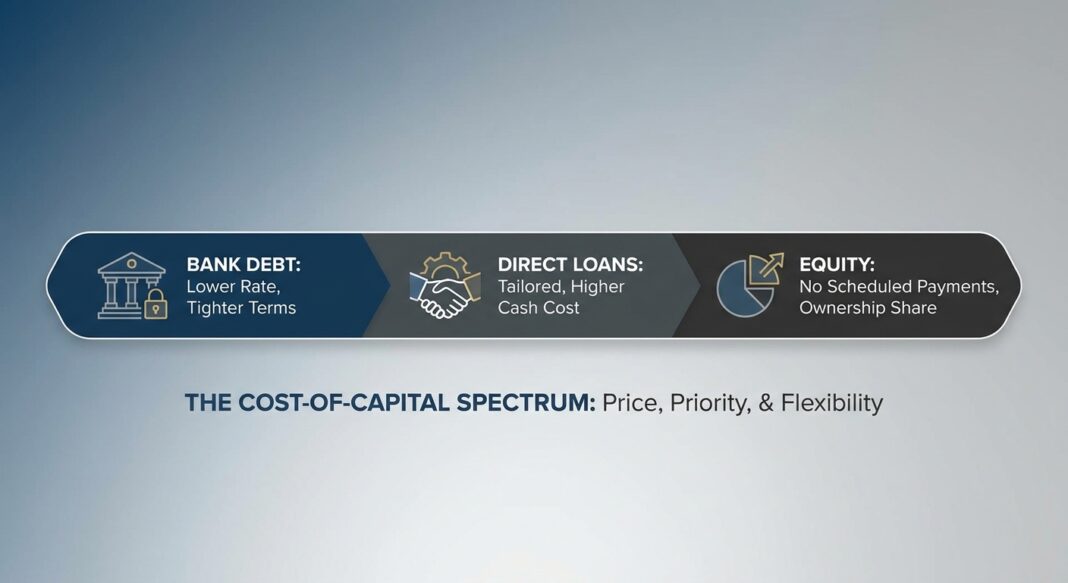
Every financing choice has a price, but the quoted interest rate is only one part of that price. A bank loan may carry a lower cash rate yet require tighter collateral, covenants, or repayment schedules. A direct private credit loan may cost more in interest while offering a larger, more tailored facility. Equity avoids scheduled interest and principal payments, but transfers ownership and a share of future gains. Comparing these options means looking at both cash cost and what the capital provider receives in return.
This is the cost-of-capital spectrum: bank debt, private credit, and equity make different claims on a company’s cash flow, assets, and control. The right comparison is not simply “Which rate is lowest?” It is whether the financing’s cash burden, restrictions, and risk allocation fit the company’s likely performance and the purpose of the money.
The Concept: Price, Priority, and Flexibility
Cost of capital is the economic return required by a capital provider. For debt, it usually includes interest, fees, original issue discount, and other contractual costs. The lender has a legal claim to scheduled payments and typically ranks ahead of equity in a restructuring. Secured lenders also have claims against specified collateral, subject to lien priority and the loan documents.
Bank debt is often the lowest-cost option for a borrower that meets a bank’s credit, collateral, and documentation requirements. But availability matters: a low quoted rate is irrelevant if the facility is too small, arrives too late, or restricts the intended use of proceeds. Direct lenders can structure larger or more customized loans for borrowers that do not fit bank programs. In exchange, they generally price for credit risk, illiquidity, and the facility’s structure.
Equity has no required coupon or maturity date. In return, the investor receives an ownership interest and a residual claim on future value. That makes equity’s cost less visible than debt interest, not costless. Founders and existing shareholders give up some ownership and may share governance rights and exit proceeds. Debt ranks ahead of equity for repayment, while equity absorbs losses first and participates more fully in upside.
How It Works: A $20 Million Funding Need
Consider a hypothetical company seeking $20 million to expand production. Assume a bank offers a four-year loan at 8% annual interest, a direct lender offers a five-year loan at 11%, and an equity investor offers $20 million at a $40 million pre-money valuation. These are illustrative assumptions, not current market quotes. Ignore fees, amortization, taxes, and changes in rates to isolate the basic trade-offs.
At the assumed rates, the bank loan requires $1.6 million in annual interest, while the private credit loan requires $2.2 million. That is a $600,000 annual cash-cost difference before principal repayment and fees. The bank option is cheaper on the stated interest rate, but the business must also test the covenants, collateral requirements, amortization, and whether the bank will fund the full amount. The direct loan costs more in this example. Its value to the operator would depend on whether its size, timing, maturity, or negotiated terms better match the expansion plan.
With equity, the company receives the same $20 million without scheduled interest or principal payments. At a $40 million pre-money valuation, the post-money valuation is $60 million, so the new investor owns one-third immediately after the investment, before any later dilution or deal-specific adjustments. If the company later sells for $100 million, that one-third stake would represent about $33.3 million of gross proceeds under this simplified example. Equity therefore protects near-term cash flow but gives away part of future value. It is not directly comparable to the two interest bills: equity return depends on the company’s eventual value, timing, and investor rights.
Current Market Relevance
Market access and pricing are changing the practical trade-offs. Preqin’s Q3 2026 Private Credit Quarterly Update, published November 8, reported that private credit fundraising reached $185 billion through Q3 2026, equal to 95% of full-year 2025 fundraising. In the same update, 79% of surveyed investors planned to commit to just one private credit fund over the next 12 months. The combination signals sizable capital formation alongside selective institutional commitments, not uniform demand for every borrower or manager.
The Federal Reserve’s October 2026 Senior Loan Officer Opinion Survey, released November 2, found that in Q3 2026 bank C&I standards were basically unchanged for large and middle-market firms, but tightened for small firms. The Fed defines “basically unchanged” as a net share of banks reporting a change between 0% and 5%. Banks also tightened premiums on riskier C&I loans across firm sizes and reported weaker demand for C&I loans overall. Bank credit is therefore not a single, equally available price point.
PitchBook’s October US Private Credit Monitor, published November 6, reported that direct lending spreads widened while syndicated-loan spreads tightened, and that direct lending activity rose over the latest three-month period on fewer, larger deals. PitchBook also reported that buyout financing fell to its lowest level since 2020. These trends make borrower size and transaction type important when comparing financing routes; averages do not describe every term sheet.
Capital supply also remains large at major managers. Ares Management’s Q3 2026 earnings presentation, released October 29, reported Credit Group AUM of $446.2 billion as of September 30, 2026, up 14% year over year. AUM is a manager-level measure, not a promise that any particular company can borrow or that the capital is immediately available for a specific deal.
Decision Framework for Investors and Operators
For investors evaluating private credit, start with the company’s ability to pay cash interest and repay principal under a downside case. Then examine lien priority, collateral value, covenant protections, maturity, and the amount of equity subordinated beneath the loan. Compare the total contractual yield with expected loss and recovery, not with a headline bank rate alone. A higher spread may compensate for more risk, but it does not remove that risk. Also consider how the fund or lender manages amendments and restructurings.
For operators selecting capital, match the financing to the use and timing of proceeds. A bank facility can suit predictable working-capital needs when the company qualifies and can live with its terms. Direct lending can be relevant when the required amount, execution timetable, or structure does not fit bank capacity. Equity merits consideration when uncertain or delayed cash flows make fixed debt service hazardous, or when preserving liquidity outweighs dilution. Compare total fees, required amortization, prepayment terms, collateral, covenant headroom, governance rights, and the amount of ownership sold. Stress-test the business at lower revenue and higher borrowing costs before treating any facility as affordable.
Key Takeaways
- Compare total financing cost and contractual obligations, not just the stated interest rate.
- Bank debt can be cheaper, but access, collateral, covenants, and repayment terms determine its real fit.
- Private credit may offer tailored capacity, with a higher cash cost that must be weighed against flexibility and execution.
- Equity removes scheduled debt service but transfers ownership, governance rights, and future upside.
- Investors should assess repayment capacity and recovery protection; operators should stress-test affordability and dilution together.


