
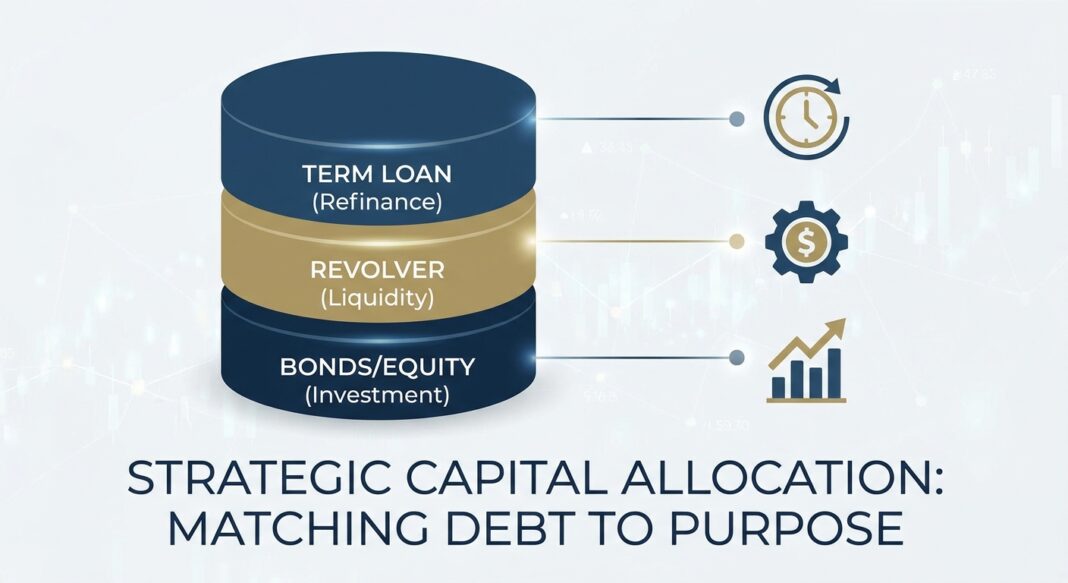
Mature-Company Refinancing: Match Each Debt Layer to Its Cash Need
A mature company approaching a bond or term-loan maturity has a different financing problem from a company funding its first product launch. The core question is not simply how much debt the business can raise. It is which part of the capital stack should fund the refinancing, protect day-to-day liquidity, and preserve room for investment while cash flow repays debt.
That distinction matters when a maturity date is fixed but the business’s cash needs are not. A term loan can refinance a known obligation; a revolver can cover working-capital swings; an equity layer can absorb risk that lenders will not take at an acceptable tenor or covenant level. Using one instrument for every purpose can leave the company with excess cost, insufficient liquidity, or repayment pressure before the funded investment produces cash.
The stack also changes by business stage. Seed companies generally depend on founder capital, grants, and equity because operating cash flow and collateral are limited. Early-stage businesses may add venture or milestone-linked capital. Growth companies can combine bank facilities, asset-based credit, private credit, and equity. Mature companies have more options, including public bonds. In succession, seller notes, preferred capital, and buyer equity can share transition risk. The proceeds and repayment source, not a generic stage label, should drive instrument selection.
Start with the use of proceeds, then build the stack
Separate the financing need into three categories: a scheduled maturity, liquidity for operations, and discretionary investment. Match each to its repayment source. A refinancing tranche should align with recurring free cash flow and the maturity it replaces. A revolver should support temporary working-capital needs and be sized against cash conversion and availability. Acquisition or expansion capital should have a tenor that allows integration or ramp-up before meaningful amortization begins.
Each layer carries a different access-versus-cost trade-off. Bank loans often offer revolving liquidity and can be economical for borrowers with predictable cash flow, but lenders may require collateral, amortization, and maintenance tests. Public bonds can reach a broad investor base and diversify maturities, though execution depends on market access and documentation. Private credit can provide a committed, negotiated solution, often with fewer lender groups but potentially higher pricing and tighter controls. Mezzanine adds subordinated debt below senior claims, commonly with a higher return requirement and sometimes PIK interest or an equity component. Preferred equity and common equity reduce fixed debt service but transfer value or ownership economics.
A company should not borrow long-term debt to fund a short-lived working-capital peak if a revolving facility can revolve with collections. Conversely, a revolver is not a substitute for permanent capital when the balance will remain drawn. That mismatch can turn a liquidity tool into a refinancing risk.
Deal example: refinance the maturity, preserve liquidity
SS&C Technologies’ November 2, 2026 announcement offers a public-company example of a layered refinancing plan. The company announced an additional $240 million of Term A loans and a $400 million increase in revolving commitments, alongside syndication of $500 million in incremental Term B loans. It said the proceeds, together with additional planned long-term debt subject to market conditions, were intended for general corporate purposes, including refinancing $2 billion of 5.500% senior notes due September 30, 2027. The company also expected to extend the Term A and revolver maturities to November 2031. The announcement described transactions subject to conditions, not a completed refinancing. SS&C, November 2, 2026 announcement.
The structural logic is more important than treating those amounts as a template. Term A debt and the revolver preserve a bank-style liquidity layer; Term B adds funded term debt; long-term debt issuance can address the near-dated bond maturity. The facility types separate liquidity from funded leverage, while the proposed maturity extension is intended to reduce near-term refinancing concentration. The announcement does not provide enough information to infer all final pricing, covenant terms, or allocation of each tranche, so those should not be assumed.
Current terms: use benchmarks with the right market context
Market terms vary by borrower, sector, leverage, collateral, and whether financing is sponsored. Pathway Capital Management’s 3Q26 private-credit update, published in November and reporting conditions as of September 30, gives a sponsored middle-market reference point: spreads of 450–550 basis points, original issue discount of 98–99, unitranche leverage up to 6.0x, and average equity contribution of 40%–55%. These are broad observations, not a quote for a mature public issuer or a promise of available leverage. Pathway Capital Management, 3Q26 Private Market Environment.
For bank availability, the Federal Reserve’s October 2026 Senior Loan Officer Opinion Survey reported that C&I standards for large and middle-market firms were basically unchanged in Q3, while standards tightened for small firms. Banks reported weaker net demand from businesses of all sizes and tighter collateralization requirements and interest-rate floors for small firms. This is evidence about survey responses, not a forecast that any individual borrower will receive the same terms. Federal Reserve, October 2026 SLOOS.
PitchBook’s October 2026 US Private Credit Monitor, published November 2026, reported widening direct-lending spreads alongside tightening syndicated-loan spreads, and said syndicated markets continued to win larger deals. That divergence makes a live comparison important: compare all-in cost, certainty, covenants, call protection, and maturity, not just headline spread. PitchBook, October 2026 US Private Credit Monitor.
The gap-capital playbook
Quantify. Build a sources-and-uses schedule by date, not just total dollars. Include the principal due, accrued interest, fees, minimum cash, seasonal working-capital peak, and committed investment. Then forecast cash flow under base and downside cases and identify the amount the company cannot fund from cash or committed facilities.
Prepare. Assemble audited financials, monthly reporting, debt documents, a maturity calendar, covenant headroom, collateral data, and a forecast that reconciles operating assumptions to cash available for debt service. Separate recurring earnings from one-time adjustments. Show how the proposed financing moves leverage, interest coverage, liquidity, and maturities under downside assumptions.
Run and negotiate. Seek comparable proposals across relevant bank, bond, and private-credit channels where execution timing allows. Compare total economics, amortization, call protection, unused revolver fees, collateral, guarantees, incremental-debt capacity, restricted-payment baskets, and covenant cures. Ask whether delayed draws can fund future needs rather than paying interest on cash held idle. Negotiate flexibility where the business plan requires it, but test that flexibility against lender protections and future refinancing options.
Key takeaways
- Classify every dollar by use and expected repayment source before choosing the instrument.
- Keep revolving liquidity distinct from permanent funded debt when the cash needs differ.
- Use current market benchmarks as context, not as borrower-specific term quotes.
- Compare financing on all-in economics, documentation, maturity, and certainty of funding.
- Model the post-close stack through downside cases, including the next maturity wall.


