
The story: A deadline inside the runway
On September 30, 2026, Akebia Therapeutics reported $159.3 million in cash and cash equivalents. The headline balance looked substantial, but the company’s financing calendar mattered as much as its cash balance. In its quarterly filing, Akebia said its estimate that cash and expected operating receipts could fund its plan for at least two years depended on refinancing its senior secured term loan. Without that refinancing, the company estimated its resources would cover at least 12 months from the filing date. Principal payments under the existing facility were scheduled to begin January 1, 2027.
The timing put a concrete constraint around management’s choices. Akebia sells kidney-disease medicines and also funds research and development. Its third-quarter revenue was $36.9 million, down from $58.8 million a year earlier, and it recorded a $14.4 million net loss. Generic competition had weighed on Auryxia revenue. A new equity issue could bring in cash without adding scheduled debt service, but it would dilute existing shareholders and set a price while revenue pressure was visible. A refinancing could defer principal, but it would leave the company paying interest and carrying secured debt.
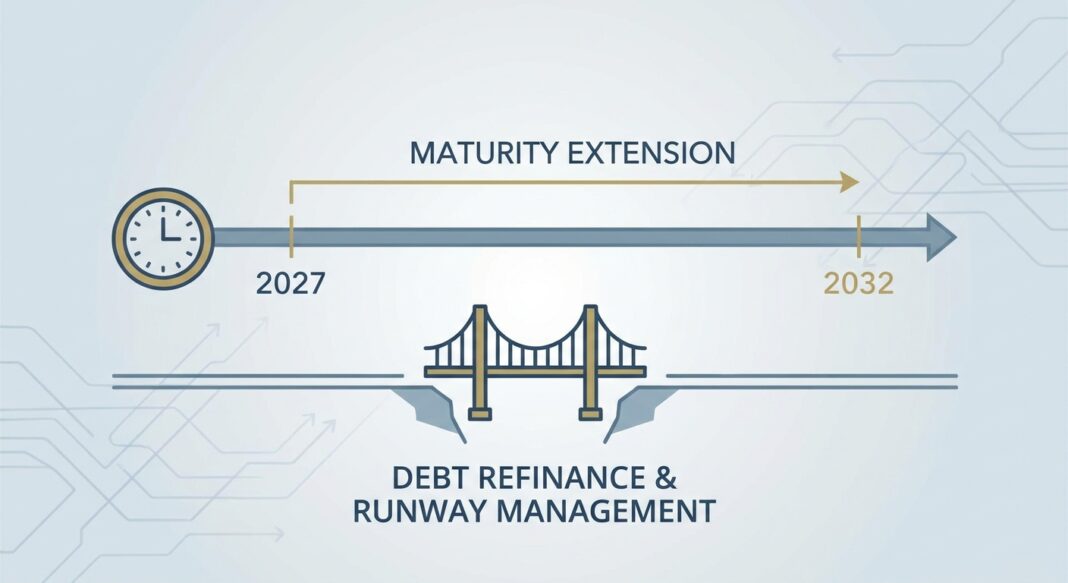
The company’s November 5 filing described that dependency before the refinancing announcement. On November 16, Akebia disclosed that it had closed a new facility with Symbiotic Capital on November 12. The deal was not an acquisition or a dividend recap. It was a maturity-management decision: replace debt that was about to begin amortizing with a new loan whose principal would not come due for five years.
Akebia’s November 5, 2026 Form 10-Q lays out the runway condition and quarterly financials. The November 16 financing announcement provides the new loan terms.
The decision: Buy time, accept the coupon
Akebia’s immediate choice was between refinancing the BlackRock facility, seeking alternative capital such as an equity raise, or managing the business against a nearer principal-payment schedule. The public record does not disclose a competing equity term sheet, nor does it say that management rejected a specific share issuance. The verifiable decision is narrower: Akebia completed a debt refinancing that deferred principal and kept the transaction non-dilutive at closing.
Symbiotic funded an initial $60 million senior secured term loan. Akebia used the proceeds to repay in full its $55 million BlackRock loan. The additional $80 million was not committed cash in hand: the company may request it, but Symbiotic has discretion over whether to fund it. The facility has a 60-month maturity and a 60-month interest-only period, with principal due at maturity. Its variable monthly rate is the greater of WSJ Prime plus 4.5 percentage points or 11.5 percent.
That structure shifts, rather than eliminates, the financing burden. There is no scheduled amortization during the five-year interest-only period, which protects near-term cash from principal payments. But the loan is secured, its floor rate is high, and the full principal remains due at maturity. The optional tranche could provide further liquidity if Symbiotic approves a request, but Akebia cannot treat that amount as certain availability.
The rationale disclosed by Akebia’s chief financial and business officer was operational flexibility and potential access to additional non-dilutive capital. Management reaffirmed its expectation of at least two years of cash runway. The company did not publish a borrowing-base formula or detailed covenant terms in the announcement, so those should not be inferred from the headline facility size.
The outcome: A refinancing, not a proven turnaround
The immediate outcome was clear: the old $55 million loan was repaid, and the company replaced it with a funded $60 million loan. The $5 million difference between new principal and the old payoff is not equivalent to $5 million of unrestricted growth capital. Fees, accrued interest, and other transaction uses can affect net proceeds, and the public announcement does not give a net-cash calculation. What it does establish is a five-year period before principal maturity, alongside interest-only payments during that period.
For shareholders, the transaction did not announce issuance of new shares to fund the refinancing. That preserves ownership percentages relative to a hypothetical equity raise, but the public record does not quantify a share count avoided or show that equity financing was actually available on particular terms. It would be unsound to claim the debt created more shareholder value than equity would have. Debt avoids immediate dilution; equity would avoid fixed interest and maturity obligations.
The operating picture remains the test. In the third quarter, Akebia’s revenue fell year over year and the company reported a net loss. Its cash balance at September 30 was $159.3 million, and its runway estimate depended on the refinancing and forecast receipts from product, royalty, supply, and license revenue. The refinancing addressed the timing of principal, not whether future product revenue will meet projections or whether the company can repay or refinance the new balance at maturity.
That distinction is the case’s central lesson. Debt can preserve equity when a business has a credible cash-generation path and the financing moves a payment wall beyond that path. If revenue underperforms, the interest bill and maturity can turn preserved ownership into a claim on a shrinking balance sheet.
The lessons: Underwrite the calendar, not just the cash balance
Akebia’s case suggests a practical sequence for evaluating a refinancing. First, locate the exact principal dates, amortization schedule, and maturity. A cash balance without that calendar can give a misleading sense of runway. Second, separate funded proceeds from conditional commitments. The $60 million was funded; the additional $80 million depended on the lender’s discretion. Third, stress-test cash flow after interest, not only before it. Akebia’s rate floor of 11.5 percent means the cost cannot fall below that level under the disclosed terms.
Then compare the debt path with an equity path using explicit assumptions. For equity, estimate dilution at a plausible issue price and account for fees and execution risk. For debt, include interest, collateral, covenants, repayment dates, and the refinancing risk at maturity. If growth or regulatory milestones are uncertain, a fixed debt schedule can be harder to bear than dilution. If cash flows are recurring and the main problem is a near-term maturity, a longer-dated facility may preserve flexibility without immediate share issuance.
Finally, do not treat a longer maturity as a solved capital structure. It is a new deadline. A sound plan names the source of repayment, the cash-flow conditions needed to reach it, and a fallback if those conditions fail. Akebia bought five years before principal maturity and avoided issuing shares in the disclosed refinancing. Whether that trade ultimately benefits shareholders depends on execution, cash generation, and the company’s ability to manage the debt through maturity.
Key insights
- Cash runway is conditional when a principal-payment date arrives before forecast cash generation.
- Akebia’s $60 million funded loan repaid a $55 million facility; the additional $80 million remained discretionary.
- Five years of interest-only payments defer principal, they do not forgive it.
- Non-dilutive financing avoids immediate share issuance but adds interest expense, security, and refinancing risk.
- Compare equity dilution against debt service and maturity under the same operating stress case.


