
Opening: Why the Borrower’s Cash Is Not the Loan’s Face Value
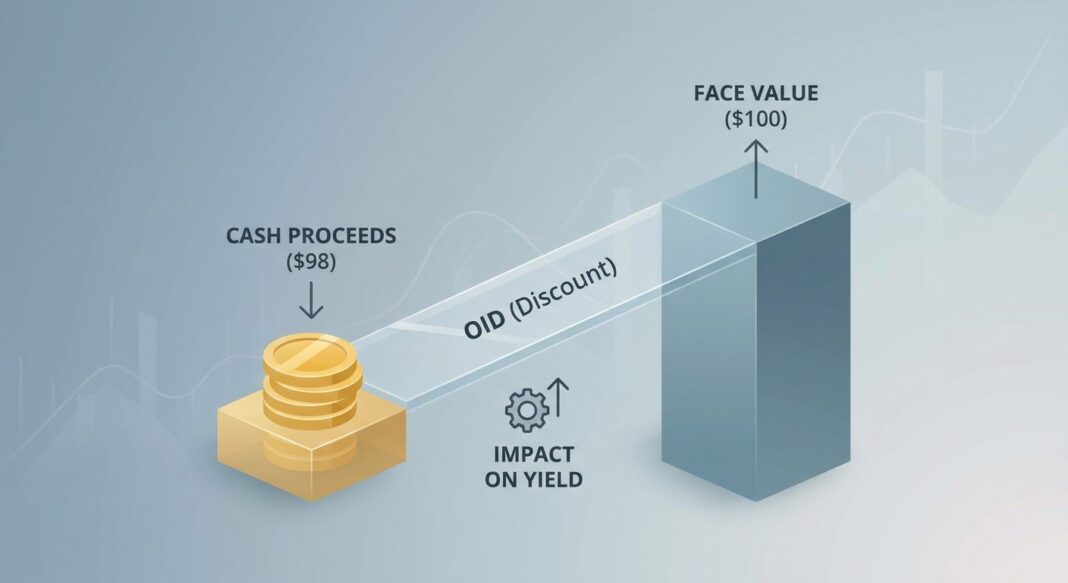
In private credit, a loan’s stated principal is not always the amount the borrower receives. A lender may commit to a $10 million loan but fund less than $10 million at closing, while the borrower remains obligated to repay the full principal. The difference is the original issue discount, or OID. It is usually quoted in points: an issue price of 98 means the lender advances $98 for each $100 of face amount.
OID is easy to miss when comparing term sheets. A borrower may focus on the coupon, such as a spread over SOFR, and treat two loans with similar coupons as similarly priced. But a discount increases the lender’s effective return and reduces the cash proceeds available to the company. The effect depends on the amount of the discount, the loan’s expected life, amortization, repayment timing, and fees.
For investors, OID is one part of the economics earned for providing debt capital. For operators, it is a financing cost and a reduction in day-one proceeds. Understanding it means comparing the cash received with every required payment, not just reading the headline interest rate.
The Concept: What OID Measures
OID is the gap between a loan’s face value and its issue price at origination. If a company borrows $10 million at 98, it receives $9.8 million before fees but owes $10 million of principal. The $200,000 discount is generally paid to the lender through repayment at face value, rather than as a separate cash charge on the closing date.
OID raises a lender’s yield because the lender pays less up front than the principal it expects to receive back, while also collecting contractual interest. Yield to maturity is the annualized return implied by the initial cash advanced and the scheduled interest and principal payments, assuming the loan is repaid as agreed. It is not the same as the coupon. A loan can have a 9% coupon and a higher yield because of OID, fees, or both.
OID is also not automatically a penalty or evidence of weak credit. It can reflect negotiated economics, transaction conditions, or a lender’s pricing for the risk and work involved. Conversely, a borrower should not assume that a low OID makes a loan inexpensive if its spread, fees, call protection, or other terms are costly. Compare the complete financing package and distinguish recurring interest from one-time economics.
How It Works: A $10 Million Example
Assume a company issues a five-year, $10 million loan at 98, with a 9% annual coupon, paid once a year. Ignore fees, scheduled principal amortization, floating-rate changes, and early repayment to isolate the discount. At closing, the lender advances $9.8 million. The company owes $10 million of principal and pays $900,000 of annual interest on the full face amount.
If repaid at the end of year five, the company pays $900,000 in interest in each of years one through five, plus $10 million of principal with the final interest payment. The lender’s cash flows are the reverse: an initial $9.8 million advance, five annual $900,000 interest receipts, and $10 million of principal at maturity. On those simplified annual cash flows, the lender’s annualized yield is about 11%, above the 9% coupon, because the lender receives $10 million of principal after advancing $9.8 million.
The borrower’s day-one proceeds are $200,000 below face value, before other closing costs. If the borrower also pays arrangement, legal, or other fees, its net proceeds fall further. Those charges must be separated in the comparison: OID is the discount from face value, while fees are additional transaction costs. Both can affect effective borrowing cost.
Now consider an early refinancing after two years. The lender has collected only two years of coupon, and whether it receives the full remaining economic value of the OID depends on the loan documents. A make-whole, call premium, or minimum return provision may protect some of that value; a loan without such protection may leave the lender with less realized yield. The operator may benefit from refinancing sooner, but must compare the savings on future interest with any repayment premium and the replacement loan’s fees and OID.
This is why headline coupon comparisons can mislead. A 9% loan at 98 may cost more than a 9% loan issued at par, while a lower-coupon loan with a larger OID may or may not be more expensive depending on its duration and repayment terms. Exact yield comparisons require dated cash flows and the actual contract terms.
Current Market Relevance
Recent market data provides context for negotiating loan economics, though it does not establish a single market-wide OID level. The Federal Reserve’s October 2026 SLOOS, covering Q3, found standards for commercial and industrial loans to large and middle-market firms basically unchanged, while banks tightened standards for small firms. The survey included responses from 61 domestic banks and 18 U.S. branches or agencies of foreign banks. Federal Reserve, October 2026 SLOOS.
Preqin reported on November 8, 2026, that private credit fundraising reached $185 billion through Q3, equal to 95% of the full-year 2025 total. Preqin also reported that 79% of surveyed investors planned to commit to only one private credit fund over the following 12 months, a sign of selectivity among allocators, not a measure of loan pricing. Preqin, Private Credit Q3 2026 Quarterly Update.
In its October 23, 2026 survey coverage, PitchBook described wider dispersion in pricing expectations: respondents were more likely than in the prior quarter to place a hypothetical $50 million EBITDA borrower above SOFR plus 550 basis points, and also more likely to place a comparable high-quality borrower below SOFR plus 500 basis points. PitchBook, Global Private Credit Survey, October 23, 2026.
Apollo’s Q3 2026 filing said new direct lending transactions were pricing around SOFR plus 475 to 500 basis points; average first-lien net leverage on Apollo’s 2026 originations was 4.1x, compared with 5.5x in 2025. These are Apollo-reported figures, not universal market benchmarks. Apollo, Q3 2026 results filing. Together, these data points show why OID should be evaluated within the specific deal: borrower quality, lender competition, leverage, and the whole set of terms shape pricing.
Decision Framework: Investors and Operators
For investors, translate OID and fees into an expected yield using the loan’s actual cash-flow schedule. Test more than the scheduled maturity: model refinancing or repayment at earlier dates, default and recovery scenarios, and any call protection. Confirm whether quoted yield includes arrangement fees, original issue discount, or other lender compensation, and check whether the lender pays par or buys the loan at a discount in a secondary transaction. A higher stated yield does not by itself compensate for weaker collateral, greater leverage, or poor documentation.
For operators, compare net cash proceeds, not just face amount. Ask lenders to show total cost under the expected holding period and a plausible early-refinancing date. Review what happens to OID economics if the loan is prepaid, repriced, or refinanced, including any call premium or minimum return. Then compare the proceeds and cost with alternatives such as a smaller facility, a different amortization profile, or equity capital. OID may be acceptable when the financing delivers enough usable cash and flexibility, but it can be expensive if the company needs a short bridge and expects to refinance quickly.
In both cases, use a consistent comparison: same borrowing amount, same timing assumptions, same treatment of fees, and the same repayment scenario. A term sheet’s coupon is one input, not the total cost of debt.
Key Takeaways
- OID is the discount between face principal and the amount funded at closing.
- A loan issued below par can produce a lender yield above its coupon.
- Borrowers compare net proceeds and all-in cash flows, not only the stated spread.
- Early refinancing changes realized yield; examine call protection and repayment terms.
- Market pricing is dispersed, so evaluate OID alongside borrower risk, leverage, and documentation.


