
A Tale of Two Policies
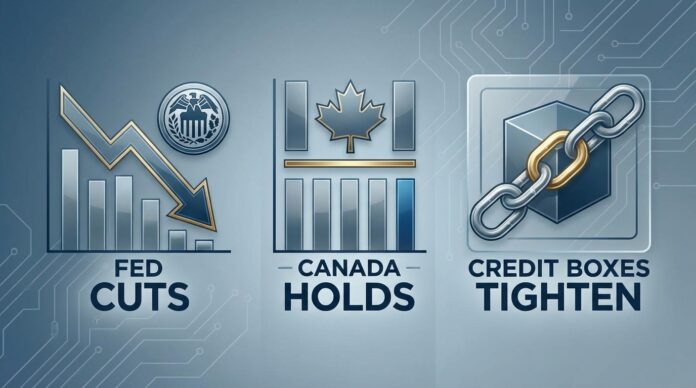
For the first time in this easing cycle, North America’s central bankers have notably diverged, sending a mixed signal to public markets. On December 10, the Federal Reserve lowered its benchmark interest rate by a quarter-point to a range of 3.50%–3.75%, marking its third consecutive cut. However, Federal Reserve Chair Jerome Powell signaled a hawkish pivot within the easing narrative, suggesting this may be the “last cut for a while” as the central bank adopts a “wait and see” approach regarding labor market data.
Conversely, the Bank of Canada (BoC) held its key interest rate steady at 2.25%. Governor Tiff Macklem cited unexpected economic resilience—with Q3 GDP and employment figures beating expectations—as the primary driver for the pause. While the BoC has already aggressively cut rates lower than its southern counterpart, the decision to hold indicates that cheap capital is not returning as quickly as Canadian borrowers might have hoped.
The “Credit Lag” Reality
While headline rates garner media attention, the real story for business owners lies in the behavior of commercial lenders. Despite the Fed’s reduction in the cost of borrowing, the availability of credit is contracting. The latest Senior Loan Officer Opinion Survey (SLOOS) reveals that banks have, on balance, tightened lending standards for commercial and industrial loans across firms of all sizes.
This disconnect—falling official rates but tightening bank standards—is a classic symptom of distinct economic friction. Banks are prioritizing liquidity and capital preservation over loan growth, driven by an uncertain regulatory outlook and the “downside risks” in the labor market cited by Powell. For the mid-market borrower, a lower prime rate is irrelevant if the loan application is declined due to a tightened credit box.
Implications for Borrowers
The message from December’s policy meetings is clear: the era of synchronized global easing has hit a speed bump. The Fed projects only one rate cut in 2026, and the BoC views current levels as “about right” for a transitioning economy.
What this means for your business:
- Volatility in FX: The widening spread between U.S. and Canadian rates may introduce volatility in the USD/CAD exchange rate, impacting importers and exporters.
- Sticky Standards: Do not expect commercial banks to loosen covenants immediately. The “lag effect” of monetary policy means traditional lenders will remain conservative well into Q1 2026.
- The Private Advantage: As traditional banks retreat to analyze the mixed macroeconomic signals, private capital remains the most reliable source of liquidity for growth, acquisitions, and transitional capital.
At Bond Capital, we look beyond the quarterly fluctuations of central bank policy. While the public markets attempt to price in the Fed’s next move, we remain focused on the fundamentals of the businesses we partner with, providing certainty in an environment where banks are increasingly hesitant.


